


TS EAMCET · Maths · Straight Lines
If \(\pi / 3\) is the angle between the straight lines \(p x+q y+r=0\) and \(x \sin \alpha+y \cos \alpha=r(r \neq 0)\) which meet at a point \(A\) and the straight line \(x \cos \alpha-y \sin \alpha=0\) also passes through the point \(A\), then
- A \(p^2+q^2=4\)
- B \(p^2+q^2=2\)
- C \(p^2+q^2=r^2\)
- D \(p^2+q^2=2 r^2\)
Answer & Solution
Correct Answer
(A) \(p^2+q^2=4\)
Step-by-step Solution
Detailed explanation
Lines \(\begin{array}{ll} & p x+q y+r=0 \\ & x \sin \alpha+y \cos \alpha=r \\ \text { and } \quad & x \cos \alpha-y \sin \alpha=0 \end{array}\) and \(x \cos \alpha-y \sin \alpha=0 \)are intersecting at \(A\) \(\therefore\) lines are concurrent…
See the Complete Solution
Get step-by-step explanations for this and 2.5 Lakh+ more JEE, NEET & CET questions.
- Unlock all solutions
- Practice the full chapter
- Track accuracy across PYQs
4.8 rated on Google Play · 14,000+ reviews
More questions from Maths
- In triangle \(\mathrm{ABC}\), if \(a=7, b=8, \mathrm{C}=\frac{3 \sqrt{5}}{2}\) and \(\mathrm{C}\) is an acute angle, then \(c=\)TS EAMCET 2022 Medium
- Let \(\mathbf{a}, \mathbf{b}\) and \(\mathbf{c}\) be three non-coplanar vectors and let \(\mathbf{p}, \mathbf{q}\) and \(\mathbf{r}\) be the vectors defined by \(\mathbf{p}=\frac{\mathbf{b} \times \mathbf{c}}{[\mathbf{a} \mathbf{b} \mathbf{c}]}, \mathbf{q}=\frac{\mathbf{c} \times \mathbf{a}}{[\mathbf{a} \mathbf{b} \mathbf{c}]}, \mathbf{r}=\frac{\mathbf{a} \times \mathbf{b}}{[\mathbf{a} \mathbf{b} \mathbf{c}]}\). Then, \((\mathbf{a}+\mathbf{b}) \cdot \mathbf{p}+(\mathbf{b}+\mathbf{c}) \cdot \mathbf{q}+(\mathbf{c}+\mathbf{a}) \cdot \mathbf{r}\) is equal toTS EAMCET 2012 Easy
- If \(\alpha, \beta\) are the roots of the equation \(x^2+x+1=0\), then \((\alpha+\beta)^2+\left(\alpha^2+\beta^2\right)^2+\left(\alpha^3+\beta^3\right)^2+\ldots+\left(\alpha^{12}+\beta^{12}\right)^2=\)TS EAMCET 2023 Medium
- \(f:[-\infty, 0] \rightarrow[0, \infty)\) is defined as \(f(x)=x^2\). The domain and range of its inverse isTS EAMCET 2017 Easy
- A family of curves whose equation is general solution of a differential equation having order 1 and degree 3 , is \((g, a, c\) are arbitrary constants)TS EAMCET 2018 Medium
- If \(\mathbf{a}=2 \hat{\mathbf{i}}+\hat{\mathbf{j}}-3 \hat{\mathbf{k}}, \mathbf{b}=\hat{\mathbf{i}}-2 \hat{\mathbf{j}}+3 \hat{\mathbf{k}}\), \(\mathbf{c}=-\hat{\mathbf{i}}+\hat{\mathbf{j}}-4 \hat{\mathbf{k}}\) and \(\mathbf{d}=\hat{\mathbf{i}}+\hat{\mathbf{j}}+2 \hat{\mathbf{k}}\), then \((\mathbf{a} \times \mathbf{b}) \times(\mathbf{c} \times \mathbf{d})=\)TS EAMCET 2018 Easy
More PYQs from TS EAMCET
- Match the following
List - 1 (Chemical) List-2 (Type) A Bithionol I Artificial sweetener B Saccharin II Antifertility drug C Sodium benzoate III Antiseptic D Norethindrone IV Food preservative
The correct answer isTS EAMCET 2025 Easy - Let \(C\) be a curve \(a x^2+2 h x y+b y^2+2 g x+2 f y+c=0\) in \(a\) cartesian plane. By rotating the coordinate axes through an angle \(\frac{\pi}{4}\) in the positive direction, if the transformed equation of \(C\) is \(Y^2+X Y-X=0\), then \(\left(h^2-a b\right)-2 g f=\)TS EAMCET 2020 Medium
- A very long wire carrying a current \(4 \sqrt{2} \mathrm{~A}\) is bent at a right angles. The magnitude of magnetic field ( \(|\mathbf{B}|)\) at a point \(P\) lying on a line perpendicular to the bent wire at a distance, \(d=20 \mathrm{~cm}\) from the point of the bending will be (Let \(\mu_0=4 \pi \times 10^{-7} \mathrm{H} / \mathrm{m}\) )
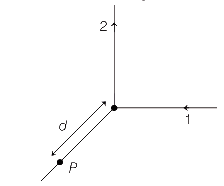 TS EAMCET 2019 Medium
 - Identify the increasing order of the angular velocities of the following 1. earth rotating about its own axis 2. hour's hand of a clock 3. second's hand of a clock 4. flywheel of radius \(2 \mathrm{~m}\) making \(300\mathrm{rpm}\)TS EAMCET 2005 Medium
- A normal chord PQ drawn at a point P on the parabola \(y^2=5 x\) subtends a right angle at the vertex. If P lies in the first quadrant, then the other end Q of the normal chord isTS EAMCET 2025 Medium
- In , right-angled at , the circumradius, inradius and radius of the excircle opposite to are respectively in the ratio , then the roots of the equation areTS EAMCET 2018 Hard