


TS EAMCET · Chemistry · General Organic Chemistry
Which one of the following is a secondary alcohol?
- A 2-methyl-2-propanol
- B 1-propanol
- C 1-butanol
- D 2-pentanol
Answer & Solution
Correct Answer
(D) 2-pentanol
Step-by-step Solution
Detailed explanation
See the Complete Solution
Get step-by-step explanations for this and 2.5 Lakh+ more JEE, NEET & CET questions.
- Unlock all solutions
- Practice the full chapter
- Track accuracy across PYQs
4.8 rated on Google Play · 14,000+ reviews
More questions from Chemistry
- The electric charge for electrode deposition of one equivalent of a substance is equal toTS EAMCET 2022 Hard
- Covalent bond length of a chlorine molecule is . Covalent radius (in ) of chlorine atom is _________TS EAMCET 2018 Easy
- Metamerism can be exhibited by the compounds containingTS EAMCET 2021 Easy
- At \(27^{\circ} \mathrm{C}\), a closed vessel contains a mixture of equal weights of helium (mol. wt. =4), methane (mol, wt. =16) and sulphur dioxide (mol. wt. = 64). The pressure exerted by the mixture is \(210 \mathrm{~mm}\). If the partial pressures of helium, methane and sulphur dioxide are \(p_1, p_1\) and \(p_3\) respectively, which one of the following is correct?TS EAMCET 2002 Easy
- Which one of the following is not an example of condensation polymer?TS EAMCET 2024 Easy
- Sulphuric acid reacts with sodium hydroxide as follows : \(\mathrm{H}_2 \mathrm{SO}_4+2 \mathrm{NaOH} \longrightarrow \mathrm{Na}_2 \mathrm{SO}_4+2 \mathrm{H}_2 \mathrm{O}\) What will be the amount of sodium sulphate formed, when \(1 \mathrm{~L}\) of \(0.2 \mathrm{M}\) sulphuric acid is allowed to react with \(1 \mathrm{~L}\) of \(0.2 \mathrm{M}\) sodium hydroxide solution?TS EAMCET 2020 Medium
More PYQs from TS EAMCET
- Match the following.
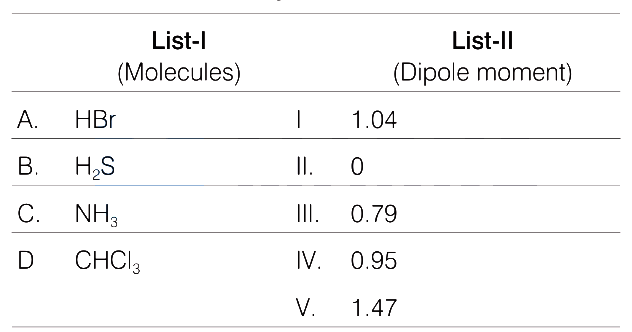
The correct match is A B C DTS EAMCET 2021 Hard - If the equilibrium constant for the reaction \(2 A B \rightleftharpoons A_2+B_2\) is 49 , what is the equilibrium constant for \(A B \rightleftharpoons \frac{1}{2} A_2+\frac{1}{2} B_2 ?\)TS EAMCET 2011 Easy
- The coagulation of \(200 \mathrm{ml}\) of a positive colloid took place when \(0.73 \mathrm{~g}\) of \(\mathrm{HCl}\) was added to it without changing the volume much. The flocculation value of \(\mathrm{HCl}\) for the colloid isTS EAMCET 2022 Medium
- Let \(A=(2,0)\) and \(B=(0,-2)\). Let \(P\) be any point such that the sum of the distances of \(P\) from \(A\) and \(B\) is 4 . Then the equation of the locus of the point \(P\) isTS EAMCET 2023 Easy
- The correct order of ionic radii of trivalent ions \(\mathrm{Y}^{3+}\), \(\mathrm{La}^{3+}, \mathrm{Eu}^{3+}\), and \(\mathrm{Lu}^{3+}\) is \[ (\mathrm{Y}=39, \mathrm{La}=57, \mathrm{Eu}=63, \mathrm{Lu}=71) \]TS EAMCET 2022 Easy
- Two bodies are projected from the same point with the same initial velocity ' \(u\) ' making angles ' \(\theta\) ' and \(\left(90^{\circ}-\theta\right)\) with the horizontal in opposite directions. The horizontal distance between their positions when the bodies are at their maximum heights isTS EAMCET 2025 Medium