


TS EAMCET · Chemistry · Electrochemistry
The electric charge for electrode deposition of one equivalent of a substance is equal to
- A
- B coulombs
- C
- D Charge on mole of electrons
Answer & Solution
Correct Answer
(D) Charge on mole of electrons
Step-by-step Solution
Detailed explanation
Electric charge for the deposition of 1 equivalent of a substance is 1 Faraday. Equivalents = Moles × valency factor 1 mol of electrons will deposit 1 equivalent. Number of electrons in 1 mol=NA=6.023×10²³ electrons. Now, Charge carried by 1…
See the Complete Solution
Get step-by-step explanations for this and 2.5 Lakh+ more JEE, NEET & CET questions.
- Unlock all solutions
- Practice the full chapter
- Track accuracy across PYQs
4.8 rated on Google Play · 14,000+ reviews
More questions from Chemistry
- Ammonia on reaction with chlorine forms an explosive \(\mathrm{NCl}_3\). What is the mole ratio of \(\mathrm{NH}_3\) and \(\mathrm{Cl}_2\) required for this reaction?TS EAMCET 2015 Easy
- Among the following, the calcination process isTS EAMCET 2024 Easy
- Silver electrode acts as anode and \(E_{\text {cell }}^{\circ}\) is \(-0.34 \mathrm{~V}\)TS EAMCET 2020 Easy
- 200 mL of an aqueous solution of \(\mathrm{HCl}(\mathrm{pH}=2)\) is mixed with 300 mL of aqueous solution of \(\mathrm{NaOH}(\mathrm{pH}=12)\) and is diluted to 1.0 L. The pH of the resulting solution isTS EAMCET 2025 Easy
- For a reaction the set of all correct statements are a) is independent of . b) is dependent on partial pressure of at a given temperature. c) will be independent of temperature. d) is independent of the catalyst addition.TS EAMCET 2022 Medium
- What is the time (in sec) required for depositing all the silver present in \(125 \mathrm{~mL}\) of \(1 \mathrm{M} \mathrm{AgNO}{ }_3\) solution by passing a current of \(241.25 \mathrm{~A}\) ? (1F \(=96500\) coulombs \()\)TS EAMCET 2006 Medium
More PYQs from TS EAMCET
- Identify the correct pairs in which the chemical substance given is correctly matched with its use \begin{array}{ll} Chemical substance & use \ (A) \mathrm{Cl}_2 & Preparation of phosgene \ (B) \mathrm{I}_2 \mathrm{O}_5 & estimation of \mathrm{CO} \ (C) \mathrm{O}_3 & disinfectant \end{array}TS EAMCET 2023 Easy
- The sequence of reagents which convert p-methyl aniline to p-methyl benzoic acid areTS EAMCET 2023 Medium
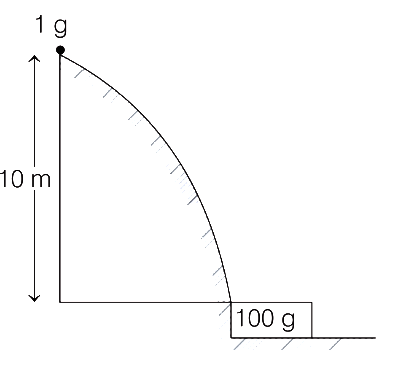
- A small disc of mass \(1 \mathrm{~g}\) slides down a smooth hill of height \(10 \mathrm{~m}\) from rest and gets on to a plank of mass \(100 \mathrm{~g}\) as shown in the figure. Due to friction between the disc and the plank. The disc slows down and moves as one piece with the plank. The work done by the frictional force is approximately (Use, \(g=10 \mathrm{~ms}^2\) )
 TS EAMCET 2021 Hard
 - The equilibrium constant for the reaction isTS EAMCET 2021 Hard
- For the formation of \(\mathrm{NH}_3\) from \(\mathrm{N}_2\) and \(\mathrm{H}_2\) at \(500 \mathrm{~K}\), the concentration of \(\mathrm{N}_2, \mathrm{H}_2\) and \(\mathrm{NH}_3\) at equilibrium are \(1.5 \times 10^{-2} \mathrm{M}, 3.0 \times 10^{-2} \mathrm{M}\) and \(1.2 \times 10^{-2} \mathrm{M}\), respectively. The equilibrium constant for the reverse reaction isTS EAMCET 2018 Medium
- The obtuse angle between the lines whose direction ratios are determined by the equations \(a+b+c=0,2 a b+2 a c-b c=0\) isTS EAMCET 2020 Medium