


TS EAMCET · Chemistry · States of Matter
Two containers \(\mathrm{A}\) and \(\mathrm{B}\) contain \(\mathrm{CO}_2\) gas. Pressure, volume and absolute temperature of the gas in \(\mathrm{A}\) are 4 times more compared to that in \(\mathrm{B}\). The mass of the gas in \(\mathrm{B}\) is \(x \mathrm{~g}\), then the mass of the gas in A will be
- A \(\frac{x}{2} g\)
- B \(4 x g\)
- C \(2 x g\)
- D \(16 x \mathrm{~g}\)
Answer & Solution
Correct Answer
(B) \(4 x g\)
Step-by-step Solution
Detailed explanation
Using PV \(=n R T\) \(\begin{aligned} & \frac{\mathrm{PV}}{\mathrm{RT}}=\mathrm{n}=\frac{\mathrm{m}}{\mathrm{M}} \\ & \therefore \quad \mathrm{M}=\mathrm{m} \frac{\mathrm{RT}}{\mathrm{PV}}\end{aligned}\) Both the containers contain same gas \(\left(\mathrm{CO}_2\right)\). So,…
See the Complete Solution
Get step-by-step explanations for this and 2.5 Lakh+ more JEE, NEET & CET questions.
- Unlock all solutions
- Practice the full chapter
- Track accuracy across PYQs
4.8 rated on Google Play · 14,000+ reviews
More questions from Chemistry
- At \(550 \mathrm{~K}\), the \(K_c\) for the following reaction is \(10^4 \mathrm{~mol}^{-1} \mathrm{~L} X(g)+Y(g) \rightleftharpoons Z(g)\) At equilibrium, it was observed that \([X]=\frac{1}{2}[Y]=\frac{1}{2}[Z]\) What is the value of [Z] (in \(\mathrm{mol} \mathrm{L}^{-1}\) ) at equilibrium?TS EAMCET 2005 Easy
- An alkene \(A\left(\mathrm{C}_4 \mathrm{H}_8\right)\) exhibits cis/trans isomerism. \(A\) on ozonolysis gives \(B\), which when reacted with \(\mathrm{NaOH}\) followed by hydroxylamine gave \(C\). What are \(B\) and \(C\) ?TS EAMCET 2020 Hard
- \(\mathrm{CH}_3 \mathrm{CH}_2 \mathrm{OH} \underset{\text { step-1 }}{\stackrel{\mathrm{Cl}_2}{\longrightarrow}} \mathrm{CH}_3 \mathrm{CHO}\) \(\underset{\text { step-2 }}{\stackrel{3 \mathrm{Cl}_2}{\longrightarrow}} \mathrm{Cl}_3 \mathrm{CCHO}\) In above reactions the role of \(\mathrm{Cl}_2\) in step- 1 and step-2 respectively is :TS EAMCET 2006 Hard
- A molecule \((X)\) has (i) four sigma bonds formed by the overlap of \(s p^2\) and \(s\) orbitals (ii) one sigma bond formed by \(s p^2\) and \(s p^2\) orbitals and (iii) one \(\pi\) bond formed by \(p_x\) and \(p_z\) orbitals. Which of the following is \(X\) ?TS EAMCET 2006 Easy
- Which of the following are not aromatic?
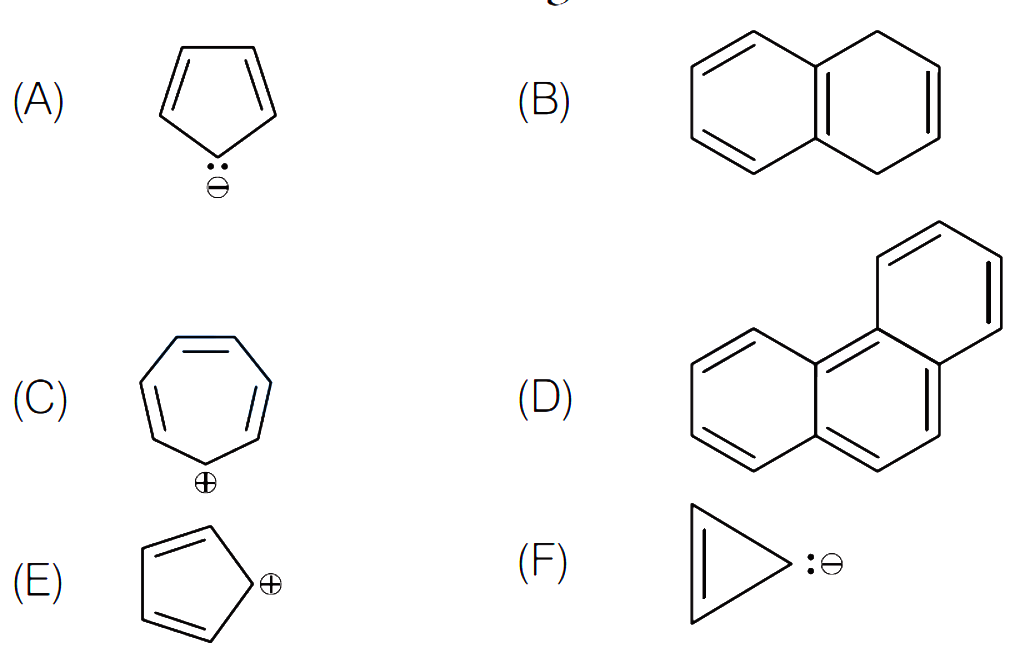 TS EAMCET 2019 Medium
 - The electronic configuration of \({ }_{59} \mathrm{Pr}\) (praseodimium) isTS EAMCET 2017 Easy
More PYQs from TS EAMCET
- In planetary motion the areal velocity of position vector of a planet depends on angular velocity \(\omega\) and the distance of the planet from sun \(r\). The correct relation for areal velocity isTS EAMCET 2003 Easy
- Identify the pair in which difference in bond order value is maximumTS EAMCET 2024 Medium
- The electronegativity order of the following elements isTS EAMCET 2021 Easy
- The fundamental frequency of transverse wave of a stretched string subjected to a tension \(\mathrm{T}_1\) is 300 Hz. If the length of the string is doubled and subjected to a tension of \(\mathrm{T}_2\), the fundamental frequency of the transverse wave in the string becomes 100 Hz, then \(\mathrm{T}_2: \mathrm{T}_1=\)
(Linear density of the string is constant)TS EAMCET 2025 Medium - Which one of the following is not an iso-electronic pair?TS EAMCET 2002 Easy
- The average energy of a neutron produced in the fission of \({ }_{92}^{235} \mathrm{U}\) isTS EAMCET 2025 Easy