


KCET · Physics · Electromagnetic Induction
Two spheres of electric charges \( +2 \mathrm{nC} \) and \( -8 \mathrm{nC} \) are placed at a distance ' \( \mathrm{d} \) ' apart. If they are allowed to touch each other, what is the new distance between them to get a repulsive force of same magnitude as before?
- A \( \frac{4 d}{3} \)
- B \( \frac{3 d}{4} \)
- C d
- D \( \frac{d}{2} \)
Answer & Solution
Correct Answer
(B) \( \frac{3 d}{4} \)
Step-by-step Solution
Detailed explanation
Given, two charges \( +2 \mathrm{nC} \) and \( -8 \mathrm{nC} \) are placed distance \( \mathrm{d} \) apart. Therefore,
\(|F|=\frac{1}{4 \Pi \varepsilon_{0}} \frac{\left(2 \times 10^{-9}\right)\left(8 \times 10^{-9}\right)}{d^{2}}=\frac{k\left(16 \times 10^{-18}\right)}{d^{2}}\)
When the charges are joined together, then
\(\left|F^{\prime}\right|=\frac{1}{4 \Pi \varepsilon_{0}} \frac{9 \times 10^{-18}}{d^{12}}=\frac{k\left(9 \times 10^{-18}\right)}{d^{12}}\)
Now,
\(|F|=\left|F^{\prime}\right| \Rightarrow \frac{k\left(16 \times 10^{-18}\right)}{d^{2}}=\frac{k\left(9 \times 10^{-18}\right)}{d^{12}} \)
\( \Rightarrow \frac{16}{d^{2}}=\frac{9}{d^{12}} \)
\(\Rightarrow d^{12}=\frac{9}{16} d^{2} \)
\(\Rightarrow d^{1}=\frac{3}{4} d\)
Therefore, in order to have same repulsive force as before the new distance between them should be \( \frac{3}{4} d \)
\(|F|=\frac{1}{4 \Pi \varepsilon_{0}} \frac{\left(2 \times 10^{-9}\right)\left(8 \times 10^{-9}\right)}{d^{2}}=\frac{k\left(16 \times 10^{-18}\right)}{d^{2}}\)
When the charges are joined together, then
\(\left|F^{\prime}\right|=\frac{1}{4 \Pi \varepsilon_{0}} \frac{9 \times 10^{-18}}{d^{12}}=\frac{k\left(9 \times 10^{-18}\right)}{d^{12}}\)
Now,
\(|F|=\left|F^{\prime}\right| \Rightarrow \frac{k\left(16 \times 10^{-18}\right)}{d^{2}}=\frac{k\left(9 \times 10^{-18}\right)}{d^{12}} \)
\( \Rightarrow \frac{16}{d^{2}}=\frac{9}{d^{12}} \)
\(\Rightarrow d^{12}=\frac{9}{16} d^{2} \)
\(\Rightarrow d^{1}=\frac{3}{4} d\)
Therefore, in order to have same repulsive force as before the new distance between them should be \( \frac{3}{4} d \)
See the Complete Solution
Get step-by-step explanations for this and 2.5 Lakh+ more JEE, NEET & CET questions.
- Unlock all solutions
- Practice the full chapter
- Track accuracy across PYQs
4.8 rated on Google Play · 14,000+ reviews
More questions from Physics
- A proton moves with a velocity of \(5 \times 10^6 \hat{\mathbf{j} \mathrm{ms}^{-1}}\) through the uniform electric field, \(\mathbf{E}=4 \times 10^6[2 \hat{\mathbf{i}}+0.2 \hat{\mathbf{j}}+0.1 \hat{\mathbf{k}}] \mathrm{Vm}^{-1}\) and the uniform magnetic field \(\mathbf{B}=0.2 \hat{\mathbf{i}}+0.2 \hat{\mathbf{j}}+\hat{\mathbf{k}}] \mathrm{T}\). The approximate net force acting on the proton isKCET 2022 Medium
- If \(r_p, v_p, L_p\) and \(r_a, v_a, L_a\) are radii, velocities and angular momenta of a planet at perihelion and aphelion of its elliptical orbit around the Sun respectively, thenKCET 2025 Medium
- A body of mass \(m\) moving along a straight line covers half the distance with a speed of \(2 \mathrm{~ms}^{-1}\). The remaining half of the distance is covered in two equal time intervals with a speed of \(3 \mathrm{~ms}^{-1}\) and \(5 \mathrm{~ms}^{-1}\) respectively. The average speed of the particle for the entire journey isKCET 2009 Medium
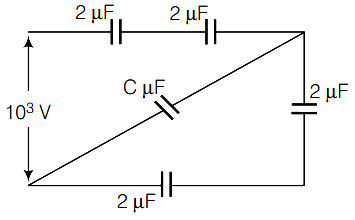
- When a potential difference of \(10^{3} \mathrm{~V}\) is applied between \(A\) and \(B\), a charge of \(0.75 \mathrm{mC}\) is value of \(\mathrm{C}\) is (in \(\mu \mathrm{F}\) )
 KCET 2013 Medium
 - Electromagnetic radiation used to sterilise milk isKCET 2016 Easy
- A fish in water (refractive index \(n\) ) looks at a bird vertically above in the air. If \(y\) is the height of the bird and \(x\) is the depth of the fish from the surface, then the distance of the bird as estimated by the fish isKCET 2008 Hard
More PYQs from KCET
- The number of naturally occurring \(p\)-block elements that are diamagnetic isKCET 2011 Easy
- The types of hybrid orbitals of nitrogen in \(\text{NO}_2^+, \text{NO}_3^-\) and \(\text{NH}_4^+\) respectively areKCET 2026 Easy
- Two wires A and B are stretched by the same load. If the area of cross section of wire 'A' is double that of 'B', then the stress on 'B' isKCET 2018 Easy
- A plano-convex lens is made of refractive index of 1.6. The radius of curvature of the curved surface is \(60 \mathrm{~cm}\). The focal length of the lens isKCET 2010 Easy
- \( \int_{-\pi / 4}^{\pi / 4} \frac{d x}{1+\cos 2 x} \) is equal toKCET 2015 Hard
- Which of the following is not a correct statement?KCET 2014 Easy