


KCET · Physics · Gravitation
If \(r_p, v_p, L_p\) and \(r_a, v_a, L_a\) are radii, velocities and angular momenta of a planet at perihelion and aphelion of its elliptical orbit around the Sun respectively, then
- A \(r_p\gt r_a, v_p\gt v_a, L_a\gt L_p\)
- B \(\mathrm{r}_{\mathrm{p}} \lt \mathrm{r}_{\mathrm{a}}, \mathrm{v}_{\mathrm{p}}\gt\mathrm{v}_{\mathrm{a}}, \mathrm{L}_{\mathrm{a}}=\mathrm{L}_{\mathrm{p}}\)
- C \(\mathrm{r}_{\mathrm{p}}\gt\mathrm{r}_{\mathrm{a}}, \mathrm{v}_{\mathrm{p}} \lt \mathrm{v}_{\mathrm{a}}, \mathrm{L}_{\mathrm{a}}=\mathrm{L}_{\mathrm{p}}\)
- D \(\mathrm{r}_{\mathrm{p}} \lt \mathrm{r}_{\mathrm{a}}, \mathrm{v}_{\mathrm{p}} \lt \mathrm{v}_{\mathrm{a}}, \mathrm{L}_{\mathrm{a}} \lt \mathrm{L}_{\mathrm{p}}\)
Answer & Solution
Correct Answer
(B) \(\mathrm{r}_{\mathrm{p}} \lt \mathrm{r}_{\mathrm{a}}, \mathrm{v}_{\mathrm{p}}\gt\mathrm{v}_{\mathrm{a}}, \mathrm{L}_{\mathrm{a}}=\mathrm{L}_{\mathrm{p}}\)
Step-by-step Solution
Detailed explanation
Angular momentum is conserved
\(\therefore L_p=L_a\)
Perihelion is point closet to the sun.
\(\therefore \mathrm{r}_{\mathrm{p}} \lt \mathrm{r}_{\mathrm{a}}\)
Also, \(\mathrm{mv}_{\mathrm{p}} \mathrm{r}_{\mathrm{p}}=\mathrm{mv}_{\mathrm{a}} \mathrm{r}_{\mathrm{a}}\)
\(\therefore \mathrm{v}_{\mathrm{p}}\gt\mathrm{v}_{\mathrm{a}}\)
\(\therefore L_p=L_a\)
Perihelion is point closet to the sun.
\(\therefore \mathrm{r}_{\mathrm{p}} \lt \mathrm{r}_{\mathrm{a}}\)
Also, \(\mathrm{mv}_{\mathrm{p}} \mathrm{r}_{\mathrm{p}}=\mathrm{mv}_{\mathrm{a}} \mathrm{r}_{\mathrm{a}}\)
\(\therefore \mathrm{v}_{\mathrm{p}}\gt\mathrm{v}_{\mathrm{a}}\)
See the Complete Solution
Get step-by-step explanations for this and 2.5 Lakh+ more JEE, NEET & CET questions.
- Unlock all solutions
- Practice the full chapter
- Track accuracy across PYQs
4.8 rated on Google Play · 14,000+ reviews
More questions from Physics
- A beam of fast moving alpha particles were directed towards a thin film of gold. The parts \(A, B\) and \(C\) of the transmitted and reflected beams corresponding to the incident parts \(A, B\) and \(C\) of the beam are shown in the adjoining diagram. The number of alpha particles in
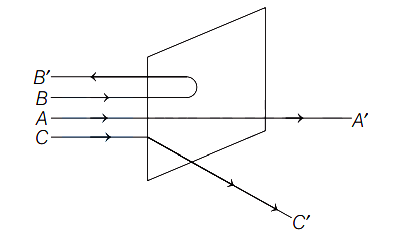 KCET 2020 Medium
 - If there are only one type of charge in the universe, then (\( \vec{E} \) Electric field, \( \vec{d} s \rightarrow \) Area vector\()\)KCET 2016 Medium
- Two identical charges repel each other with a force equal to \(10 \mathrm{mg}\) wt when they are \(0.6 \mathrm{~m}\) a part in air \(\left(g=10 \mathrm{~ms}^{-2}\right)\). The value of each charge isKCET 2007 Easy
- A particle shows distance - time curve as shown in the figure. the maximum instantaneous velocity of the particle is around the point
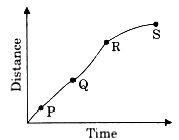 KCET 2018 Easy
 - If a charge on the body is \( 1 \mathrm{nC} \), then how many electrons are present on the body?KCET 2014 Hard
- The energy equivalent to a substance of mass \( 1 \mathrm{~g} \) isKCET 2018 Medium
More PYQs from KCET
- Which of the following statements is not true?KCET 2025 Easy
- The head lights of a jeep are \(1.2 \mathrm{~m}\) apart. If the pupil of the eye of an observer has a diameter of \(2 \mathrm{~mm}\) and light of wavelength \(5896 Å\) is used, what should be the maximum distance of the jeep from the observer if the two head lights are just separated?KCET 2007 Hard
- If \((\mathbf{a} \times \mathbf{b})^{2}+(\mathbf{a} \cdot \mathbf{b})^{2}=144\) and \(|\mathbf{a}|=4\), then \(|\mathbf{b}|\) is equal toKCET 2012 Easy
- During a field trip a student observed a marine organism with worm-like body. The cylindrical body was division into proboscis, collar and a long trunk. The organism may be __________KCET 2025 Easy
- The value of \(\int_{-\pi / 2}^{\pi / 2} \frac{\cos x}{1+e^{x}} d x\) isKCET 2020 Easy
- An electron enters the space between the plates of a charged capacitor as shown. The charge density on the plate is \(\sigma\). Electric intensity in the space between the plates is E. A uniform magnetic field \(B\) also exists in the space perpendicular to the direction of \(E\)
The electron moves perpendicular to both \(\overrightarrow{\mathrm{E}}\) and \(\overrightarrow{\mathbf{B}}\) without any change in direction. The time taken by the electron to travel a distance \(l\) in the space is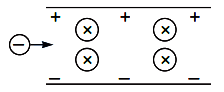 KCET 2010 Hard