


KCET · Physics · Motion In One Dimension
A body of mass \(m\) moving along a straight line covers half the distance with a speed of \(2 \mathrm{~ms}^{-1}\). The remaining half of the distance is covered in two equal time intervals with a speed of \(3 \mathrm{~ms}^{-1}\) and \(5 \mathrm{~ms}^{-1}\) respectively. The average speed of the particle for the entire journey is
- A \(\frac{3}{8} \mathrm{~ms}^{-1}\)
- B \(\frac{8}{3} \mathrm{~ms}^{-1}\)
- C \(\frac{4}{3} \mathrm{~ms}^{-1}\)
- D \(\frac{16}{3} \mathrm{~ms}^{-1}\)
Answer & Solution
Correct Answer
(B) \(\frac{8}{3} \mathrm{~ms}^{-1}\)
Step-by-step Solution
Detailed explanation
Let the total distance travelled by the body is \(2 S\). If \(\mathrm{t}_{1}\) is the time taken by the body to travel first half of the distance, then
\(\mathrm{t}_{1}=\frac{\mathrm{S}}{2}\)
Let \(\mathrm{t}_{2}\) be the time taken by the body for each time interval for the remaining half journey.
\(\therefore \quad \mathrm{S}=3 \mathrm{t}_{2}+5 \mathrm{t}_{2}=8 \mathrm{t}_{2}\)
So, average speed \(=\frac{\text { Total distance travelled }}{\text { Total time taken }}\)
\(=\frac{2 S}{t_{1}+2 t_{2}}\)
\(=\frac{2 S}{\frac{S}{2}+\frac{S}{4}}\)
\(=\frac{8}{3} \mathrm{~ms}^{-1}\)
\(\mathrm{t}_{1}=\frac{\mathrm{S}}{2}\)
Let \(\mathrm{t}_{2}\) be the time taken by the body for each time interval for the remaining half journey.
\(\therefore \quad \mathrm{S}=3 \mathrm{t}_{2}+5 \mathrm{t}_{2}=8 \mathrm{t}_{2}\)
So, average speed \(=\frac{\text { Total distance travelled }}{\text { Total time taken }}\)
\(=\frac{2 S}{t_{1}+2 t_{2}}\)
\(=\frac{2 S}{\frac{S}{2}+\frac{S}{4}}\)
\(=\frac{8}{3} \mathrm{~ms}^{-1}\)
See the Complete Solution
Get step-by-step explanations for this and 2.5 Lakh+ more JEE, NEET & CET questions.
- Unlock all solutions
- Practice the full chapter
- Track accuracy across PYQs
4.8 rated on Google Play · 14,000+ reviews
More questions from Physics
- Two bodies with kinetic energies in the ratio of \(3:1\) are moving with equal linear momentum. The ratio of their masses isKCET 2026 Easy
- The magnetic susceptibility of a paramagnetic material at \( -73^{\circ} \mathrm{C} \) is \( 0.0075 \) and its value at
\( -173^{\circ} \mathrm{C} \) will beKCET 2015 Easy - The head lights of a jeep are \(1.2 \mathrm{~m}\) apart. If the pupil of the eye of an observer has a diameter of \(2 \mathrm{~mm}\) and light of wavelength \(5896 Å\) is used, what should be the maximum distance of the jeep from the observer if the two head lights are just separated?KCET 2007 Hard
- A source of frequency \(\nu\) gives \(6\) beats/second when sounded with a source of frequency \(200\) Hz. The second Harmonic of frequency \(2\nu\) of the source gives \(8\) beats/second when sounded with a source of frequency \(420\) Hz. The value of \(\nu\) isKCET 2026 Medium
- Two thin biconvex lenses have focal lengths \(f_{1}\) and \(f_{2}\). A third thin biconcave lens has focal length of \(f_{3}\). If the two biconvex lenses are in contact, then the total power of the lenses is \(P_{1}\). If the first convex lens is in contact with the third lens, then the total power is \(P_{2}\). If the second lens is in contact with the third lens, the total power is \(P_{3}\), thenKCET 2021 Hard
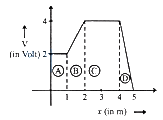
- The figure gives the electric potential \( V \) as a function of distance through four regions on \( x- \) axis. Which of the following is true for the magnitude of the electric field \( E \) in these regions?
 KCET 2019 Easy
More PYQs from KCET
- If \(\sin x-\sin y=\frac{1}{2}\) and \(\cos x-\cos y=1\), then \(\tan (x+y)\) is equal toKCET 2013 Hard
- If we consider an electron and a photon of same de-Broglie wavelength, then they will have sameKCET 2025 Easy
- The angle between the tangents drawn to the parabola \(y^{2}=12 x\) from the point \((-3,2)\) isKCET 2009 Hard
- The ratio of the velocity of sound in hydrogen \(\left(\gamma=\frac{7}{5}\right)\) to that in helium \(\left(\gamma=\frac{5}{3}\right)\) at the same temperature isKCET 2007 Easy
- The differential equation \(y \frac{d y}{d x}+x=\) crepresentsKCET 2008 Medium
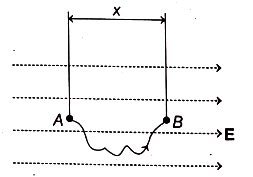
- A uniform electric field vector \(\mathbf{E}\) exists along horizontal direction as shown. The electric potential at \(A\) is \(V_A\). A small point charge \(q\) is slowly taken from \(A\) to \(B\) along the curved path as shown. The potential energy of the charge when it is at point \(B\) is
 KCET 2023 Medium