


KCET · Physics · Capacitance
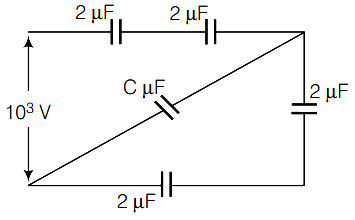
When a potential difference of \(10^{3} \mathrm{~V}\) is applied between \(A\) and \(B\), a charge of \(0.75 \mathrm{mC}\) is value of \(\mathrm{C}\) is (in \(\mu \mathrm{F}\) )
- A \(\frac{1}{2}\)
- B 2
- C \(2.5\)
- D 3
Answer & Solution
Correct Answer
(B) 2
Step-by-step Solution
Detailed explanation
In the given circuit,
\(2 \mu \mathrm{F}\) and \(2 \mu \mathrm{F}\) capacitors are in series \(\therefore\)
\(C_{S}=\frac{2 \times 2}{2+2}=1 \mu \mathrm{F}\)
So, equivalent circuit will be
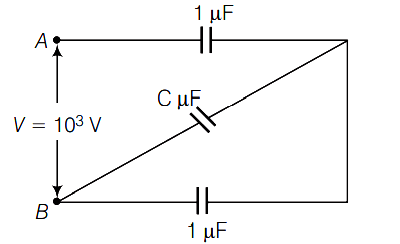
Now \(C \mu \mathrm{F}\) and \(1 \mu \mathrm{F}\) are in parallel which is in series with \(1 \mu \mathrm{F}\)
\(\therefore C_{\text {eff }}=\frac{(C+1) \times 1}{(C+1)+1}=\frac{C+1}{C+2}\)
Given, \(q=0.75 \times 10^{-3} \mathrm{C}=750 \times 10^{-6} \mathrm{C}, V=10^{3} \mathrm{~V}\)
So, \(\quad C_{\text {eff }}=\frac{q}{V}\)
\(\Rightarrow \frac{C+1}{C+2}=\frac{750 \times 10^{-6}}{10^{3}}\)
\(=750 \times 10^{-3} \mathrm{~F}=0.75 \mu \mathrm{F}\)
\(\Rightarrow 0.75=\frac{C+1}{C+2}\)
\(\Rightarrow \frac{3}{4}=\frac{C+1}{C+2}\)
\(\Rightarrow 3 C+6=4 C+4 \Rightarrow C=2 \mu \mathrm{F}\)
\(2 \mu \mathrm{F}\) and \(2 \mu \mathrm{F}\) capacitors are in series \(\therefore\)
\(C_{S}=\frac{2 \times 2}{2+2}=1 \mu \mathrm{F}\)
So, equivalent circuit will be
Now \(C \mu \mathrm{F}\) and \(1 \mu \mathrm{F}\) are in parallel which is in series with \(1 \mu \mathrm{F}\)
\(\therefore C_{\text {eff }}=\frac{(C+1) \times 1}{(C+1)+1}=\frac{C+1}{C+2}\)
Given, \(q=0.75 \times 10^{-3} \mathrm{C}=750 \times 10^{-6} \mathrm{C}, V=10^{3} \mathrm{~V}\)
So, \(\quad C_{\text {eff }}=\frac{q}{V}\)
\(\Rightarrow \frac{C+1}{C+2}=\frac{750 \times 10^{-6}}{10^{3}}\)
\(=750 \times 10^{-3} \mathrm{~F}=0.75 \mu \mathrm{F}\)
\(\Rightarrow 0.75=\frac{C+1}{C+2}\)
\(\Rightarrow \frac{3}{4}=\frac{C+1}{C+2}\)
\(\Rightarrow 3 C+6=4 C+4 \Rightarrow C=2 \mu \mathrm{F}\)
See the Complete Solution
Get step-by-step explanations for this and 2.5 Lakh+ more JEE, NEET & CET questions.
- Unlock all solutions
- Practice the full chapter
- Track accuracy across PYQs
4.8 rated on Google Play · 14,000+ reviews
More questions from Physics
- A cube of side 1 cm contains 100 molecules each having an induced dipole moment of \(0.2 \times 10^{-6} \mathrm{C}-\mathrm{m}\) in an external electric field of \(4 \mathrm{NC}^{-1}\). The electric susceptibility of the materials is ....\(\mathrm{C}^2 \mathrm{~N}^{-1} \mathrm{~m}^{-2}\).KCET 2024 Hard
- In domestic electric mains supply, the voltage and the current areKCET 2025 Easy
- A circular coil carrying a certain current produces a magnetic field \(B_{0}\) at its centre. The coil is now rewound so as to have 3 turns and the same current is passed through it. The new magnetic field at the centre isKCET 2007 Medium
- A person throws balls into air vertically upward in regular intervals of time of one second. The next ball is thrown when the velocity of the ball thrown earlier becomes zero. The height to which the balls rise is
(Assume, \(\mathrm{g}=10 \mathrm{~ms}^{-2}\) )KCET 2012 Hard - Two identical circular current loops carrying equal currents are placed with their axes inclined at \(45^\circ\) to each other as shown in the figure. The resultant magnetic field at P is
 KCET 2026 Hard
 - A wafer of pure germanium crystal has two parts X and Y. The end X is obtained by doping with arsenic and Y with indium. It is connected to a battery as shown in the figure. Which of the following statements is correct?
 KCET 2026 Medium
More PYQs from KCET
- The centre of a circle which cuts \(x^{2}+y^{2}+6 x-1=0, \quad x^{2}+y^{2}-3 y+2=0\) and \(x^{2}+y^{2}+x+y-3=0\) orthogonally isKCET 2011 Hard
- A member of the Lanthanoid series which is well known to exhibit +4 oxidation state isKCET 2025 Easy
- If ' \(n\) ' is a positive integer, then \(\mathrm{n}^{3}+2 \mathrm{n}\) is divisible byKCET 2009 Easy
- When the pure solvent diffuses out of the solution through the semi-permeable membrane then
the process is calledKCET 2017 Medium - Which aspect forms the basis of DNA finger - printing?KCET 2022 Easy
- \( A(g) \stackrel{\Delta}{\rightarrow} P(g)+Q(g)+R(g) \), follows first order kinetics with a half life of \( 69.3 \mathrm{~s} \) at \( 500^{\circ} \mathrm{C} \).
Starting from the gas 'A' enclosed in a container at \( 500^{\circ} \mathrm{C} \) and at a pressure of \( 0.4 \mathrm{~atm} \), the
total pressure of the system after \( 230 \mathrm{~s} \) will beKCET 2014 Easy