


KCET · Physics · Laws of Motion
Three concurrent co-planar forces \(1 \mathrm{~N}, 2 \mathrm{~N}\) and \(3 \mathrm{~N}\) acting along different directions on a body
- A can keep the body in equilibrium if \(2 \mathrm{~N}\) and \(3 \mathrm{~N}\) act at right angle
- B can keep the body in equilibrium if \(1 \mathrm{~N}\) and \(2 \mathrm{~N}\) act at right angle
- C cannot keep the body in equilibrium
- D can keep the body in equilibrium in \(1 \mathrm{~N}\) and \(3 \mathrm{~N}\) act at an acute angle
Answer & Solution
Correct Answer
(C) cannot keep the body in equilibrium
Step-by-step Solution
Detailed explanation
If we keep \(1 \mathrm{~N}\) and \(2 \mathrm{~N}\) forces act in same direction then these are balanced by \(3 \mathrm{~N}\) force, but this is against statement of question. Hence, options (c) is correct.
See the Complete Solution
Get step-by-step explanations for this and 2.5 Lakh+ more JEE, NEET & CET questions.
- Unlock all solutions
- Practice the full chapter
- Track accuracy across PYQs
4.8 rated on Google Play · 14,000+ reviews
More questions from Physics
- A body of mass \(m\) moving along a straight line covers half the distance with a speed of \(2 \mathrm{~ms}^{-1}\). The remaining half of the distance is covered in two equal time intervals with a speed of \(3 \mathrm{~ms}^{-1}\) and \(5 \mathrm{~ms}^{-1}\) respectively. The average speed of the particle for the entire journey isKCET 2009 Medium
- From the following graph of photo current against collector plate potential, for two different intensities of light \( I_{1} \) and \( I_{2} \), one can conclude
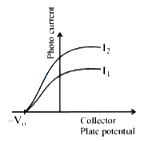 KCET 2017 Hard
 - In an oscillating \(L C\)-circuit, \(L=3 \mathrm{mH}\) and \(C=2.7 \mu \mathrm{F}\). At \(t=0\), the charge on the capacitor is zero and the current is \(2 \mathrm{~A}\). The maximum charge that will appear on the capacitor will beKCET 2021 Medium
- If \( \vec{A}=2 \hat{i}+3 \hat{j}+8 \hat{k} \) is perpendicular to \( \vec{B}=4 \hat{j}-4 \hat{i}+\alpha \hat{k} \), then the value of ' \( \alpha \) ' isKCET 2017 Easy
- A body is projected vertically upwards. The times corresponding to height while ascending and while descending are \(\mathrm{t}_{1}\) and \(\mathrm{t}_{2}\) respectively. Then the velocity of projection is ( is acceleration due to gravity)KCET 2008 Hard
- A planoconvex lens has a maximum thickness of \(6 \mathrm{~cm}\). When placed on a horizontal table with the curved surface in contact with the table surface, the apparent depth of the bottommost point of the lens is found to be \(4 \mathrm{~cm}\). If the lens is inverted such that the plane face of the lens is in contact with the surface of the table, the apparent depth of the centre of the plane face is found to be \(\left(\frac{17}{4}\right) \mathrm{cm}\). The radius of curvature of the lens isKCET 2011 Hard
More PYQs from KCET
- The two curves \( x^{3}-3 x y^{2}+2=0 \) and \( 3 x^{2} y-y^{3}=2 \)KCET 2015 Medium
- Which of the following possess net dipole moment?KCET 2019 Easy
- \( 3+5+7+\ldots \ldots \) to \( n \) terms isKCET 2017 Easy
- The rate of reaction increases with rise in temperature because ofKCET 2013 Easy
- Compare the statement A and B.
Statement A: A monocistronic mRNA can produce several type of polypeptide chains.
Statement B: The terminator codon is present on the mRNA.
Select the correct description.KCET 2009 Easy - The value of the integral
\(\int_{0}^{\pi / 2}\left(\sin ^{100} x-\cos ^{100} x\right) d x\) isKCET 2007 Easy