


KCET · Physics · Alternating Current
In an oscillating \(L C\)-circuit, \(L=3 \mathrm{mH}\) and \(C=2.7 \mu \mathrm{F}\). At \(t=0\), the charge on the capacitor is zero and the current is \(2 \mathrm{~A}\). The maximum charge that will appear on the capacitor will be
- A \(1.8 \times 10^{-5} \mathrm{C}\)
- B \(18 \times 10^{-5} \mathrm{C}\)
- C \(9 \times 10^{-5} \mathrm{C}\)
- D \(90 \times 10^{-5} \mathrm{C}\)
Answer & Solution
Correct Answer
(B) \(18 \times 10^{-5} \mathrm{C}\)
Step-by-step Solution
Detailed explanation
The charge is a function of time \((t)\), is given by
\(q=q_{0} \sin \omega t...(i)\)
where, \(q_{0}=\) maximum charge,
and \(\omega=\) angular frequency.
Differentiating Eq. (i), we get
\(I=\frac{d q}{d t}=\frac{d}{d t}\left(q_{0} \sin \omega t\right)=\omega q_{0} \cos \omega t\)
At, \(\quad t=0\),
\(I =\omega q_{0} \cos (0)=\omega q_{0} \)
\( \therefore I =\frac{1}{\sqrt{L C}} q_{0} \text { or } q_{0}=I \sqrt{L C} \left[\because \omega=\frac{1}{\sqrt{L C}}\right] \)
\( =2 \sqrt{3 \times 2.7 \times 10^{-6}} \)
\( =18 \times 10^{-5} \mathrm{C}\)
\(q=q_{0} \sin \omega t...(i)\)
where, \(q_{0}=\) maximum charge,
and \(\omega=\) angular frequency.
Differentiating Eq. (i), we get
\(I=\frac{d q}{d t}=\frac{d}{d t}\left(q_{0} \sin \omega t\right)=\omega q_{0} \cos \omega t\)
At, \(\quad t=0\),
\(I =\omega q_{0} \cos (0)=\omega q_{0} \)
\( \therefore I =\frac{1}{\sqrt{L C}} q_{0} \text { or } q_{0}=I \sqrt{L C} \left[\because \omega=\frac{1}{\sqrt{L C}}\right] \)
\( =2 \sqrt{3 \times 2.7 \times 10^{-6}} \)
\( =18 \times 10^{-5} \mathrm{C}\)
See the Complete Solution
Get step-by-step explanations for this and 2.5 Lakh+ more JEE, NEET & CET questions.
- Unlock all solutions
- Practice the full chapter
- Track accuracy across PYQs
4.8 rated on Google Play · 14,000+ reviews
More questions from Physics
- Two tangent galvanometers \(A\) and \(B\) are identical except in their number of turns. They are connected in series. On passing a current through them, deflections of \(60^{\circ}\) and \(30^{\circ}\) are produced. The ratio of the number of turns in \(A\) and \(B\) isKCET 2008 Medium
- A transparent medium shows relation between \( i \) and \( r \) as shown. If the speed of light in vacuum
is \( c \) the Brewster angle for the medium is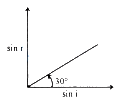 KCET 2019 Easy
 - The relation between half life \( (T) \) and decay constant \( (\lambda) \) isKCET 2014 Easy
- A step-down transformer reduces the voltage of a transmission line from \(2200 \mathrm{~V}\) to \(220 \mathrm{~V}\). The power delivered by it is \(880 \mathrm{~W}\) and its efficiency is \(88 \%\). The input current isKCET 2007 Easy
- \(A\) and \(B\) are the two radioactive elements. The mixtue of these elements show a total activity of 1200 disintergrations/minute. The half-life of \(A\) is 1 day and that of \(B\) is 2 days. What will be the total activity after 4 days? Given, the initial number of atoms in \(A\) and \(B\) are equalKCET 2013 Medium
- Two tuning forks \(A\) and \(B\), produce notes of frequencies \(258 \mathrm{~Hz}\) and \(262 \mathrm{~Hz}\). An unknown note sounded with A produces certain beats. When the same note is sounded with \(B\), the beat frequency gets doubled. The unknown frequency isKCET 2011 Hard
More PYQs from KCET
- If \(f(x)=\sin ^{-1}\left(\frac{2 x}{1+x^{2}}\right)\), then \(f^{\prime}(\sqrt{3})\) isKCET 2020 Medium
- The distance of the point \( (1,2,1) \) from the line \( \frac{x-1}{2}=\frac{y-2}{1}=\frac{z-3}{2} \) isKCET 2019 Easy
- The speed of electromagnetic wave in vacuum depends upon the source of radiationKCET 2010 Easy
- If \(\quad 2 x^{2}+2 y^{2}+4 x+5 y+1=0 \quad\) and \(3 x^{2}+3 y^{2}+6 x-7 y+3 k=0 \quad\) are orthogonal, then value of \(k\) isKCET 2011 Hard
- If \(\mathbf{a}, \mathbf{b}\) and \(\mathbf{c}\) are unit vectors such that \(\mathbf{a}+\mathbf{b}+\mathbf{c}=0\), then \(\mathbf{a} \cdot \mathbf{b}+\mathbf{b} \cdot \mathbf{c}+\mathbf{c} \cdot \mathbf{a}\) is equal toKCET 2013 Easy
- The method of natural contraception which requires correct knowledge of menstrual cycle isKCET 2019 Easy