


KCET · Chemistry · Chemical Kinetics
The rate of reaction increases with rise in temperature because of
- A increase in number of activated molecules
- B increase in energy of activation
- C decrease in energy of activation
- D increase in the number of effective collisions
Answer & Solution
Correct Answer
(D) increase in the number of effective collisions
Step-by-step Solution
Detailed explanation
For a collision to be effective, the colloiding molecules must have energy more than a particular value known as threshold energy. At room temperature most of the reactant molecules have energy less than the threshold value. When temperature is increased, the reactant molecules absorb this energy and their energy becomes equal to or greater than threshold value. This extra amount of energy absorbed by the reacting molecules is known as activation energy.
Activation energy \(=\) Threshold energy \(-\) Average kinetic energy of the reactants.
Evidently, the rate of reaction increases on rise in temperature, because average kinetic energy of the reactants increases and activation energy decreases. Also, on rise in temperature, the number of molecules having kinetic energy greater than threshold value increases. Thus, the increase in the rate of reaction with increase in temperature in mainly due to increase in number of effective collisions.
Activation energy \(=\) Threshold energy \(-\) Average kinetic energy of the reactants.
Evidently, the rate of reaction increases on rise in temperature, because average kinetic energy of the reactants increases and activation energy decreases. Also, on rise in temperature, the number of molecules having kinetic energy greater than threshold value increases. Thus, the increase in the rate of reaction with increase in temperature in mainly due to increase in number of effective collisions.
See the Complete Solution
Get step-by-step explanations for this and 2.5 Lakh+ more JEE, NEET & CET questions.
- Unlock all solutions
- Practice the full chapter
- Track accuracy across PYQs
4.8 rated on Google Play · 14,000+ reviews
More questions from Chemistry
- For the reversible reaction,
\(\text{N}_{2(g)} + 3\text{H}_{2(g)} \rightleftharpoons 2\text{NH}_{3(g)}\)
When the partial pressure is measured in atmosphere, the value of \(K_p\) at \(500^\circ\text{C}\) is \(1.44 \times 10^{-5}\). The value of \(K_c\) when the concentration is expressed in mol L\(^{-1}\) is:KCET 2026 Medium - Plaster of Paris is represented asKCET 2017 Easy
- Which of the following colloids cannot be easily coagulated?KCET 2015 Easy
- In alkaline medium, alanine exists predominantly asKCET 2010 Easy
- The Glycosidic linkage present in sucrose isbetweenKCET 2017 Medium
- The following data is obtained during the first order thermal decomposition of
\(2 \mathrm{~A}(g) \longrightarrow \mathrm{B}(g)+\mathrm{C}(\mathrm{s})\)
at constant volume and temperature.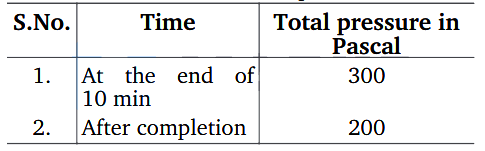
The rate constant in \(\min ^{-1}\) isKCET 2010 Easy
More PYQs from KCET
- A solenoid is 1 m long and 4 cm in diameter. It has five layers of windings of 1000 turns each and carries a current of 7 A . The magnetic field at the centre of the solenoid isKCET 2025 Medium
- The period of revolution of an electron revolving in nth orbit of H-atom is proportional toKCET 2020 Easy
- The real root of the equation \(x^{3}-6 x+9=0\) isKCET 2008 Easy
- The area bounded between the parabola \(y^{2}=4 x\) and the line \(\mathrm{y}=2 \mathrm{x}-4\) is equal toKCET 2009 Hard
- The value of rate constant of a pseudo first order reactionKCET 2018 Easy
- In an LCR circuit, at resonanceKCET 2015 Easy