


KCET · Physics · Current Electricity
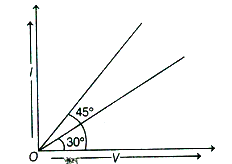
The \(I-V\) graph for a conductor at two different temperatures \(100^{\circ} \mathrm{C}\) and \(400^{\circ} \mathrm{C}\) is as shown in the figure. The temperature coefficient of resistance of the conductor is about (in per degree Celsius)
- A \(3 \times 10^{-5}\)
- B \(8 \times 10^{-3}\)
- C \(9 \times 10^{-3}\)
- D \(12 \times 10^{-3}\)
Answer & Solution
Correct Answer
(A) \(3 \times 10^{-5}\)
Step-by-step Solution
Detailed explanation
From the \(I-V\) graph,
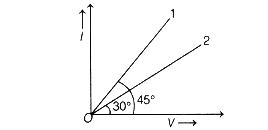
Resistance of first conductor,
\(R_1=\frac{1}{\tan 45^{\circ}}=1 \Omega\)
Resistance of second conductor,
\(R_2=\frac{1}{\tan 30^{\circ}}=\sqrt{3} \Omega\)
\(\therefore\) Temperature coefficient of resistance of the conductor.
\(\alpha=\frac{R_2-R_1}{R_1 t_2-R_2 t_1}=\frac{\sqrt{3-1}}{1 \times 400-\sqrt{3} \times 100}\)
\(=3.22 \times 10^{-3} \rho \mathrm{C}=3 \times 10^{-3} /{ }^{\circ} \mathrm{C}\)
Resistance of first conductor,
\(R_1=\frac{1}{\tan 45^{\circ}}=1 \Omega\)
Resistance of second conductor,
\(R_2=\frac{1}{\tan 30^{\circ}}=\sqrt{3} \Omega\)
\(\therefore\) Temperature coefficient of resistance of the conductor.
\(\alpha=\frac{R_2-R_1}{R_1 t_2-R_2 t_1}=\frac{\sqrt{3-1}}{1 \times 400-\sqrt{3} \times 100}\)
\(=3.22 \times 10^{-3} \rho \mathrm{C}=3 \times 10^{-3} /{ }^{\circ} \mathrm{C}\)
See the Complete Solution
Get step-by-step explanations for this and 2.5 Lakh+ more JEE, NEET & CET questions.
- Unlock all solutions
- Practice the full chapter
- Track accuracy across PYQs
4.8 rated on Google Play · 14,000+ reviews
More questions from Physics
- If the refractive index from air to glass is \(\frac{3}{2}\) and that from air to water is \(\frac{4}{3}\), then the ratio of focal lengths of a glass lens in water and in air isKCET 2021 Medium
- A body is projected vertically upwards. The times corresponding to height while ascending and while descending are \(\mathrm{t}_{1}\) and \(\mathrm{t}_{2}\) respectively. Then the velocity of projection is ( is acceleration due to gravity)KCET 2008 Hard
- A circular coil of radius \( 10 \mathrm{~cm} \) and \( 100 \) turns carries a current \( 1 \mathrm{~A} \). What is the magnetic moment of the coil ?KCET 2014 Medium
- Eight equal drops of water are falling through air with a steady velocity of \(10 \mathrm{~cm} \mathrm{~s}^{-1}\). If the drops combine to form a single drop big in size, then the terminal velocity of this big drop isKCET 2011 Hard
- The quantities of heat required to raise the temperatures of two copper spheres of radii \(r_{1}\) and \(r_{2}\left(r_{1}=1.5 r_{2}\right)\) through \(1 \mathrm{~K}\) are in the ratio ofKCET 2011 Medium
- A body is moving along a straight line with initial velocity \(v_0\). Its acceleration \(a\) is constant. After \(t\).seconds, its velocity becomes \(v\). The average velocity of the body over the given time interval isKCET 2023 Medium
More PYQs from KCET
- Verhulst-Pearl logistic growth is described by the equation \(\frac{ dN }{ dt }= rN \left[\frac{ K - N }{ K }\right]\), where 'r' and 'K' represent.KCET 2018 Easy
- Two poles are separated by a distance of \(3.14 \mathrm{~m}\). The resolving power of human eye is \(1 \mathrm{~min}\) of an arc. The maximum distance from which he can identify the two poles distinctly isKCET 2020 Medium
- \(E_{1}, E_{2}\) and \(E_{3}\) are the emfs of the following three galvanic cells respectively.KCET 2011 Easy
- In which of the following compounds, an element exhibits two different oxidation states?KCET 2022 Easy
- Which of the following characters is not requires for autogamy?KCET 2017 Medium
- The aqueous solution of following salt will have the lowest \( \mathrm{pH} \) :KCET 2015 Easy