


KCET · Physics · Ray Optics
Two poles are separated by a distance of \(3.14 \mathrm{~m}\). The resolving power of human eye is \(1 \mathrm{~min}\) of an arc. The maximum distance from which he can identify the two poles distinctly is
- A \(10.8 \mathrm{~km}\)
- B \(5.4 \mathrm{~km}\)
- C \(188 \mathrm{~m}\)
- D \(376 \mathrm{~m}\)
Answer & Solution
Correct Answer
(A) \(10.8 \mathrm{~km}\)
Step-by-step Solution
Detailed explanation
Given, distance between poles \((d)=3.14 \mathrm{~m}\)
Resoolving power \(=1\) min or \(1^{\prime}\)
Let maximum distance of two poles from eye to be resolved distinctly be \(x\). Then, angle on eye in minute for two poles can be found using figure given below
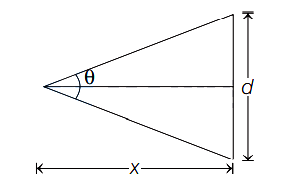
\(\theta=\frac{d}{x} \times \frac{180}{\pi} \times 60\)
\(\Rightarrow \quad 1=\frac{3.14}{x} \times \frac{180}{\pi} \times 60\)
\(\Rightarrow \quad x=\frac{3.14 \times 180 \times 60}{\pi}=10794.5\)
\(=10.8 \mathrm{~km}\)
Resoolving power \(=1\) min or \(1^{\prime}\)
Let maximum distance of two poles from eye to be resolved distinctly be \(x\). Then, angle on eye in minute for two poles can be found using figure given below
\(\theta=\frac{d}{x} \times \frac{180}{\pi} \times 60\)
\(\Rightarrow \quad 1=\frac{3.14}{x} \times \frac{180}{\pi} \times 60\)
\(\Rightarrow \quad x=\frac{3.14 \times 180 \times 60}{\pi}=10794.5\)
\(=10.8 \mathrm{~km}\)
See the Complete Solution
Get step-by-step explanations for this and 2.5 Lakh+ more JEE, NEET & CET questions.
- Unlock all solutions
- Practice the full chapter
- Track accuracy across PYQs
4.8 rated on Google Play · 14,000+ reviews
More questions from Physics
- The efficiency of Carnot's heat engine is \(0.5\) when the temperature of the source is \(\mathrm{T}_{1}\) and that of \(\operatorname{sink}\) is \(\mathrm{T}_{2}\). The efficiency of another Carnot's heat engine is also 0.5. The temperatures of source and sink of the second engine are respectivelyKCET 2010 Medium
- An electromagnetic wave is travelling in \( x \)-direction with electric field vector given by, \( \vec{E}_{y}=E_{0} \sin (k x-\omega t) \hat{j} \). The correct expression for magnetic field vector isKCET 2019 Easy
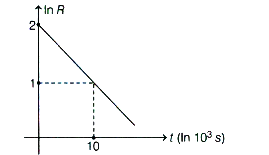
- The natural logarithm of the activity \(R\) of a radioactive sample varies with time \(t\) as shown. At \(t=0\), there are \(N_0\) undecayed nuclei. Then, \(N_0\) is equal to [Take \(e^2=7.5\) ]
 KCET 2024 Easy
 - The angle between the particle velocity and wave velocity in a transverse wave is [except when the particle passes through the mean position]KCET 2025 Easy
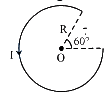
- The magnetic field at the centre ' \( \mathrm{O} \) ' in the given figure is
 KCET 2019 Medium
 - The resultant of two forces acting at an angle of \(120^{\circ}\) is \(10 \mathrm{~kg}\)-wt and is perpendicular to one of the forces. That force isKCET 2011 Easy
More PYQs from KCET
- If one of the slopes of the pair of lines \(\mathrm{ax}^{2}+2 \mathrm{hxy}+\mathrm{by}^{2}=0\) is \(\mathrm{n}\) times the other, thenKCET 2012 Hard
- Frequency of revolution of an electron revolving in nth orbit of H-atom is proportional toKCET 2019 Medium
- Which of the following will not act as an oxidising agent?KCET 2026 Medium
- A small oil drop of mass \(10^{-6} \mathrm{~kg}\) is hanging in at rest between two plates separated by \(1 \mathrm{~mm}\) having a potential difference of \(500 \mathrm{~V}\). The charge on the drop is \(\left(g=10 \mathrm{~ms}^{-2}\right.\) )KCET 2013 Hard
- A stone is thrown vertically upwards and the height \(x \mathrm{ft}\) reached by the stone in t seconds is given by \(x=80 t-16 t^{2}\). The stone reaches the maximum height inKCET 2008 Easy
- Match the plant structures given in the Column I with their plants given in Column II.
Column I Column II (A) Prothallus (p) Bryophytes (B) Microsporophyll (q) Pteridophytes (C) Protonema (r) Angiosperms (D) PEN (s) Gymnosperms KCET 2016 Medium