


KCET · Physics · Motion In One Dimension
A body is moving along a straight line with initial velocity \(v_0\). Its acceleration \(a\) is constant. After \(t\).seconds, its velocity becomes \(v\). The average velocity of the body over the given time interval is
- A \(\bar{v}=\frac{v^2-v_0^2}{a t}\)
- B \(\bar{v}=\frac{v^2+v_0^2}{2 a t}\)
- C \(\bar{v}=\frac{v^2+v_0^2}{a t}\)
- D \(\bar{v}=\frac{v^2-v_0^2}{2 a t}\)
Answer & Solution
Correct Answer
(D) \(\bar{v}=\frac{v^2-v_0^2}{2 a t}\)
Step-by-step Solution
Detailed explanation
Given,
\(\begin{aligned} & v_1=v_0 \\ & v_2=v\end{aligned}\)
acceleration \(=a\)
for time \(=t \mathrm{~s}\)
Using Newton's equations of motion,
\(\begin{aligned} v^2-u^2 & =2 a s \\ s & =\frac{v^2-u^2}{2 a}(\text { total distance covered }) \\ s & =\frac{v^2-v_0^2}{2 a}\end{aligned}\)
Average yelocity \(=\frac{\text { Total distance }}{\text { Total time }}=\frac{\frac{v^2-v_0^2}{2 a}}{t}\)
[Using Eq. (i)]
\(v_{\mathrm{avg}}=\frac{v^2-v_0^2}{2 a t}\)
\(\begin{aligned} & v_1=v_0 \\ & v_2=v\end{aligned}\)
acceleration \(=a\)
for time \(=t \mathrm{~s}\)
Using Newton's equations of motion,
\(\begin{aligned} v^2-u^2 & =2 a s \\ s & =\frac{v^2-u^2}{2 a}(\text { total distance covered }) \\ s & =\frac{v^2-v_0^2}{2 a}\end{aligned}\)
Average yelocity \(=\frac{\text { Total distance }}{\text { Total time }}=\frac{\frac{v^2-v_0^2}{2 a}}{t}\)
[Using Eq. (i)]
\(v_{\mathrm{avg}}=\frac{v^2-v_0^2}{2 a t}\)
See the Complete Solution
Get step-by-step explanations for this and 2.5 Lakh+ more JEE, NEET & CET questions.
- Unlock all solutions
- Practice the full chapter
- Track accuracy across PYQs
4.8 rated on Google Play · 14,000+ reviews
More questions from Physics
- When electron jumps from \( n=4 \) level to \( n=1 \) level, the angular momentum of electron
changes byKCET 2016 Easy - The relation between half life \( (T) \) and decay constant \( (\lambda) \) isKCET 2014 Easy
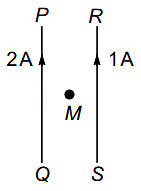
- \(\mathrm{PQ}\) and RS are long parallel conductors separated by certain distance. \(M\) is the midpoint between them (see the figure). The net magnetic field at \(M\) is B. Now, the current 2 A is switched off. The field at \(M\) now becomes
 KCET 2010 Medium
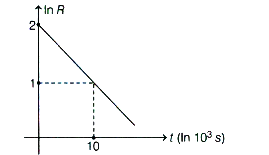
 - The natural logarithm of the activity \(R\) of a radioactive sample varies with time \(t\) as shown. At \(t=0\), there are \(N_0\) undecayed nuclei. Then, \(N_0\) is equal to [Take \(e^2=7.5\) ]
 KCET 2024 Easy
 - The ratio of volume of \(\mathrm{Al}^{27}\) nucleus to its surfactarea is (Given, \(R_0=1.2 \times 10^{-15} \mathrm{~m}\) )KCET 2024 Easy
- A charged particle is moving in an electric field of \(3 \times 10^{-10} \mathrm{Vm}^{-1}\) with mobility \(2.5 \times 10^6 \mathrm{~m}^2 / \mathrm{V}\)-s, its drift velocity isKCET 2022 Easy
More PYQs from KCET
- Though the electron drift velocity is small and electron charge is very small, a conductor can
carry an appreciably large current becauseKCET 2019 Easy - Which of the following is not a colligative property?KCET 2016 Easy
- A bat flies at a steady speed of \(4 \mathrm{~ms}^{-1}\) emitting a sound of \(\mathrm{f}=90 \times 10^{3} \mathrm{~Hz}\). It is flying horizontally towards a vertical wall. The frequency of the reflected sound as detected by the bat will be (take velocity of sound in air is \(330 \mathrm{~ms}^{-1}\) )KCET 2010 Hard
- If we consider an electron and a photon of same de-Broglie wavelength, then they will have sameKCET 2025 Easy
- The angle strain in cyclobutane isKCET 2008 Medium
- In chromite ore, the oxidation number of iron and chromium are respectivelyKCET 2011 Medium