


KCET · Physics · Alternating Current
The frequency of an alternating current is \( 50 \mathrm{~Hz} \). What is the minimum time taken by current to reach its peak value from rms value?
- A \( 0.02 \mathrm{~s} \)
- B \( 5 \times 10^{-3} s \)
- C \( 10 \times 10^{-3} \)
- D \( 2.5 \times 10^{-3} \mathrm{~s} \)
Answer & Solution
Correct Answer
(D) \( 2.5 \times 10^{-3} \mathrm{~s} \)
Step-by-step Solution
Detailed explanation
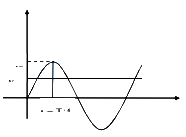
We know that \( v_{r m s}=v_{0} \sin \omega t \)
\( \frac{v_{0}}{\sqrt{2}}=v_{0} \sin \omega t \)
\( \therefore \sin \omega t=\left(\frac{1}{\sqrt{2}}\right) \)
i.e., \( \omega t=\frac{\Pi}{4} \Rightarrow \frac{2 \Pi}{T} \cdot t=\frac{\Pi}{4} \)
\( \therefore t=\frac{T}{8} \)
Time for current to reach from rms value to peak value is i.e., \( I_{r m s} \rightarrow I_{0} \)
\( \frac{T}{4}-\frac{T}{8}=\frac{T}{8}\left(\frac{I_{0}}{\sqrt{2}} \rightarrow I_{0}\right) \)
\( f=50 \therefore t=\frac{I}{8} \)
\( =\frac{1}{50 \times 8}=\frac{1}{400}=0.25 \times 10^{-2} \)
\( =2.5 \times 10^{-3} \mathrm{~s} \)
\( \therefore[\mathrm{D}] \) is correct.
See the Complete Solution
Get step-by-step explanations for this and 2.5 Lakh+ more JEE, NEET & CET questions.
- Unlock all solutions
- Practice the full chapter
- Track accuracy across PYQs
4.8 rated on Google Play · 14,000+ reviews
More questions from Physics
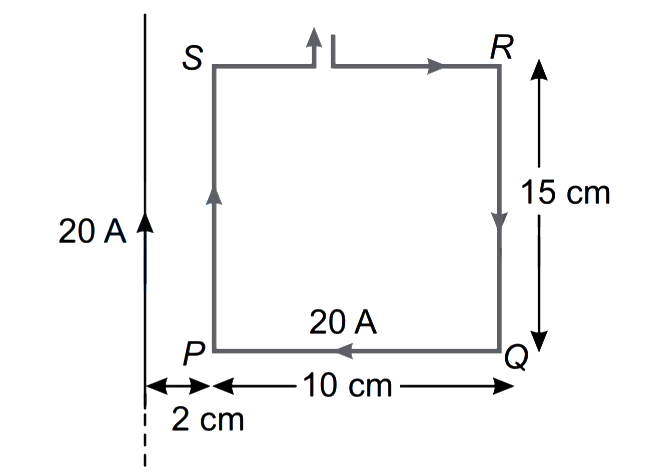
- The resultant force on the current loop due to a long current carrying conductor will be
 KCET 2008 Hard
 - Two identical charged spheres of material density \(\rho\), suspended from the same point by inextensible strings of equal length make an angle \(\theta\) between the strings. When suspended in a liquid of density \(\sigma\) the angle \(\theta\) remains the same. The dielectric constant \(K\) of the liquid isKCET 2011 Hard
- An \(\alpha\)-particle and a proton moving with the same kinetic energy enter a region of uniform magnetic field at right angles to the field. The ratio of the radii of the paths of \(\alpha\)-particle to that of the proton isKCET 2012 Medium
- An electron is moving with an initial velocity \( \vec{V}=V_{0} \hat{i} \) and is in a uniform magnetic field \( \vec{B}=B_{0} \hat{j} \). Then its de Broglie wavelengthKCET 2019 Medium
- The force of repulsion between two identical positive charges when kept with a separation 'r' in air is ' \( F \) '. Half the gap between the two charges us filled by a dielectric slab of dielectric constant \( =4 \), Then the new force of repulsion between those two charges becomesKCET 2018 Hard
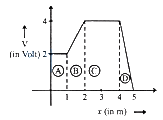
- The figure gives the electric potential \( V \) as a function of distance through four regions on \( x- \) axis. Which of the following is true for the magnitude of the electric field \( E \) in these regions?
 KCET 2019 Easy
More PYQs from KCET
- Tertiary alkyl halide is practically to substitution by \( S_{N} 2 \) mechanism because ofKCET 2018 Easy
- Some of the steps of DNA fingerprinting are given below. Identify the correct sequence from the options given.
A. Electrophoresis of DNA fragments
B. Hybridsation with DNA probe
C. Digestion of DNA by RENS
D. Autoradiography
E Blotting of DNA fragments to nitrocellulose membraneKCET 2014 Medium - The process which is responsible for the formation of delta at a place where rivers meets the
sea isKCET 2017 Easy - If the function \( g(x) \) is defined by
\[
g(x)=\frac{\chi^{200}}{200}+\frac{\chi^{199}}{199}+\frac{\chi^{198}}{198}+\ldots \ldots+\frac{\chi^{2}}{2}+\chi+5, \text { then } g^{\prime}(0)=
\]KCET 2015 Easy - Which of the following hormones is not secreted by human placenta?KCET 2022 Hard
-
 \(\xrightarrow{\large{\text{Conc.HNO}_3/\text{Conc.H}_2\text{SO}_4,\ 323-333\text{K}}} A \xrightarrow{\large{\text{Fe/HCl}}} B \xrightarrow{\large{\text{NaNO}_2/\text{HCl},\ 273\text{K}}} C \xrightarrow{\large{\text{C}_2\text{H}_5\text{OH},\ -\text{N}_2}}\)
  \(+ D + \text{HCl}\)
Organic compound 'D' isKCET 2026 Medium