


KCET · Chemistry · Alcohols Phenols and Ethers
 \(\xrightarrow{\large{\text{Conc.HNO}_3/\text{Conc.H}_2\text{SO}_4,\ 323-333\text{K}}} A \xrightarrow{\large{\text{Fe/HCl}}} B \xrightarrow{\large{\text{NaNO}_2/\text{HCl},\ 273\text{K}}} C \xrightarrow{\large{\text{C}_2\text{H}_5\text{OH},\ -\text{N}_2}}\)
  \(+ D + \text{HCl}\)
Organic compound 'D' is
- B \(\text{CH}_3\text{COOH}\)
- C \(\text{CH}_3\text{CHO}\)
Answer & Solution
Correct Answer
(C) \(\text{CH}_3\text{CHO}\)
Step-by-step Solution
Detailed explanation
Benzene undergoes nitration with concentrated \(\text{HNO}_3\) and concentrated \(\text{H}_2\text{SO}_4\) at \(323-333\text{ K}\) to form nitrobenzene (A).
\(\text{C}_6\text{H}_6 \xrightarrow{\text{Conc. HNO}_3 / \text{Conc. H}_2\text{SO}_4} \text{C}_6\text{H}_5\text{NO}_2 \text{ (A)}\)
Nitrobenzene (A) is reduced by \(\text{Fe/HCl}\) to yield aniline (B).
\(\text{C}_6\text{H}_5\text{NO}_2 \xrightarrow{\text{Fe/HCl}} \text{C}_6\text{H}_5\text{NH}_2 \text{ (B)}\)
Aniline (B) undergoes diazotization with \(\text{NaNO}_2\) and \(\text{HCl}\) at \(273\text{ K}\) to form benzene diazonium chloride (C).
\(\text{C}_6\text{H}_5\text{NH}_2 \xrightarrow{\text{NaNO}_2/\text{HCl},\ 273\text{K}} \text{C}_6\text{H}_5\text{N}_2^+\text{Cl}^- \text{ (C)}\)
Benzene diazonium chloride (C) is reduced by ethanol (\(\text{C}_2\text{H}_5\text{OH}\)) to benzene. In this process, ethanol acts as a reducing agent and gets oxidized to acetaldehyde (\(\text{CH}_3\text{CHO}\)).
\(\text{C}_6\text{H}_5\text{N}_2^+\text{Cl}^- + \text{CH}_3\text{CH}_2\text{OH} \rightarrow \text{C}_6\text{H}_6 + \text{CH}_3\text{CHO} + \text{N}_2 + \text{HCl}\)
Therefore, the organic compound D is acetaldehyde (\(\text{CH}_3\text{CHO}\)).
Answer: \(\text{CH}_3\text{CHO}\)
\(\text{C}_6\text{H}_6 \xrightarrow{\text{Conc. HNO}_3 / \text{Conc. H}_2\text{SO}_4} \text{C}_6\text{H}_5\text{NO}_2 \text{ (A)}\)
Nitrobenzene (A) is reduced by \(\text{Fe/HCl}\) to yield aniline (B).
\(\text{C}_6\text{H}_5\text{NO}_2 \xrightarrow{\text{Fe/HCl}} \text{C}_6\text{H}_5\text{NH}_2 \text{ (B)}\)
Aniline (B) undergoes diazotization with \(\text{NaNO}_2\) and \(\text{HCl}\) at \(273\text{ K}\) to form benzene diazonium chloride (C).
\(\text{C}_6\text{H}_5\text{NH}_2 \xrightarrow{\text{NaNO}_2/\text{HCl},\ 273\text{K}} \text{C}_6\text{H}_5\text{N}_2^+\text{Cl}^- \text{ (C)}\)
Benzene diazonium chloride (C) is reduced by ethanol (\(\text{C}_2\text{H}_5\text{OH}\)) to benzene. In this process, ethanol acts as a reducing agent and gets oxidized to acetaldehyde (\(\text{CH}_3\text{CHO}\)).
\(\text{C}_6\text{H}_5\text{N}_2^+\text{Cl}^- + \text{CH}_3\text{CH}_2\text{OH} \rightarrow \text{C}_6\text{H}_6 + \text{CH}_3\text{CHO} + \text{N}_2 + \text{HCl}\)
Therefore, the organic compound D is acetaldehyde (\(\text{CH}_3\text{CHO}\)).
Answer: \(\text{CH}_3\text{CHO}\)
See the Complete Solution
Get step-by-step explanations for this and 2.5 Lakh+ more JEE, NEET & CET questions.
- Unlock all solutions
- Practice the full chapter
- Track accuracy across PYQs
4.8 rated on Google Play · 14,000+ reviews
More questions from Chemistry
- For a stable molecule, the value of bond order must beKCET 2007 Easy
- For the crystal field splitting in octahedral complexes,KCET 2021 Medium
- Hinsberg's reagent isKCET 2020 Medium
- \(\alpha-\mathrm{D}-(+)\)-glucose and \(\beta\)-D-(+)-glucose areKCET 2024 Medium
- In carbylamine test for primary amines the resulting foul smelling product isKCET 2022 Easy
- The electronic configuration of \( G d^{2+} \) is (at. no. of \( G d \) is 64)KCET 2015 Easy
More PYQs from KCET
- Identify the correct statement.KCET 2021 Easy
- The total number of terms in the expansion of \( (x+a)^{47}-(x-a)^{47} \) after simplification isKCET 2017 Easy
- A convex and a concave lens separated by distance are then put in contact. The focal length of the combinationKCET 2008 Medium
- The number of values of \(\mathrm{c}\) such that the line \(y=4 x+c\) touches the curve \(\frac{x^{2}}{4}+y^{2}=1\) isKCET 2009 Easy
- Out of the compounds below the vapour pressure of (B) at a particular temperature is
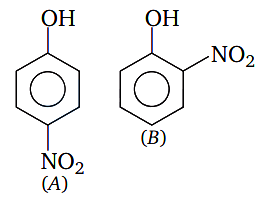 KCET 2010 Medium
 - The activation energy for a reaction at the temperature \(T \mathrm{~K}\) was found to be \(2.303 \mathrm{RT}\) \(\mathrm{J} \mathrm{mol}^{-1}\). The ratio of the rate constant to Arrhenius factor isKCET 2010 Easy