


KCET · Physics · Electrostatics
The force of repulsion between two identical positive charges when kept with a separation 'r' in air is ' \( F \) '. Half the gap between the two charges us filled by a dielectric slab of dielectric constant \( =4 \), Then the new force of repulsion between those two charges becomes
- A \( \frac{F}{3} \)
- B \( \frac{F}{2} \)
- C \( \frac{F}{4} \)
- D \( \frac{4 F}{9} \)
Answer & Solution
Correct Answer
(D) \( \frac{4 F}{9} \)
Step-by-step Solution
Detailed explanation
Given, force of repulsion between two identical positive charges with separation, \( r=F \).
Half of gap is filled with dielectric constant \( =4 \).
Now \( F=\frac{1}{4 \Pi \varepsilon_{0}} \frac{q_{1} q_{2}}{r^{2}} \)
where \( q_{1} \) and \( q_{2} \) are two positive charges. For identical charges, \( q_{1}=q-2=q \)
\(F=\frac{1}{4 \Pi \varepsilon_{0}} \frac{q^{2}}{r^{2}} \rightarrow(1)\)
When the gap is half filled with dielectric constant then
\(F^{\prime}=\frac{1}{4 \Pi \varepsilon_{0}} \frac{q^{2}}{(r-t+t \sqrt{k})^{2}}\)
where \( k \) is dielectric constant \( =4 ; t \) is thickness of dielectric \( =r / 2 \). Therefore,
\(F^{\prime}=\frac{1}{4 \Pi \varepsilon_{0}} \frac{q^{2}}{\left(r-\frac{r}{2}+\frac{r}{2} \sqrt{4}\right)^{2}}=\frac{1}{4 \Pi \varepsilon_{0}} \frac{q^{2}}{\left(r-\frac{r}{2}+r\right)^{2}} \)
\(=\frac{1}{4 \Pi \varepsilon_{0}} \frac{q^{2}}{(2 r-r / 2)^{2}}=\frac{1}{4 \Pi \varepsilon_{0}} \frac{q^{2}}{\left(\frac{3}{2} r\right)^{2}}=\frac{1}{4 \Pi \varepsilon_{0}} \frac{q^{2}}{r^{2}} \times \frac{4}{9}\)
\(\text {Thus } F^{\prime}=\frac{4}{9} F \quad \quad(U \operatorname{sing} \text { Eq. (1)) }\)
Half of gap is filled with dielectric constant \( =4 \).
Now \( F=\frac{1}{4 \Pi \varepsilon_{0}} \frac{q_{1} q_{2}}{r^{2}} \)
where \( q_{1} \) and \( q_{2} \) are two positive charges. For identical charges, \( q_{1}=q-2=q \)
\(F=\frac{1}{4 \Pi \varepsilon_{0}} \frac{q^{2}}{r^{2}} \rightarrow(1)\)
When the gap is half filled with dielectric constant then
\(F^{\prime}=\frac{1}{4 \Pi \varepsilon_{0}} \frac{q^{2}}{(r-t+t \sqrt{k})^{2}}\)
where \( k \) is dielectric constant \( =4 ; t \) is thickness of dielectric \( =r / 2 \). Therefore,
\(F^{\prime}=\frac{1}{4 \Pi \varepsilon_{0}} \frac{q^{2}}{\left(r-\frac{r}{2}+\frac{r}{2} \sqrt{4}\right)^{2}}=\frac{1}{4 \Pi \varepsilon_{0}} \frac{q^{2}}{\left(r-\frac{r}{2}+r\right)^{2}} \)
\(=\frac{1}{4 \Pi \varepsilon_{0}} \frac{q^{2}}{(2 r-r / 2)^{2}}=\frac{1}{4 \Pi \varepsilon_{0}} \frac{q^{2}}{\left(\frac{3}{2} r\right)^{2}}=\frac{1}{4 \Pi \varepsilon_{0}} \frac{q^{2}}{r^{2}} \times \frac{4}{9}\)
\(\text {Thus } F^{\prime}=\frac{4}{9} F \quad \quad(U \operatorname{sing} \text { Eq. (1)) }\)
See the Complete Solution
Get step-by-step explanations for this and 2.5 Lakh+ more JEE, NEET & CET questions.
- Unlock all solutions
- Practice the full chapter
- Track accuracy across PYQs
4.8 rated on Google Play · 14,000+ reviews
More questions from Physics
- Moment of Inertia of a thin uniform rod rotating about the perpendicular axis passing through its centre is \( I \). If the same rod is bent into a ring and its moment of inertia about its diameter is \( I^{\prime} \) then the ratio \( \frac{I}{I^{\prime}} \) isKCET 2015 Easy
- The rms value of current in a \( 50 \mathrm{~Hz} \mathrm{AC} \) circuit is \( 6 \mathrm{~A} \). The average value of \( \mathrm{AC} \) current over a cycle isKCET 2016 Easy
- A proton moving with a momentum \(p_{1}\) has a kinetic energy \(1 / 8\) th of its rest mass-energy. Another light photon having energy equal to the kinetic energy of the possesses a momentum \(p_{2}\). Then, the ratio \(\frac{p_{1}-p_{2}}{p_{1}}\) is equal toKCET 2021 Medium
- In the following circuit what are \(P\) and \(Q\)
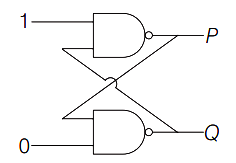 KCET 2020 Easy
 - Magnetic field at a distance \(r\) from an infinitely long straight conductor carrying a steady current varies asKCET 2012 Easy
- In Young's double slit experiment the source is white light. One slit is covered with red filter and
the other with blue filter. There shall beKCET 2016 Easy
More PYQs from KCET
- The maximum area of a rectangle inscribed in the circle \( (x+1)^{2}+(y-3)^{2}=64 \) isKCET 2018 Hard
- For a stable molecule, the value of bond order must beKCET 2007 Easy
- One mole of an ideal gas is taken from A to B, from \(B\) to \(C\) and then back to \(A\). The variation of its volume with temperature for that change is as shown. Its pressure at \(\mathrm{A}\) is \(\mathrm{P}_{0}\), volume is \(\mathrm{V}_{0}\), Then, the internal energy
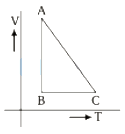 KCET 2012 Hard
 - The nourishing cells in the seminiferous tubules areKCET 2019 Hard
- The ratio of hydraulic stress to the corresponding strain is known asKCET 2015 Easy
- Which of the following phenomena support the wave theory of light?
(1) Scattering
(2) Interference
(3) Diffraction
(4) Velocity of light in a denser medium is less than the velocity of light in the rare mediumKCET 2013 Easy