


KCET · Physics · Atomic Physics
An electron is moving in an orbit of a hydrogen atom from which there can be a maximum of six transition. An electron is moving in an orbit of another hydrogen atom from which there can be a maximum of three transition. The ratio of the velocities of the electron in these two orbits is
- A \(\frac{1}{2}\)
- B \(\frac{2}{1}\)
- C \(\frac{5}{4}\)
- D \(\frac{3}{4}\)
Answer & Solution
Correct Answer
(D) \(\frac{3}{4}\)
Step-by-step Solution
Detailed explanation
Number of spectral lines obtained due to transition of electrons from \(n\)th orbit to lower orbit is,
\(\begin{array}{ll} & \mathrm{N}=\frac{\mathrm{n}(\mathrm{n}-1)}{2} \\ \text { I case } & 6=\frac{\mathrm{n}_{1}\left(\mathrm{n}_{1}-1\right)}{2} \\ \Rightarrow & \mathrm{n}_{1}=4 \\ \text { II case } & 3=\frac{\mathrm{n}_{2}\left(\mathrm{n}_{2}-1\right)}{2} \\ \Rightarrow & \mathrm{n}_{2}=3\end{array}\)
Velocity of electron in hydrogen atom in \(n\)th orbit
\[
\begin{aligned}
\mathrm{v}_{\mathrm{n}} & \propto \frac{1}{\mathrm{n}} \\
\frac{\mathrm{v}_{\mathrm{n}}}{\mathrm{v}_{\mathrm{n}}} &=\frac{\mathrm{n}_{2}}{\mathrm{n}_{1}} \\
\Rightarrow \quad \frac{\mathrm{v}_{6}}{\mathrm{v}_{3}} &=\frac{3}{4}
\end{aligned}
\]
\(\begin{array}{ll} & \mathrm{N}=\frac{\mathrm{n}(\mathrm{n}-1)}{2} \\ \text { I case } & 6=\frac{\mathrm{n}_{1}\left(\mathrm{n}_{1}-1\right)}{2} \\ \Rightarrow & \mathrm{n}_{1}=4 \\ \text { II case } & 3=\frac{\mathrm{n}_{2}\left(\mathrm{n}_{2}-1\right)}{2} \\ \Rightarrow & \mathrm{n}_{2}=3\end{array}\)
Velocity of electron in hydrogen atom in \(n\)th orbit
\[
\begin{aligned}
\mathrm{v}_{\mathrm{n}} & \propto \frac{1}{\mathrm{n}} \\
\frac{\mathrm{v}_{\mathrm{n}}}{\mathrm{v}_{\mathrm{n}}} &=\frac{\mathrm{n}_{2}}{\mathrm{n}_{1}} \\
\Rightarrow \quad \frac{\mathrm{v}_{6}}{\mathrm{v}_{3}} &=\frac{3}{4}
\end{aligned}
\]
See the Complete Solution
Get step-by-step explanations for this and 2.5 Lakh+ more JEE, NEET & CET questions.
- Unlock all solutions
- Practice the full chapter
- Track accuracy across PYQs
4.8 rated on Google Play · 14,000+ reviews
More questions from Physics
- Two monochromatic light waves of amplitudes \(3 \mathrm{~A}\) and \(2 \mathrm{~A}\) interfering at a point have a phase difference of \(60^{\circ}\). The intensity at that point will be proportional toKCET 2011 Medium
- The value of acceleration due to gravity at a height of \(10 \mathrm{~km}\) from the surface of earth is \(x\). At what depth inside the earth is the value of the acceleration due to gravity has the same value \(x\) ?KCET 2020 Medium
- Three conductors draw currents of \(1 \mathrm{~A}, 2 \mathrm{~A}\) and 3 A respectively, when connected in turn across a battery. If they are connected in series and the combination is connected across the same battery, the current drawn will beKCET 2013 Medium
- A parallel beam of light of wavelength \(6000 Å\) gets diffracted by a single slit of width \(0.3 \mathrm{~mm}\). The angular position of the first minima of diffracted light isKCET 2011 Easy
- A vessel of height \(2 d\) is half-filled with a liquid of refractive index \(\sqrt{2}\) and the other half with a liquid of refractive index \(n\) (the given liquids are immiscible). Then the apparent depth of the inner surface of the bottom of the vessel (neglecting the thickness of the bottom of the vessel) will beKCET 2007 Hard
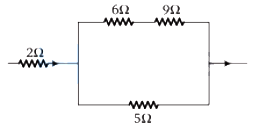
- In this circuit, when certain current flows, the heat produced in \(5 \Omega\) is \(4.05 \mathrm{~J}\) in a time t. The heat produced in \(2 \Omega\) coil in the same time interval is
 KCET 2012 Easy
More PYQs from KCET
- Oil of winter green isKCET 2012 Easy
- The relation between half life \( (T) \) and decay constant \( (\lambda) \) isKCET 2014 Easy
- A box contains \( 6 \) red marbles numbers from \( 1 \) through \( 6 \) and \( 4 \) white marbles \( 12 \) through \( 15 . \)
Find the probability that a marble drawn 'at random' is white and odd numbered.KCET 2015 Easy - A metallic wire of \( 1 \mathrm{~m} \) length has a mass of \( 10 \times 10^{-3} \mathrm{~kg} \). If a tension of \( 100 \mathrm{~N} \) is applied to a wire, what is the speed of transverse wave ?KCET 2014 Easy
- In Young's double slit experiment using monochromatic light of wavelength \( \lambda \), the intensity of
light at a point on the screen where path different is \( \lambda \) is \( \mathrm{K} \) units. The intensity of light at a point
where path difference \( \frac{\lambda}{3} \) isKCET 2019 Medium - When a change in the gene frequency of population occurs by chance, it is called __________KCET 2025 Easy