


KCET · Physics · Wave Optics
A parallel beam of light of wavelength \(6000 Å\) gets diffracted by a single slit of width \(0.3 \mathrm{~mm}\). The angular position of the first minima of diffracted light is
- A \(2 \times 10^{-3} \mathrm{rad}\)
- B \(3 \times 10^{-3} \mathrm{rad}\)
- C \(1.8 \times 10^{-3} \mathrm{rad}\)
- D \(6 \times 10^{-3} \mathrm{rad}\)
Answer & Solution
Correct Answer
(A) \(2 \times 10^{-3} \mathrm{rad}\)
Step-by-step Solution
Detailed explanation
Given, \(\lambda=6000 Å=6000 \times 10^{-10} \mathrm{~m}\) and \(n=0.3 \mathrm{~mm}=0.3 \times 10^{-3} \mathrm{~m}\) \(0.3 \times 10^{-3} \times \sin \theta=6000 \times 10^{-10}\)
\[
\sin \theta=2 \times 10^{-3}
\]
or \(\theta=2 \times 10^{-3} \mathrm{rad}\)
\[
\sin \theta=2 \times 10^{-3}
\]
or \(\theta=2 \times 10^{-3} \mathrm{rad}\)
See the Complete Solution
Get step-by-step explanations for this and 2.5 Lakh+ more JEE, NEET & CET questions.
- Unlock all solutions
- Practice the full chapter
- Track accuracy across PYQs
4.8 rated on Google Play · 14,000+ reviews
More questions from Physics
- In alpha particle scattering experiment, if \(v\) is the initial velocity of the particle, then the distance of closest approach is \(d\). If the velocity is doubled, then the distance of closest approach changes to:KCET 2024 Medium
- Binding energy of a nitrogen nucleus \(\left[{ }_7^{14} \mathrm{~N}\right]\), given \(m\left[{ }_7^{14} \mathrm{~N}\right]=14.00307 \mathrm{u}\)KCET 2022 Easy
- A closed organ pipe and an open organ pipe of same length produce 2 beats/second while vibrating in their fundamental modes. The length of the open organ pipe is halved and that of closed pipe is doubled. Then the number of beats produced per second while vibrating in the fundamental mode isKCET 2010 Hard
- Two beams of red and violet colours are made to pass separately through a prism of \(\mathrm{A}=60^{\circ}\). In the minimum deviation position, the angle of refraction inside the prism will beKCET 2010 Easy
- Mass number of the elements A, B, C and D are \(30,60,90\) and 120 respectively. The specific binding energy of them are \(5 \mathrm{MeV}, 8.5 \mathrm{MeV}\), \(8 \mathrm{MeV}\) and \(7 \mathrm{MeV}\) respectively. Then, in which of the following reaction/s energy is released?
1. \(\mathrm{D} \rightarrow 2 \mathrm{~B}\)
2. \(\mathrm{C} \rightarrow \mathrm{B}+\mathrm{A}\)
3. \(\mathrm{B} \rightarrow 2 \mathrm{~A}\)KCET 2012 Medium - A nucleus \({ }_{Z} X^{A}\) emits an \(\alpha\)-particle with velocity \(v\). The recoil speed of the daughter nucleus isKCET 2013 Medium
More PYQs from KCET
- If \(n(A) = 2\) and the number of relations from set A to set B is \(1024\), then \(n(B)\) isKCET 2026 Easy
- In the following equation representing \(\beta^{-}\) decay, the number of neutrons in the nucleus \(X\) is
\({ }_{83}^{210} \mathrm{Bi} \longrightarrow X+e^{-1}+\bar{v}\)KCET 2023 Easy - Which of the following equations does NOT represent Charles's law for a given mass of gas at
constant pressure?KCET 2019 Easy -
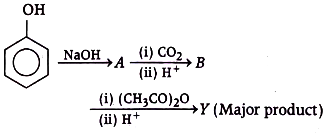
\(Y\) in the above reaction isKCET 2023 Medium - An animal which has both exoskeletal endoskeletal structure isKCET 2009 Hard
- Among the given pair of vectors, the resultant of two vectors can never be 3 units. The vectors areKCET 2024 Easy