


KCET · Physics · Current Electricity
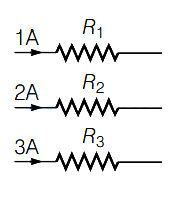
Three conductors draw currents of \(1 \mathrm{~A}, 2 \mathrm{~A}\) and 3 A respectively, when connected in turn across a battery. If they are connected in series and the combination is connected across the same battery, the current drawn will be
- A \(\frac{2}{7} \mathrm{~A}\)
- B \(\frac{3}{7} \mathrm{~A}\)
- C \(\frac{4}{7} \mathrm{~A}\)
- D \(\frac{5}{7} \mathrm{~A}\)
Answer & Solution
Correct Answer
(B) \(\frac{3}{7} \mathrm{~A}\)
Step-by-step Solution
Detailed explanation
Let the three conductors are \(R_{1}, R_{2}\) and \(R_{3}\) and the current drawn by them \(1 \mathrm{~A}, 2 \mathrm{~A}\) and \(3 \mathrm{~A}\) respectively when connected in turn across a battery.
\(\therefore V=R_{1}, \quad V=2 R_{2}\) and \(V=3 R_{3}\)
So, \(\quad R_{1}=V, R_{2}=\frac{V}{2}\) and \(R_{3}=\frac{V}{3}\)
When the conductors are connected in series, across the same battery, then
\(\Rightarrow V=l\left[R_{1}+R_{2}+R_{3}\right] \)
\( \Rightarrow V=I\left[V+\frac{V}{2}+\frac{V}{3}\right] \)
\( 1=I\left[\frac{6+3+2}{6}\right] \)
\( \text {or } I=\frac{6}{11} \mathrm{~A}\)
\(\therefore V=R_{1}, \quad V=2 R_{2}\) and \(V=3 R_{3}\)
So, \(\quad R_{1}=V, R_{2}=\frac{V}{2}\) and \(R_{3}=\frac{V}{3}\)
When the conductors are connected in series, across the same battery, then
\(\Rightarrow V=l\left[R_{1}+R_{2}+R_{3}\right] \)
\( \Rightarrow V=I\left[V+\frac{V}{2}+\frac{V}{3}\right] \)
\( 1=I\left[\frac{6+3+2}{6}\right] \)
\( \text {or } I=\frac{6}{11} \mathrm{~A}\)
See the Complete Solution
Get step-by-step explanations for this and 2.5 Lakh+ more JEE, NEET & CET questions.
- Unlock all solutions
- Practice the full chapter
- Track accuracy across PYQs
4.8 rated on Google Play · 14,000+ reviews
More questions from Physics
- Focal length of a convex lens will be maximum forKCET 2022 Easy
- The average power dissipated in A.C. circuit is \( 2 \) watt. If a current flowing through a circuit is \( 2 \)
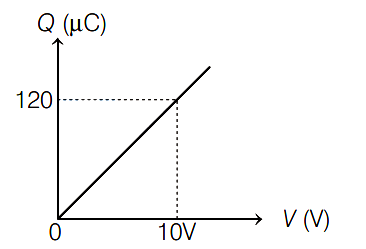
\( A \) and impedance is \( 1 \Omega \), what is the power factor of the \( A C \) circuit?KCET 2014 Easy - In figure, charge on the capacitor is plotted against potential difference across the capacitor. The capacitance and energy stored in the capacitor are respectively.
 KCET 2021 Medium
 - Match the following types of waves with their wavelength ranges
\(\begin{array}{|l|l|l|l|}\hline & \text{Waves} & & \text{Wavelength ranges} \\\hline \text{i}. & \text{Microwave} & \text{(a.)} & \text { } 700 \mathrm{~nm} \text { to } 400 \mathrm{~nm} \\\hline \text{ii.} & \text{Visible light} & \text{(b.)} & 1 \mathrm{~nm} \text { to } 10^{-3} \mathrm{~nm} \\\hline \text{iii.} & \text{Ultraviolet} & \text{(c.)} & 0.1 \mathrm{~m} \text { to } 1 \mathrm{~mm} \\\hline \text{iv.} & \text{X-rays} & \text{(d.)} & 400 \mathrm{~nm} \text { to } 1 \mathrm{~nm} \\\hline\end{array}\)KCET 2025 Easy - The refracting angle of prism is \(A\) and refractive index of material of prism is \(\cot \frac{A}{2}\). The angle of minimum deviation is \(A\)KCET 2020 Medium
- A person wants a real image of his own, \( 3 \) times enlarged. Where should he stand infront of a concave mirror of radius of curvature \( 30 \mathrm{~cm} \) ?KCET 2015 Easy
More PYQs from KCET
- The electronic configuration of \(\mathrm{Cr}^{3+}\) isKCET 2007 Medium
- In Prokaryotes the glycocalyx when it is thick is calledKCET 2015 Hard
- In F.C.C. the unit cell is shared equally by how many unit cells?KCET 2018 Easy
- The dc common emitter current gain of a n-p-n transistor is 50, The potential difference applied
across the collector and emitter of a transistor used in \( C E \) configuration is \( V_{C E}=2 V \). If the
collector resistance,
\( R_{C}=4 \mathrm{~K} \Omega \), the base current \( \left(I_{B}\right) \) and the collector current \( \left(I_{C}\right) \) areKCET 2018 Hard - Of the total incident solar radiation, the percentage of photosynthetically active radiation (PAR) captured by the plants isKCET 2019 Hard
- Conjunctive tissue is present between (i) and (ii) in (ⅲ).KCET 2018 Easy