


KCET · Physics · Ray Optics
A vessel of height \(2 d\) is half-filled with a liquid of refractive index \(\sqrt{2}\) and the other half with a liquid of refractive index \(n\) (the given liquids are immiscible). Then the apparent depth of the inner surface of the bottom of the vessel (neglecting the thickness of the bottom of the vessel) will be
- A \(\frac{n}{d(n+\sqrt{2})}\)
- B \(\frac{d(n+\sqrt{2})}{n \sqrt{2}}\)
- C \(\frac{\sqrt{2} n}{d(n+\sqrt{2})}\)
- D \(\frac{n d}{d+\sqrt{2 n}}\)
Answer & Solution
Correct Answer
(B) \(\frac{d(n+\sqrt{2})}{n \sqrt{2}}\)
Step-by-step Solution
Detailed explanation
Refractive index
\[
\mu=\frac{\text { Real depth }(d)}{\text { Apparent depth }(x x)}
\]
For 1st liquid, \(\sqrt{2}=\frac{d}{x_{1}}\)
\(\Rightarrow \quad x_{1}=\frac{d}{\sqrt{2}}\)
Similarly, for 2 nd liquid,
\[
n=\frac{d}{x_{2}} \Rightarrow x_{2}=\frac{d}{n}
\]
Total apparent depth \(=x_{1}+x_{2}\)
\[
=\frac{d}{\sqrt{2}}+\frac{d}{n}=\frac{d(n+\sqrt{2})}{n \sqrt{2}}
\]
\[
\mu=\frac{\text { Real depth }(d)}{\text { Apparent depth }(x x)}
\]
For 1st liquid, \(\sqrt{2}=\frac{d}{x_{1}}\)
\(\Rightarrow \quad x_{1}=\frac{d}{\sqrt{2}}\)
Similarly, for 2 nd liquid,
\[
n=\frac{d}{x_{2}} \Rightarrow x_{2}=\frac{d}{n}
\]
Total apparent depth \(=x_{1}+x_{2}\)
\[
=\frac{d}{\sqrt{2}}+\frac{d}{n}=\frac{d(n+\sqrt{2})}{n \sqrt{2}}
\]
See the Complete Solution
Get step-by-step explanations for this and 2.5 Lakh+ more JEE, NEET & CET questions.
- Unlock all solutions
- Practice the full chapter
- Track accuracy across PYQs
4.8 rated on Google Play · 14,000+ reviews
More questions from Physics
- A proton, a deuteron and an \( \alpha \) - particle are projected perpendicular to the direction of a
uniform magnetic field with same kinetic energy. The ratio of the radii of the circular paths
described by them isKCET 2017 Medium - A nucleus of mass \( 20 \mathrm{u} \) emits a \( \mathrm{y} \) photon of energy \( 6 \mathrm{MeV} \). If the emission assume to occur
when nucleus is free and rest, then the nucleus will have kinetic energy nearest to
(take \( 1 \mathrm{u}=1.6 \times 10^{-27} \mathrm{~kg} \) )KCET 2016 Hard - The energy gap of an LED is \(2.4 \mathrm{eV}\). When the LED is switched ON, the momentum of the emitted photons isKCET 2023 Easy
- Earth's magnetic field always has a horizontal component except atKCET 2021 Easy
- During inelastic collision between two objects, which of the following quantity always remains
conserved?KCET 2019 Easy - The difference between equivalent capacitances of two identical capacitors connected in parallel to that in series is \(6 \mu \mathrm{F}\). The value of capacitance of each capacitor isKCET 2020 Easy
More PYQs from KCET
- A hot body is allowed to cool. The surrounding temperature is constant at \(30^{\circ} \mathrm{C}\). The takes time \(t_{1}\) to cool from \(70^{\circ} \mathrm{C}\) to \(68^{\circ} \mathrm{C}\) and time \(t_{2}\) to cool from \(60^{\circ} \mathrm{C}\) to \(59.5^{\circ} \mathrm{C}\). ThenKCET 2012 Medium
- For Freundlich adsorption isotherm, a graph of \(\log (x / m)\) vs \(\log (p)\) gives a straight line. The slope of line and its \(Y\)-axis intercept respectively areKCET 2023 Easy
- The eccentricity of the ellipse \( 9 x^{2}+25 y^{2}=225 \) isKCET 2019 Easy
- Identify the enzyme that catalyses the step labelled as 'M' in the given schematic representation of replication of retrovirus.
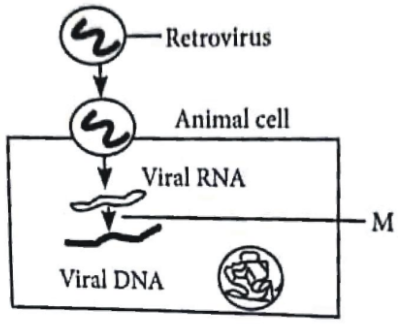 KCET 2019 Hard
 - Given that, \(A\) and \(B\) are two events such that \(P(B)=\frac{3}{5}, P\left(\frac{A}{B}\right)=\frac{1}{2}\) and \(P(A \cup B)=\frac{4}{5}\), then \(P(A)\) is equal toKCET 2021 Easy
- Let \(R\) be an equivalence relation defined on a set containing 6 elements. The minimum number or ordered pairs that \(R\) should contain isKCET 2010 Easy