


KCET · Physics · Atomic Physics
A polarized light of intensity \( I_{0} \) is passed through another polarizer whose pass axis makes an
angle of \( 60^{\circ} \) with the pass axis of the former. What is the intensity of emergent polarized light
from second polarizer?
- A \( \mathrm{O} I=I_{0} \)
- B \( I=I_{0} / 6 \)
- C \( O=I_{0} / 5 \)
- D \( I_{0} / 4 \)
Answer & Solution
Correct Answer
(D) \( I_{0} / 4 \)
Step-by-step Solution
Detailed explanation
According to Malus Law, we have
\[
I=I_{0} \cos ^{2} \theta
\]
where, \( I \) is intensity of emergent polarised light; \( I_{0} \) is intensity of incident polarised light; \( \theta \) is angle between pass axis of
both polarisers
Here \( \theta=60^{\circ} \)
Therefore \( I=I_{0}(\cos 60)^{2}=I_{0}\left(\frac{1}{2}\right)^{2}=\frac{I_{0}}{4} \)
Thus, intensity of emergent polarised light from second polarizer \( =\frac{I_{0}}{4} \)
\[
I=I_{0} \cos ^{2} \theta
\]
where, \( I \) is intensity of emergent polarised light; \( I_{0} \) is intensity of incident polarised light; \( \theta \) is angle between pass axis of
both polarisers
Here \( \theta=60^{\circ} \)
Therefore \( I=I_{0}(\cos 60)^{2}=I_{0}\left(\frac{1}{2}\right)^{2}=\frac{I_{0}}{4} \)
Thus, intensity of emergent polarised light from second polarizer \( =\frac{I_{0}}{4} \)
See the Complete Solution
Get step-by-step explanations for this and 2.5 Lakh+ more JEE, NEET & CET questions.
- Unlock all solutions
- Practice the full chapter
- Track accuracy across PYQs
4.8 rated on Google Play · 14,000+ reviews
More questions from Physics
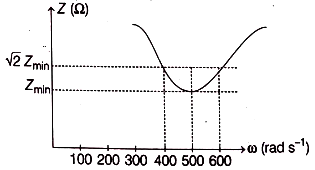
- Total impedance of a series \(L-C-R\) circuit varies with angular frequency of the \(\mathrm{AC}\) source connected to it as shown in the graph. The quality factor \(Q\) of the series \(L-C-R\) circuit is
 KCET 2023 Easy
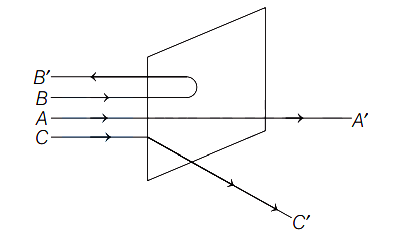
 - A beam of fast moving alpha particles were directed towards a thin film of gold. The parts \(A, B\) and \(C\) of the transmitted and reflected beams corresponding to the incident parts \(A, B\) and \(C\) of the beam are shown in the adjoining diagram. The number of alpha particles in
 KCET 2020 Medium
 - The equation of a simple harmonic wave is given by \(y=6 \sin 2 \pi(2 t-0.1 x)\), where and are in \(\mathrm{mm}\) and is in seconds. The phase difference between two particles \(2 \mathrm{~mm}\) apart at any instant isKCET 2008 Medium
- The equation of a wave is given by \(y=10 \sin \left(\frac{2 \pi}{45} t+\alpha\right)\). If the displacement is \(5 \mathrm{~cm}\) at \(t=0\), then the total phase at \(t=7.5 \mathrm{~s}\) isKCET 2011 Easy
- A stretched wire of a material whose young's modulus \(Y=2 \times 10^{11} \mathrm{Nm}^{-2}\) has poisson's ratio 0.25 . Its lateral strain \(\varepsilon_l=10^{-3}\). The elastic energy density of the wire isKCET 2023 Easy
- Maximum velocity of the photoelectron emitted by a metal is \(1.8 \times 10^{6} \mathrm{~ms}^{-1}\). Take the value of specific charge of the electron is \(1.8 \times 10^{11} \mathrm{C} \mathrm{kg}^{-1}\). Then the stopping potential in volt isKCET 2013 Easy
More PYQs from KCET
- The domain of the function \( f: R \rightarrow R \) defined by \( f(x)=\sqrt{x^{2}-7 x+12} \) isKCET 2019 Easy
- A radioactive element forms its own isotope after 3 consecutive disintegrations. The particles emitted areKCET 2007 Easy
- From the following table, select the option that correctly characterizes various phases of menstrual cycleKCET 2023 Hard
- A magnetic dipole of magnetic moment \( 6 \times 10^{-2} \mathrm{Am}^{2} \) and moment of inertia
\( 12 \times 10^{-6} \mathrm{~kg} \mathrm{~m}^{2} \) performs oscillations in a magnetic field of \( 2 \times 10^{-2} \mathrm{~T} \). The time taken by
the dipole to complete \( 20 \) oscillations is \( (\pi \simeq 3) \)KCET 2017 Medium - Dry ice isKCET 2018 Easy
- A cylindrical conductor of diameter \( 0.1 \mathrm{~mm} \) carries a current of \( 90 \mathrm{~mA} \). The current density (in \(\mathrm{Am}^{-2})\) is \( (\pi \simeq 3) \)KCET 2017 Hard