


KCET · Physics · Mechanical Properties of Solids
A stretched wire of a material whose young's modulus \(Y=2 \times 10^{11} \mathrm{Nm}^{-2}\) has poisson's ratio 0.25 . Its lateral strain \(\varepsilon_l=10^{-3}\). The elastic energy density of the wire is
- A \(16 \times 10^5 \mathrm{Jm}^{-3}\)
- B \(1 \times 10^5 \mathrm{Jm}^{-3}\)
- C \(4 \times 10^5 \mathrm{Jm}^{-3}\)
- D \(8 \times 10^5 \mathrm{Jm}^{-3}\)
Answer & Solution
Correct Answer
(A) \(16 \times 10^5 \mathrm{Jm}^{-3}\)
Step-by-step Solution
Detailed explanation
Given, Young's modulus, \(Y=2 \times 10^{11} \mathrm{Nm}^{-2}\)
Poisson ratio, \(\sigma=0.25\)
Lateral strain, \(\varepsilon_1=10^{-3}\)
Elastic potential energy density is given by, \(\mathrm{PE}\) \(=\frac{1}{2} \times Y \times(\text { strain })^2\)
Poisson ratio
\(\begin{aligned} & =\frac{\text { Lateral strain }}{\text { longitudinal strain }}=\frac{\varepsilon_1}{\text { longitudinal strain }} \\ & \Rightarrow \sigma=\frac{\varepsilon_1}{\text { longitudinal strain }} \\ & \Rightarrow \text { longitudinal strain }=\frac{\varepsilon_1}{\sigma}=\frac{10^{-3}}{0.25}=c \times 10^{-3}\end{aligned}\)
Elastic potential energy density \(=\frac{1}{2} \times Y \times\left(\frac{E_l}{\sigma}\right)^2\)
\(\begin{aligned} & =\frac{1}{2} \times 2 \times 10^{11} \times\left(4 \times 10^{-3}\right)^2 \\ & =10^{11} \times 16 \times 10^{-6}=16 \times 10^5 \mathrm{Jm}^{-3}\end{aligned}\)
Poisson ratio, \(\sigma=0.25\)
Lateral strain, \(\varepsilon_1=10^{-3}\)
Elastic potential energy density is given by, \(\mathrm{PE}\) \(=\frac{1}{2} \times Y \times(\text { strain })^2\)
Poisson ratio
\(\begin{aligned} & =\frac{\text { Lateral strain }}{\text { longitudinal strain }}=\frac{\varepsilon_1}{\text { longitudinal strain }} \\ & \Rightarrow \sigma=\frac{\varepsilon_1}{\text { longitudinal strain }} \\ & \Rightarrow \text { longitudinal strain }=\frac{\varepsilon_1}{\sigma}=\frac{10^{-3}}{0.25}=c \times 10^{-3}\end{aligned}\)
Elastic potential energy density \(=\frac{1}{2} \times Y \times\left(\frac{E_l}{\sigma}\right)^2\)
\(\begin{aligned} & =\frac{1}{2} \times 2 \times 10^{11} \times\left(4 \times 10^{-3}\right)^2 \\ & =10^{11} \times 16 \times 10^{-6}=16 \times 10^5 \mathrm{Jm}^{-3}\end{aligned}\)
See the Complete Solution
Get step-by-step explanations for this and 2.5 Lakh+ more JEE, NEET & CET questions.
- Unlock all solutions
- Practice the full chapter
- Track accuracy across PYQs
4.8 rated on Google Play · 14,000+ reviews
More questions from Physics
- In hydrogen atom, electron excites from ground state to higher energy state and its orbital velocity is reduced to \(\frac{1}{3}\) rd of its initial value. The radius of the orbit in the ground state is \(\mathrm{R}\).
The radius of the orbit in that higher energy state isKCET 2012 Hard - Light of certain frequency and intensity incident on a photosensitive material causes
photoelectric effect. If both the frequency and intensity are doubled, the photoelectric
saturation current becomesKCET 2019 Easy - On bombarding \(\mathrm{U}^{235}\) by slow neutron, \(200 \mathrm{MeV}\) energy is released. If the power output of atomic reactor is \(1.6 \mathrm{MW}\), then the rate of fission will beKCET 2008 Medium
- A Carnot's engine operates with source at \(127^{\circ} \mathrm{C}\) and sink at \(27^{\circ} \mathrm{C}\). If the source supplies \(40 \mathrm{~kJ}\) of heat energy, the work done by the engine isKCET 2007 Easy
- A jet plane having a wing span of \( 25 \mathrm{~m} \) is travelling horizontally towards east with a speed of
\( 3600 \mathrm{~km} / \mathrm{h}^{-1} \).If the Earth's magnetic field at the location is \( 4 \times 10^{-4} \mathrm{~T} \) and the angle of dip is
\( 30^{\circ} \), then the potential difference between the ends of the wing isKCET 2018 Hard - With reference to the figure shown below, match the following:

List-I List-II (a) Angle of reflection (i) \(60^\circ\) (b) Value of \(\alpha\) (ii) \(120^\circ\) (c) Angle of deviation (iii) \(30^\circ\) KCET 2026 Easy
More PYQs from KCET
- In the situation shown in the diagram, magnitude, if \(q<<|Q|\) and \(r \gg a\). The net force on the free charge \(-q\) and net torque on it about \(O\) at the instant shown are respectively. ( \(p=2 a Q\) is the dipole moment)
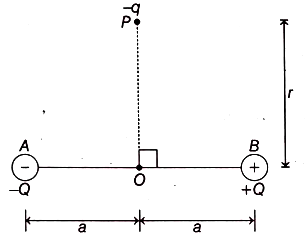 KCET 2023 Medium
 - The brain stem is made up ofKCET 2011 Medium
- For a transistor amplifier, the voltage gainKCET 2019 Medium
- Mass number of the elements A, B, C and D are \(30,60,90\) and 120 respectively. The specific binding energy of them are \(5 \mathrm{MeV}, 8.5 \mathrm{MeV}\), \(8 \mathrm{MeV}\) and \(7 \mathrm{MeV}\) respectively. Then, in which of the following reaction/s energy is released?
1. \(\mathrm{D} \rightarrow 2 \mathrm{~B}\)
2. \(\mathrm{C} \rightarrow \mathrm{B}+\mathrm{A}\)
3. \(\mathrm{B} \rightarrow 2 \mathrm{~A}\)KCET 2012 Medium - In a CE amplifier, the input ac signal to be amplified is applied acrossKCET 2018 Medium
- Sertoli cells are nourshing cells in the testis. They also secrete a hormone. Identify the same.KCET 2005 Hard