


KCET · Physics · Gravitation
A person is driving a vehicle at uniform speed of \( 5 \mathrm{~ms}^{-1} \) on a level curved track of radius \( 5 \mathrm{~m} \).
The coefficient of static friction between tyres and road is \( 0.1 \). Will the person slip while taking
the turn with the same speed? Take \( g=10 \mathrm{~ms}^{-2} \).
Choose the correct statement.
- A A person will slip if \( v^{2}=5 \mathrm{~ms}^{-1} \)
- B A person will slip if \( v^{2}>5 m s^{-1} \)
- C A person will slip if \( v^{2} < 5 m s^{-1} \)
- D A person will slip if \( v^{2}>10 \mathrm{~ms}^{-1} \)
Answer & Solution
Correct Answer
(B) A person will slip if \( v^{2}>5 m s^{-1} \)
Step-by-step Solution
Detailed explanation
Given, Speed of vehicle \(=5 \mathrm{~ms}^{-1}\), radius of track \(=5 \mathrm{~m}\), coefficient of static friction \(=0.1, \mathrm{~g}=10 \mathrm{~m} \mathrm{~s}-1\) maximum
speed without slipping in given as
\(\mathrm{v}_{\max }=\sqrt{\mu_{s} \times r \times g}\)
Substituting the values, we get
\(v_{\max }=\sqrt{0.1 \times 5 \times 10}=\sqrt{5} \Rightarrow v_{\max }^{2}=5\)
Thus, the person will slip while taking the turn with the speed greater than \(5 \mathrm{~ms}^{-1}\)
speed without slipping in given as
\(\mathrm{v}_{\max }=\sqrt{\mu_{s} \times r \times g}\)
Substituting the values, we get
\(v_{\max }=\sqrt{0.1 \times 5 \times 10}=\sqrt{5} \Rightarrow v_{\max }^{2}=5\)
Thus, the person will slip while taking the turn with the speed greater than \(5 \mathrm{~ms}^{-1}\)
See the Complete Solution
Get step-by-step explanations for this and 2.5 Lakh+ more JEE, NEET & CET questions.
- Unlock all solutions
- Practice the full chapter
- Track accuracy across PYQs
4.8 rated on Google Play · 14,000+ reviews
More questions from Physics
- The speed of sound in an ideal gas at a given temperature \(T\) is \(v\). The rms speed of gas molecules at that temperature is \(v_{\mathrm{rms}}\). The ratio of the velocities \(v\) and \(v_{\text {rms }}\) for helium and oxygen gases are \(X\) and \(X^{\prime}\). respectively. Then, \(\frac{X}{X^{\prime}}\) is equal toKCET 2023 Easy
- The \(p-V\) diagram of a Carnot's engine is shown in the graph below. The engine uses 1 mole of an ideal gas as working substance. From the graph, the area enclosed by the \(p\) - \(V\) diagram is [The heat supplied to the gas is \(8000 \mathrm{~J}\)]
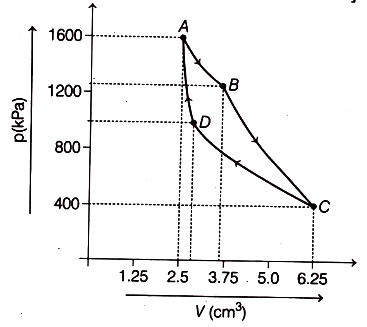 KCET 2023 Medium
 - Electrons in a certain energy level \(n=n_{1}\), can emit 3 spectral lines. When they are in another energy level, \(n=n_{2}\) they can emit 6 spectral lines. The orbital speed of the electrons in the orbits are in the ratioKCET 2007 Hard
- A sinusoidal voltage produced by an AC generator at any instant t is given by an equation \(\mathrm{V}=311 \sin 314\) t . The rms value of voltage and frequency are respectivelyKCET 2025 Easy
- An object is placed at the principle focus of a convex mirror. The image will be atKCET 2018 Easy
- What is the de Broglie wavelength of the electron accelerated through a potential difference of
\( 100 \) Volt?KCET 2014 Easy
More PYQs from KCET
- For one of the element various successive ionization enthalpies (in \( \mathrm{kJ} \mathrm{mol}^{-1} \) ) are given below
\(\begin{array}{|l|l|l|l|l|l|}
\hline \multirow{2}{*}{ I.E } & 1^{\text {st }} & 2^{\text {nd }} & 3^{\text {rd }} & 4^{\text {th }} & 5^{\text {th }} \\
\hline & 577.5 & 1810 & 2750 & 11,580 & 14,820 \\
\hline
\end{array}\)
The element isKCET 2015 Medium - The chord of the circle \(x^{2}+y^{2}-4 x=0\) which is bisected at \((1,0)\) is perpendicular to the lineKCET 2010 Easy
- A straight wire of length \( 50 \mathrm{~cm} \) carrying a current of \( 2.5 \mathrm{~A} \) is suspended in mid-air by a uniform magnetic field of \( 0.5 \mathrm{~T} \) (as shown in figure). The mass of the wire is \( \left(\mathrm{g}=10 \mathrm{~m} \mathrm{~s}^{-2}\right) \)KCET 2017 Hard
- For a transistor, \(\beta=100\). The value of \(\alpha\) isKCET 2012 Easy
- If \(a_1, a_2 ; a_3, \ldots, a_{10}\) is a geometric progression and \(\frac{a_3}{a_1}=25\), then \(\frac{a_9}{a_5}\) equalsKCET 2022 Easy
- \(1 \mathrm{dm}^{3}\) solution containing \(10^{-5}\) moles each of \(\mathrm{Cl}^{-}\)ions and \(\mathrm{CrO}_{4}^{2-}\) ions is treated with \(10^{-4}\) moles of silver nitrate. Which one of the following observations is made?
\(\begin{aligned} {\left[\mathrm{K}_{\mathrm{sp}} \mathrm{Ag}_{2} \mathrm{CrO}_{4}\right.} &\left.=4 \times 10^{-12}\right] \\ {\left[\mathrm{K}_{\mathrm{sp}} \mathrm{AgCl}\right.} &\left.=1 \times 10^{-10}\right] \end{aligned}\)KCET 2010 Medium