


KCET · Physics · Nuclear Physics
\(A\) and \(B\) are the two radioactive elements. The mixtue of these elements show a total activity of 1200 disintergrations/minute. The half-life of \(A\) is 1 day and that of \(B\) is 2 days. What will be the total activity after 4 days? Given, the initial number of atoms in \(A\) and \(B\) are equal
- A \(200 \mathrm{dis} / \mathrm{min}\)
- B \(250 \mathrm{dis} / \mathrm{min}\)
- C \(500 \mathrm{dis} / \mathrm{min}\)
- D \(150 \mathrm{dis} / \mathrm{min}\)
Answer & Solution
Correct Answer
(D) \(150 \mathrm{dis} / \mathrm{min}\)
Step-by-step Solution
Detailed explanation
We have, \(A=\lambda(N)=\frac{0.693}{T_{1 / 2}}(N)\)
Initial number of atoms is \(A\) and \(B\) are same
\(\therefore \quad A_{0} \propto \frac{1}{T_{1 / 2}}\)
\(\Rightarrow \quad \frac{A_{0}(A)}{A_{0}(B)}=\frac{48 \mathrm{hr}}{24 \mathrm{hr}}=2\)
Also, \(A_{0}(A)+A_{0}(B)=1200\)
\(\Rightarrow \quad 3 A_{0}(B)=1200\)
\(\Rightarrow \quad A_{0}(B)=400\)
and \(\quad A_{0}(A)=800\)
So, \(\quad A(A)=\frac{A_{0}(A)}{2^{4}}=\frac{800}{16}=50\)
and \(\quad A(B)=\frac{A_{b}(B)}{(2)^{2}}=\frac{400}{4}=100\)
Hence, total activity after 4 days is
\(=A_{0}(A)+A_{0}(B)=50+100=150 \mathrm{dis} / \mathrm{min}\)
Initial number of atoms is \(A\) and \(B\) are same
\(\therefore \quad A_{0} \propto \frac{1}{T_{1 / 2}}\)
\(\Rightarrow \quad \frac{A_{0}(A)}{A_{0}(B)}=\frac{48 \mathrm{hr}}{24 \mathrm{hr}}=2\)
Also, \(A_{0}(A)+A_{0}(B)=1200\)
\(\Rightarrow \quad 3 A_{0}(B)=1200\)
\(\Rightarrow \quad A_{0}(B)=400\)
and \(\quad A_{0}(A)=800\)
So, \(\quad A(A)=\frac{A_{0}(A)}{2^{4}}=\frac{800}{16}=50\)
and \(\quad A(B)=\frac{A_{b}(B)}{(2)^{2}}=\frac{400}{4}=100\)
Hence, total activity after 4 days is
\(=A_{0}(A)+A_{0}(B)=50+100=150 \mathrm{dis} / \mathrm{min}\)
See the Complete Solution
Get step-by-step explanations for this and 2.5 Lakh+ more JEE, NEET & CET questions.
- Unlock all solutions
- Practice the full chapter
- Track accuracy across PYQs
4.8 rated on Google Play · 14,000+ reviews
More questions from Physics
- Match the following Maxwell's equations:
(The symbols used here have their usual meanings)List-I List-II (a) Gauss' law for electrostatics (i) \(\oint \vec{E} \cdot d\vec{A} = \dfrac{Q}{\varepsilon_0}\) (b) Gauss' law for magnetism (ii) \(\oint \vec{B} \cdot d\vec{l} = \mu_0 \left[i_c + \varepsilon_0 \dfrac{d\phi_E}{dt}\right]\) (c) Faraday's law (iii) \(\oint \vec{B} \cdot d\vec{A} = 0\) (d) Ampere-Maxwell's law (iv) \(\oint \vec{E} \cdot d\vec{l} = -\dfrac{d\phi_B}{dt}\) KCET 2026 Easy - A glass tube is open at both the ends. A tuning fork of frequency \(f\) resonates with the air column inside the tube. Now the tube is placed vertically inside water so that half the length of the tube is filled with water. Now the air column inside the tube is in unison with another fork of frequency \(f^{\prime}\). ThenKCET 2007 Hard
- Eight drops of mercury of equal radii combine to form a big drop. The capacitance of a bigger drop as compared to each smaller drop isKCET 2021 Easy
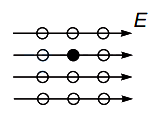
- There is a uniform electric field of intensity E which is as shown. How many labelled points have the same electric potential as the fully shaded point?
 KCET 2010 Easy
 - What is the de Broglie wavelength of the electron accelerated through a potential difference of
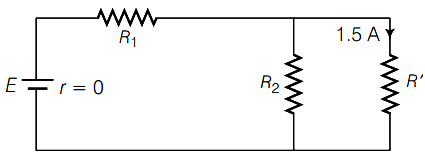
\( 100 \) Volt?KCET 2014 Easy - In the circuit, \(R_{1}=R_{2}\). The value of \(E\) and \(R_{1}\) are \(\ldots \ldots \ldots\left(E-\mathrm{EMF}, R_{1}-\right.\) resistance \()\)
 KCET 2013 Medium
More PYQs from KCET
- The trajectory of projectile isKCET 2021 Easy
- The value of \(\sin \left[2 \cos ^{-1} \frac{\sqrt{5}}{3}\right]\) isKCET 2007 Easy
- If \(f(x)=\left\{\begin{array}{l}2 a-x \text { when }-a < x < a \\ 3 x-2 a \text { when } a \leq x\end{array}\right.\).
Then, which of the following is true?KCET 2013 Medium - Two concentric coils each of radius equal to \( 2 \Pi \mathrm{cm} \) are placed right angles to each other. If \( 3 \mathrm{~A} \) and \( 4 \mathrm{~A} \) are the currents flowing through the two coils respectively. The magnetic induction (in \( \mathrm{Wb} \mathrm{m}^{-2} \) ) at the centre of the coils will beKCET 2015 Easy
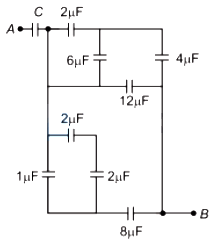
- In the given network, the valve of \(C\), so that an equivalent capacitance between points \(A\) and \(B\) is \(3 \mu \mathrm{F}\), is
 KCET 2011 Medium
 - The real value of ' \(\alpha\) ' for which \(\frac{1-i \sin \alpha}{1+2 i \sin \alpha}\) is purely real isKCET 2024 Medium