


KCET · Maths · Continuity and Differentiability
If \(f(x)=\left\{\begin{array}{l}2 a-x \text { when }-a < x < a \\ 3 x-2 a \text { when } a \leq x\end{array}\right.\).
Then, which of the following is true?
- A \(f(x)\) is not differentiable at \(x=a\)
- B \(f(x)\) is discontinuous at \(x=a\)
- C \(f(x)\) is continuous for all \(x < a\)
- D \(f(x)\) is differentiable for all \(x \geq a\)
Answer & Solution
Correct Answer
(A) \(f(x)\) is not differentiable at \(x=a\)
Step-by-step Solution
Detailed explanation
Given, \(f(x)=\left\{\begin{array}{l}2 a-x, \quad \text { when }-a < x < a \\ 3 x-2 a, \text { when } a \leq x\end{array}\right.\)
Now, \(f^{\prime}(x)=\left\{\begin{array}{cl}-1, & \text { when }-a < x < a \\ 3, & \text { when } a \leq x\end{array}\right.\) \(\because \quad L f^{\prime}(a)=-1\) and \(R f^{\prime}(a)=3\) i.e., \(\quad L f^{\prime}(a) \neq R f^{\prime}(a)\)
Hence, \(f(x)\) is not differentiable at \(x=a\).
Now, \(f^{\prime}(x)=\left\{\begin{array}{cl}-1, & \text { when }-a < x < a \\ 3, & \text { when } a \leq x\end{array}\right.\) \(\because \quad L f^{\prime}(a)=-1\) and \(R f^{\prime}(a)=3\) i.e., \(\quad L f^{\prime}(a) \neq R f^{\prime}(a)\)
Hence, \(f(x)\) is not differentiable at \(x=a\).
See the Complete Solution
Get step-by-step explanations for this and 2.5 Lakh+ more JEE, NEET & CET questions.
- Unlock all solutions
- Practice the full chapter
- Track accuracy across PYQs
4.8 rated on Google Play · 14,000+ reviews
More questions from Maths
- The right hand and left hand limit of the function are respectively.
\(f(x)=\left\{\begin{array}{cc}\frac{e^{1 / x}-1}{e^{1 / x}+1}, & \text { if } x \neq 0 \\ 0, & \text { if } x=0\end{array}\right.\)KCET 2020 Medium - The area enclosed by the curve \(x = \sqrt{3}\cos\theta, y = \sqrt{3}\sin\theta\) isKCET 2026 Easy
- If \(\alpha, \beta\) and \(\gamma\) are the roots of the equation \(x^{3}+4 x+2=0\), then \(\alpha^{3}+\beta^{3}+\gamma^{3}\) is equal toKCET 2012 Easy
- At \(x=1\), the function \(f(x)=\left\{\begin{array}{cc}x^{3}-1, & 1 < x < \infty \\ x-1, & -\infty < x \leq 1\end{array}\right.\) isKCET 2021 Easy
- The negation of the statement "All continuous functions are differentiable"KCET 2019 Easy
- The contrapositive of the converse of the statement "If \( x \) is a prime number then \( x \) is odd" isKCET 2016 Medium
More PYQs from KCET
- A radioactive nucleus has specific binding energy \(\mathrm{E}_{1}\). It emits an \(\alpha\)-particle. The resulting nucleus has specific binding energy \(\mathrm{E}_{2}\). ThenKCET 2012 Medium
- The following figure shows the stomatal apparatus. Identify the parts labelled as A, B, C and D.
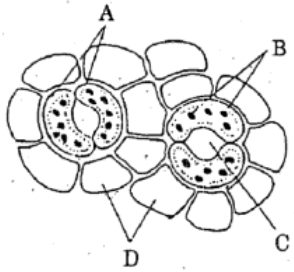
Choose the correct answer form the following.KCET 2005 Hard - In alkaline medium, alanine exists predominantly asKCET 2010 Easy
- \(20 \mathrm{~mL}\) of methane is completely burnt using \(50 \mathrm{~mL}\) of oxygen. The volume of the gas left after cooling to room temperature isKCET 2012 Medium
- The area of the region bounded by \( y \)-axis. \( y=\cos x \) and \( y=\sin x ; 0 \leq x \leq \frac{\pi}{2} \) isKCET 2019 Easy
- Which of the following has most acidic Hydrogen?KCET 2025 Medium