


KCET · Physics · Current Electricity
In the circuit, \(R_{1}=R_{2}\). The value of \(E\) and \(R_{1}\) are \(\ldots \ldots \ldots\left(E-\mathrm{EMF}, R_{1}-\right.\) resistance \()\)
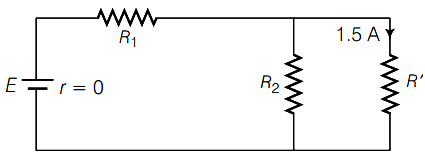
- A \(180 \mathrm{~V}, 60 \Omega\)
- B \(120 \mathrm{~V}, 60 \Omega\)
- C \(180 \mathrm{~V}, 10 \Omega\)
- D \(120 \mathrm{~V}, 10 \Omega\)
Answer & Solution
Correct Answer
(A) \(180 \mathrm{~V}, 60 \Omega\)
Step-by-step Solution
Detailed explanation
Applying Kirchoff's 2nd law in loop \(A B E F A\)
\(-I R-(I-1.5) R+E=0\)
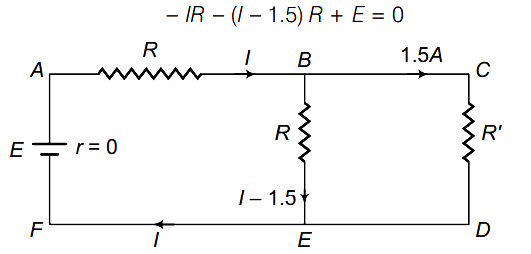
or \(E=I R+(I-1.5) R\)
\(\Rightarrow E=R[2 l-1.5]...(i)\)
Now apply KVL in loop \(A B C D E F A\),
\(\Rightarrow -I R-1.5 R^{\prime}+E=0\)
\(\Rightarrow E=I R+1.5 R^{\prime}...(ii)\)
Eliminating / from Equ. (i) and (ii),
\(\Rightarrow \frac{1}{2}\left[\frac{E}{R}+1.5\right]=1 \quad\) [from Eq. (i)]
and
\(\left[\frac{E-1.5 R^{\prime}}{R}\right]=1\quad\)[from Eq. (ii)]
So,
\(\frac{E}{R}+1.5=\frac{2}{R}\left[E-1.5 R^{\prime}\right]\)
\(-I R-(I-1.5) R+E=0\)
or \(E=I R+(I-1.5) R\)
\(\Rightarrow E=R[2 l-1.5]...(i)\)
Now apply KVL in loop \(A B C D E F A\),
\(\Rightarrow -I R-1.5 R^{\prime}+E=0\)
\(\Rightarrow E=I R+1.5 R^{\prime}...(ii)\)
Eliminating / from Equ. (i) and (ii),
\(\Rightarrow \frac{1}{2}\left[\frac{E}{R}+1.5\right]=1 \quad\) [from Eq. (i)]
and
\(\left[\frac{E-1.5 R^{\prime}}{R}\right]=1\quad\)[from Eq. (ii)]
So,
\(\frac{E}{R}+1.5=\frac{2}{R}\left[E-1.5 R^{\prime}\right]\)
See the Complete Solution
Get step-by-step explanations for this and 2.5 Lakh+ more JEE, NEET & CET questions.
- Unlock all solutions
- Practice the full chapter
- Track accuracy across PYQs
4.8 rated on Google Play · 14,000+ reviews
More questions from Physics
- A particle of mass \( 1 \mathrm{gm} \) and charge \( 1 \mu \mathrm{C} \) is held at rest on a frictionless horizontal surface at distance \( 1 \mathrm{~m} \) from the fixed charge \( 2 \mathrm{mC} \). If the particle is released, it will be repelled. The speed of the particle when it is at a distance of \( 10 \mathrm{~m} \) from the fixed chargeKCET 2016 Medium
- In the given circuit the peak voltage across \(C\), \(L\) and \(R\) are \(30 \mathrm{~V}, 110 \mathrm{~V}\) and \(60 \mathrm{~V}\), respectively. The rms value of the applied voltage is
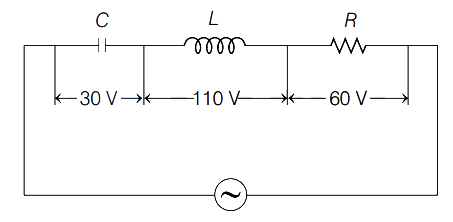 KCET 2020 Easy
 - Sound waves transferKCET 2009 Easy
- An object with mass \( 5 \mathrm{~kg} \) is acted upon by a force, \( \vec{F}=(-3 \hat{i}+4 \hat{j}) \mathrm{N} \). If its initial velocity at
\( \mathrm{t}=0 \) is \( \vec{v}=(6 \hat{i}-12 \hat{j}) \mathrm{ms}^{-1} \), the time at which it will just have a velocity along \( \mathrm{y} \)-axis isKCET 2019 Medium - Two identical conducting balls \(A\) and \(B\) have positive charges \(\mathrm{q}_{1}\) and \(\mathrm{q}_{2}\) respectively but \(\mathrm{q}_{1} \neq \mathrm{q}_{2}\). The balls are brought together so that they touch each other and then kept in their original positions. The force between them isKCET 2010 Hard
- A coil having 9 turns carrying a current produces magnetic field \(B_1\) at the centre. Now the coil is rewounded into 3 turns carrying same current. Then, the magnetic field at the centre \(B_2=\)KCET 2024 Medium
More PYQs from KCET
- \((\sin \theta+\cos \theta)(\tan \theta+\cot \theta)\) is equal toKCET 2010 Easy
- Which of the following is not related to drug-enzyme interaction?KCET 2020 Easy
- The term Uremia refers toKCET 2024 Easy
- Which one of the following statements is not correct about a plasmid?KCET 2016 Hard
- An unpolarised beam of intensity \(\mathrm{I}_{0}\) falls on a polaroid. The intensity of the emergent light isKCET 2008 Easy
- Which of the following aqueous solution has highest freezing point?KCET 2017 Hard