


KCET · Physics · Electromagnetic Waves
Match the following Maxwell's equations:
(The symbols used here have their usual meanings)
| List-I | List-II | ||
|---|---|---|---|
| (a) | Gauss' law for electrostatics | (i) | \(\oint \vec{E} \cdot d\vec{A} = \dfrac{Q}{\varepsilon_0}\) |
| (b) | Gauss' law for magnetism | (ii) | \(\oint \vec{B} \cdot d\vec{l} = \mu_0 \left[i_c + \varepsilon_0 \dfrac{d\phi_E}{dt}\right]\) |
| (c) | Faraday's law | (iii) | \(\oint \vec{B} \cdot d\vec{A} = 0\) |
| (d) | Ampere-Maxwell's law | (iv) | \(\oint \vec{E} \cdot d\vec{l} = -\dfrac{d\phi_B}{dt}\) |
- A a - i, b - iii, c - iv, d – ii
- B a - ii, b - iii, c - i, d – iv
- C a - i, b - ii, c - iii, d – iv
- D a - ii, b - iii, c - iv, d – i
Answer & Solution
Correct Answer
(A) a - i, b - iii, c - iv, d – ii
Step-by-step Solution
Detailed explanation
Gauss' law for electrostatics relates the electric flux through a closed surface to the enclosed charge: \(\oint \vec{E} \cdot d\vec{A} = \dfrac{Q}{\varepsilon_0}\).
Gauss' law for magnetism states that the net magnetic flux through any closed surface is zero: \(\oint \vec{B} \cdot d\vec{A} = 0\).
Faraday's law of induction relates the induced electric field along a closed loop to the rate of change of magnetic flux through the loop: \(\oint \vec{E} \cdot d\vec{l} = -\dfrac{d\phi_B}{dt}\).
Ampere-Maxwell's law relates the magnetic field along a closed loop to the conduction current and the rate of change of electric flux (displacement current): \(\oint \vec{B} \cdot d\vec{l} = \mu_0 \left[i_c + \varepsilon_0 \dfrac{d\phi_E}{dt}\right]\).
Thus, the correct matching is a - i, b - iii, c - iv, d - ii.
Answer: a - i, b - iii, c - iv, d – ii
Gauss' law for magnetism states that the net magnetic flux through any closed surface is zero: \(\oint \vec{B} \cdot d\vec{A} = 0\).
Faraday's law of induction relates the induced electric field along a closed loop to the rate of change of magnetic flux through the loop: \(\oint \vec{E} \cdot d\vec{l} = -\dfrac{d\phi_B}{dt}\).
Ampere-Maxwell's law relates the magnetic field along a closed loop to the conduction current and the rate of change of electric flux (displacement current): \(\oint \vec{B} \cdot d\vec{l} = \mu_0 \left[i_c + \varepsilon_0 \dfrac{d\phi_E}{dt}\right]\).
Thus, the correct matching is a - i, b - iii, c - iv, d - ii.
Answer: a - i, b - iii, c - iv, d – ii
See the Complete Solution
Get step-by-step explanations for this and 2.5 Lakh+ more JEE, NEET & CET questions.
- Unlock all solutions
- Practice the full chapter
- Track accuracy across PYQs
4.8 rated on Google Play · 14,000+ reviews
More questions from Physics
- A direct current I flows along the length of an infinitely long straight thin walled pipe, then the magnetic field isKCET 2009 Easy
- If a velocity has both perpendicular and parallel components while moving through a magnetic field, what is the path followed by a charged particle?KCET 2014 Medium
- A series combination of resistor \((R)\), capacitor (C) is connected to an A.C. source of angular frequency \(\omega\). Keeping the voltage same, if the frequency is changed to \(\omega / 3\), the current becomes half of the original current. Then the ratio of the capacitive reactance and resistance at the former frequency isKCET 2013 Medium
- The potential difference between and in the following figure is
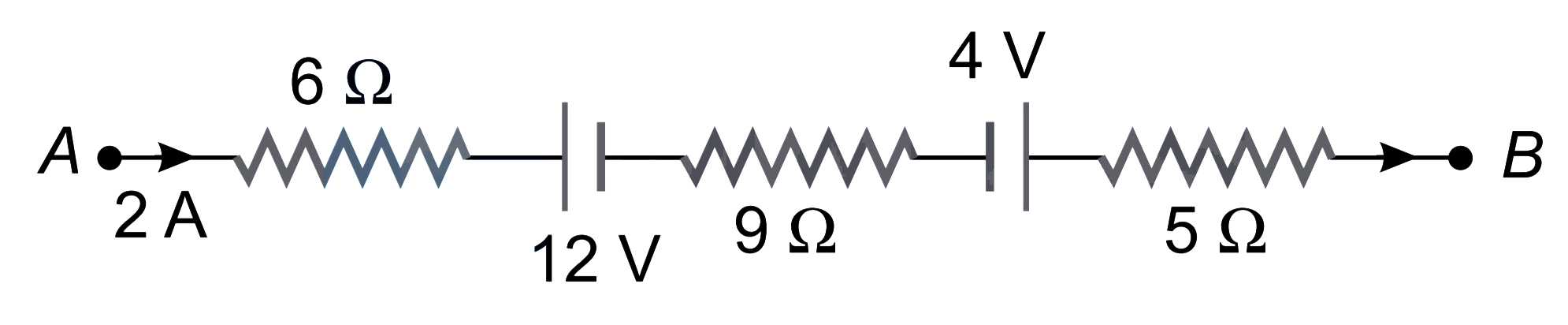 KCET 2008 Hard
 - The waves set up in a closed pipe areKCET 2017 Easy
- A copper wire of length \(1 \mathrm{~m}\) and uniform cross-sectional area \(5 \times 10^{-7} \mathrm{~m}^{2}\) carries a current of \(1 \mathrm{~A}\). Assuming that, there are \(8 \times 10^{28}\) free electrons per \(\mathrm{m}^{3}\) in copper, how long will an electron take to drift from one end of the wire to the other?KCET 2021 Hard
More PYQs from KCET
- A better reagent to oxidise primary alcohols into aldehyde isKCET 2023 Easy
- In an LCR circuit, at resonanceKCET 2015 Easy
- In a population of plants, some were extremely tall, and the remaining were extremely dwarf. No plants of the population showed intermediate height. The type of operation of natural selection in the above case isKCET 2020 Hard
- Maximum velocity of the photoelectron emitted by a metal is \(1.8 \times 10^{6} \mathrm{~ms}^{-1}\). Take the value of specific charge of the electron is \(1.8 \times 10^{11} \mathrm{C} \mathrm{kg}^{-1}\). Then the stopping potential in volt isKCET 2013 Easy
- If the area of the auxillary circle of the ellipse \(\frac{x^{2}}{a^{2}}+\frac{y^{2}}{b^{2}}=1(\) where, \(a>b)\) is twice the area of the ellipse, then the eccentricity of the ellipse isKCET 2013 Medium
- The value of \(\left|\begin{array}{lll}\sin ^2 14^{\circ} & \sin ^2 66^{\circ} & \tan 135^{\circ} \\ \sin ^2 66^{\circ} & \tan 135^{\circ} & \sin ^2 14^{\circ} \\ \tan 135^{\circ} & \sin ^2 14^{\circ} & \sin ^2 66^{\circ}\end{array}\right|\) isKCET 2023 Hard