


KCET · Maths · Complex Number
If \(P\) is the point in the Agrand diagram corresponding to the complex number \(\sqrt{3}+i\) and if \(O P Q\) is an isosceles right angled triangle, right angled at ' \(O\) ', then \(Q\) represents the complex number
- A \(-1+i \sqrt{3}\) or \(1-i \sqrt{3}\)
- B \(1 \pm \mathrm{i} \sqrt{3}\)
- C \(\sqrt{3}-\mathrm{i}\) or \(1-\mathrm{i} \sqrt{3}\)
- D \(-1 \pm \mathrm{i} \sqrt{3}\)
Answer & Solution
Correct Answer
(A) \(-1+i \sqrt{3}\) or \(1-i \sqrt{3}\)
Step-by-step Solution
Detailed explanation
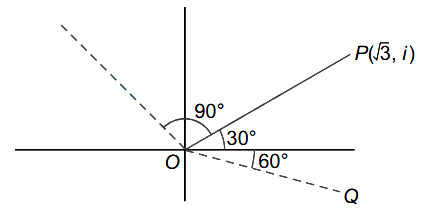
Let \(z=\sqrt{3}+i\)
\(
\begin{aligned}
\therefore \quad \arg (\mathrm{z}) &=\tan ^{-1}\left(\frac{1}{\sqrt{3}}\right) \\
&=30^{\circ}
\end{aligned}
\)
For making a right angled triangle OPQ, point \(Q\) either in IInd quadrant or IVth quadrant.
If the point \(Q\) is in Ind quadrant, then we take \(\theta=120^{\circ}\)
\(
\begin{aligned}
\therefore \quad \tan 120^{\circ} &=-\cot 30^{\circ} \\
&=\frac{\sqrt{3}}{-1}
\end{aligned}
\)
\(\therefore\) Point \(Q\) is \((-1, \sqrt{3})\) and if the point \(Q\) is in IVth quadrant, then we take
\(
\begin{aligned}
\theta &=-60^{\circ} \\
\therefore \quad \tan \left(-60^{\circ}\right) &=-\tan 60^{\circ} \\
&=-\frac{1}{\sqrt{3}}
\end{aligned}
\)
\(\therefore\) Point \(\mathrm{Q}\) is \((1,-\sqrt{3})\).
Hence, option (a) is correct.
\(
\begin{aligned}
\therefore \quad \arg (\mathrm{z}) &=\tan ^{-1}\left(\frac{1}{\sqrt{3}}\right) \\
&=30^{\circ}
\end{aligned}
\)
For making a right angled triangle OPQ, point \(Q\) either in IInd quadrant or IVth quadrant.
If the point \(Q\) is in Ind quadrant, then we take \(\theta=120^{\circ}\)
\(
\begin{aligned}
\therefore \quad \tan 120^{\circ} &=-\cot 30^{\circ} \\
&=\frac{\sqrt{3}}{-1}
\end{aligned}
\)
\(\therefore\) Point \(Q\) is \((-1, \sqrt{3})\) and if the point \(Q\) is in IVth quadrant, then we take
\(
\begin{aligned}
\theta &=-60^{\circ} \\
\therefore \quad \tan \left(-60^{\circ}\right) &=-\tan 60^{\circ} \\
&=-\frac{1}{\sqrt{3}}
\end{aligned}
\)
\(\therefore\) Point \(\mathrm{Q}\) is \((1,-\sqrt{3})\).
Hence, option (a) is correct.
See the Complete Solution
Get step-by-step explanations for this and 2.5 Lakh+ more JEE, NEET & CET questions.
- Unlock all solutions
- Practice the full chapter
- Track accuracy across PYQs
4.8 rated on Google Play · 14,000+ reviews
More questions from Maths
- The perimeter of a sector is a constant. If its area is to be maximum, then the sectorial angle isKCET 2012 Hard
- \( \int_{0}^{\pi / 4} \log \left(\frac{\sin x+\cos x}{\cos x}\right) d x \)KCET 2015 Medium
- The equation of a hyperbola whose asymptotes are \(3 x \pm 5 y=0\) and vertices are \((\pm 5,0)\) isKCET 2011 Medium
- The range of the function \(f(x)=\sin [x],-\frac{\pi}{4} < x < \frac{\pi}{4}\), where \([x]\) denotes the greatest integer \(\leq x\), isKCET 2013 Easy
- If \( A=\frac{1}{\Pi}\left[\begin{array}{ll}\sin ^{-1}(\Pi x) & \tan ^{-1}\left(\frac{x}{I I}\right) \\ \tan ^{-1}\left(\frac{x}{I I}\right) & \cot ^{-1}(\Pi x)\end{array}\right] \) then \( A-B \) isKCET 2017 Medium
- The distance between the two planes \(2 x+3 y+4 z=4\) and \(4 x+6 y+8 z=12\) isKCET 2024 Easy
More PYQs from KCET
- \(2 \mathrm{HI}(\mathrm{g}) \rightleftharpoons \mathrm{H}_{2}(\mathrm{~g})+\mathrm{I}_{2}(\mathrm{~g})\)
The equilibrium constant of the above reaction is \(6.4\) at \(300 \mathrm{~K}\). If \(0.25\) mole each of \(\mathrm{H}_{2}\) and \(\mathrm{I}_{2}\) are added to the system, the equilibrium constant will beKCET 2009 Medium - Match the reagents in List-I with products obtained from their carbonyl compounds in List-II.
List-I List-II (a) \(\text{NH}_2\text{OH}\) (i) Cyanohydrin (b) \(R-\text{NH}_2\) (ii) Oxime (c) \(R-\text{OH}\) (iii) Schiff base (d) \(H-C \equiv N\) (iv) Acetal KCET 2026 Medium - In prokaryotes, the transcription of DNA is initiated with the help ofKCET 2019 Medium
- A charged particle is subjected to acceleration in a cyclotron as shown. The charged particle undergoes increase in its speed
 KCET 2023 Easy
 - \(80 \mathrm{~g}\) of oxygen contains as many atoms as inKCET 2008 Easy
- According to Newton's corpuscular theory, the speed of light isKCET 2009 Easy