


KCET · Chemistry · Aldehydes and Ketones
Match the reagents in List-I with products obtained from their carbonyl compounds in List-II.
| List-I | List-II | ||
|---|---|---|---|
| (a) | \(\text{NH}_2\text{OH}\) | (i) | Cyanohydrin |
| (b) | \(R-\text{NH}_2\) | (ii) | Oxime |
| (c) | \(R-\text{OH}\) | (iii) | Schiff base |
| (d) | \(H-C \equiv N\) | (iv) | Acetal |
- A a-ii, b-iii, c-iv, d-i
- B a-i, b-ii, c-iii, d-iv
- C a-iii, b-ii, c-i, d-iv
- D a-i, b-iii, c-ii, d-iv
Answer & Solution
Correct Answer
(A) a-ii, b-iii, c-iv, d-i
Step-by-step Solution
Detailed explanation
Reaction of carbonyl compounds with various reagents yields specific products:
(a) Reaction with hydroxylamine (\(\text{NH}_2\text{OH}\)) forms an oxime.
\(\text{C=O} + \text{NH}_2\text{OH} \rightarrow \text{C=N-OH} + \text{H}_2\text{O}\)
(b) Reaction with a primary amine (\(R-\text{NH}_2\)) forms a substituted imine, also known as a Schiff base.
\(\text{C=O} + R-\text{NH}_2 \rightarrow \text{C=N}-R + \text{H}_2\text{O}\)
(c) Reaction with an alcohol (\(R-\text{OH}\)) in the presence of dry HCl gas forms a hemiacetal, which further reacts with another molecule of alcohol to form an acetal.
\(\text{RCHO} + 2R'\text{OH} \rightarrow \text{RCH(OR')}_2 + \text{H}_2\text{O}\)
(d) Reaction with hydrogen cyanide (\(\text{HCN}\)) forms a cyanohydrin.
\(\text{C=O} + \text{HCN} \rightarrow \text{C(OH)(CN)}\)
Thus, the correct matching is (a)-(ii), (b)-(iii), (c)-(iv), (d)-(i).
Answer: a-ii, b-iii, c-iv, d-i
(a) Reaction with hydroxylamine (\(\text{NH}_2\text{OH}\)) forms an oxime.
\(\text{C=O} + \text{NH}_2\text{OH} \rightarrow \text{C=N-OH} + \text{H}_2\text{O}\)
(b) Reaction with a primary amine (\(R-\text{NH}_2\)) forms a substituted imine, also known as a Schiff base.
\(\text{C=O} + R-\text{NH}_2 \rightarrow \text{C=N}-R + \text{H}_2\text{O}\)
(c) Reaction with an alcohol (\(R-\text{OH}\)) in the presence of dry HCl gas forms a hemiacetal, which further reacts with another molecule of alcohol to form an acetal.
\(\text{RCHO} + 2R'\text{OH} \rightarrow \text{RCH(OR')}_2 + \text{H}_2\text{O}\)
(d) Reaction with hydrogen cyanide (\(\text{HCN}\)) forms a cyanohydrin.
\(\text{C=O} + \text{HCN} \rightarrow \text{C(OH)(CN)}\)
Thus, the correct matching is (a)-(ii), (b)-(iii), (c)-(iv), (d)-(i).
Answer: a-ii, b-iii, c-iv, d-i
See the Complete Solution
Get step-by-step explanations for this and 2.5 Lakh+ more JEE, NEET & CET questions.
- Unlock all solutions
- Practice the full chapter
- Track accuracy across PYQs
4.8 rated on Google Play · 14,000+ reviews
More questions from Chemistry
- -propyl bromide on treating with alcoholic \(\mathrm{KOH}\) producesKCET 2008 Medium
- For an ideal binary liquid mixtureKCET 2014 Medium
- An aqueous solution of \( \mathrm{CuSO}_{4} \) is subjected to electrolysis using inert electrodes. The \( \mathrm{pH} \) of
the solution willKCET 2019 Medium - The major product of the following reaction is \(\mathrm{CH}_{2}=\mathrm{CH}-\mathrm{CH}_{2}-\mathrm{OH} \underset{\text { Excess }}{\stackrel{\mathrm{HBr}}{\longrightarrow}}\) ProductKCET 2021 Medium
- Excess of \(\mathrm{PCl}_{5}\) reacts with conc \(\mathrm{H}_{2} \mathrm{SO}_{4}\) givingKCET 2008 Medium
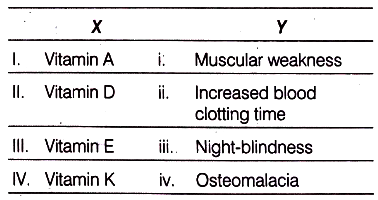
- The correct order of match between column \(X\) and column \(Y\) is
 KCET 2023 Hard
More PYQs from KCET
- In the periodic table metals usually used as catalysts belong toKCET 2007 Medium
- In the following pairs, the one in which both transition metal ions are colourless isKCET 2025 Medium
- Vapour pressure of pure 'A' is \(70 \mathrm{~mm}\) of \(\mathrm{Hg}\) at \(25^{\circ} \mathrm{C}\). It forms an ideal solution with ' \(B\) ' in which mole fraction of \(A\) is \(0.8\). If the vapour pressure of the solution is \(84 \mathrm{~mm}\) of \(\mathrm{Hg}\) at \(25^{\circ} \mathrm{C}\), the vapour pressure of pure ' \(B\) ' at \(25^{\circ} \mathrm{C}\) isKCET 2009 Easy
- Which of the following hormones is not secreted by human placenta?KCET 2024 Easy
- For the reversible reaction, \(A(s)+B(g) \rightleftharpoons\) \(C(g)+D(g), \Delta G^{\circ}=-350 \mathrm{~kJ}\), which one of the following statements is true?KCET 2011 Medium
- The enzymes which are absolutely necessary for recombinant DNA technology areKCET 2012 Medium