


KCET · Maths · Circle
The perimeter of a sector is a constant. If its area is to be maximum, then the sectorial angle is
- A \(\frac{\pi^{c}}{6}\)
- B \(\frac{\pi^{c}}{4}\)
- C \(4^{\mathrm{c}}\)
- D \(2^{\mathrm{c}}\)
Answer & Solution
Correct Answer
(D) \(2^{\mathrm{c}}\)
Step-by-step Solution
Detailed explanation
Let \(r\) be the radius and \(\theta\) be the sectorial angle. \(\therefore\) Perimeter of sector,
\(\begin{aligned} & k=2 r+\frac{\theta}{180^{\circ}} \pi r \\ \Rightarrow \quad & r=\frac{k}{2+\frac{\theta \pi}{180^{\circ}}} \end{aligned}\)
\(\begin{aligned} \therefore \text { Area of sector, } \mathrm{A} &=\frac{\theta}{360^{\circ}} \pi \mathrm{r}^{2} \\ &=\frac{\pi}{360^{\circ}}\left[\theta \times\left(\frac{\mathrm{k}}{2+\frac{\pi \theta}{180^{\circ}}}\right)^{2}\right] \\ \Rightarrow \quad \mathrm{A} &=\frac{\mathrm{k}^{2} \pi}{360^{\circ}}\left[\theta \times\left(2+\frac{\pi \theta}{180^{\circ}}\right)^{-2}\right] \end{aligned}\)
On differentiating w.r.t. ' \(\theta\) ', we get
\[
\begin{aligned}
\frac{\mathrm{dA}}{\mathrm{d} \theta}=& \frac{\mathrm{k}^{2} \pi}{360^{\circ}}\left[1 \times\left(2+\frac{\pi \theta}{180^{\circ}}\right)^{-2}-2\left(2+\frac{\pi \theta}{180^{\circ}}\right)^{-3}\right.\\
&\left.=\frac{\mathrm{k}^{2} \pi}{360^{\circ}}\left(2+\frac{\pi \theta}{180^{\circ}}\right)^{-2}\left[1-\frac{\pi}{180^{\circ}}\right)\right] \\
&=\frac{\mathrm{k}^{2} \pi}{360^{\circ}}\left(2+\frac{\pi \theta}{180^{\circ}}\right)^{-3}\left[2-\frac{\pi \theta}{180^{\circ}}\right] \\
\text { Put } \left.\frac{\mathrm{dA}}{\mathrm{d} \theta}=0 \Rightarrow 2-\frac{\pi \theta}{180^{\circ}}\right] \\
\Rightarrow \quad \theta=\frac{2 \times 180^{\circ}}{\pi}=2^{\circ}
\end{aligned}
\]
At \(\theta=2^{c}, \quad \frac{d^{2} \mathrm{~A}}{d \theta^{2}} < 0\) (maximum)
\(\begin{aligned} & k=2 r+\frac{\theta}{180^{\circ}} \pi r \\ \Rightarrow \quad & r=\frac{k}{2+\frac{\theta \pi}{180^{\circ}}} \end{aligned}\)
\(\begin{aligned} \therefore \text { Area of sector, } \mathrm{A} &=\frac{\theta}{360^{\circ}} \pi \mathrm{r}^{2} \\ &=\frac{\pi}{360^{\circ}}\left[\theta \times\left(\frac{\mathrm{k}}{2+\frac{\pi \theta}{180^{\circ}}}\right)^{2}\right] \\ \Rightarrow \quad \mathrm{A} &=\frac{\mathrm{k}^{2} \pi}{360^{\circ}}\left[\theta \times\left(2+\frac{\pi \theta}{180^{\circ}}\right)^{-2}\right] \end{aligned}\)
On differentiating w.r.t. ' \(\theta\) ', we get
\[
\begin{aligned}
\frac{\mathrm{dA}}{\mathrm{d} \theta}=& \frac{\mathrm{k}^{2} \pi}{360^{\circ}}\left[1 \times\left(2+\frac{\pi \theta}{180^{\circ}}\right)^{-2}-2\left(2+\frac{\pi \theta}{180^{\circ}}\right)^{-3}\right.\\
&\left.=\frac{\mathrm{k}^{2} \pi}{360^{\circ}}\left(2+\frac{\pi \theta}{180^{\circ}}\right)^{-2}\left[1-\frac{\pi}{180^{\circ}}\right)\right] \\
&=\frac{\mathrm{k}^{2} \pi}{360^{\circ}}\left(2+\frac{\pi \theta}{180^{\circ}}\right)^{-3}\left[2-\frac{\pi \theta}{180^{\circ}}\right] \\
\text { Put } \left.\frac{\mathrm{dA}}{\mathrm{d} \theta}=0 \Rightarrow 2-\frac{\pi \theta}{180^{\circ}}\right] \\
\Rightarrow \quad \theta=\frac{2 \times 180^{\circ}}{\pi}=2^{\circ}
\end{aligned}
\]
At \(\theta=2^{c}, \quad \frac{d^{2} \mathrm{~A}}{d \theta^{2}} < 0\) (maximum)
See the Complete Solution
Get step-by-step explanations for this and 2.5 Lakh+ more JEE, NEET & CET questions.
- Unlock all solutions
- Practice the full chapter
- Track accuracy across PYQs
4.8 rated on Google Play · 14,000+ reviews
More questions from Maths
- The integrating factor of \( \frac{d y}{d x}+y=\frac{1+y}{x} \) isKCET 2018 Medium
- A sphere increases its volume at the rate of \(\pi \mathrm{cc} / \mathrm{s}\). The rate at which its surface area increases when the radius is \(1 \mathrm{~cm}\) isKCET 2011 Medium
- The characteristic roots of the matrix \(\left[\begin{array}{ccc}1 & 0 & 0 \\ 2 & 3 & 0 \\ 4 & 5 & 6\end{array}\right]\) areKCET 2008 Easy
- \(\lim _{x \rightarrow 1} \frac{\tan \left(x^{2}-1\right)}{x-1}\) is equal toKCET 2007 Easy
- The range in which \(y=-x^{2}+6 x-3\) is increasing isKCET 2007 Easy
- If \( 3 \tan ^{-1} x+\cot ^{-1}=\pi \) then \( x \) equal toKCET 2016 Easy
More PYQs from KCET
- The diagram of Labeo rohita is given below. Identify the parts labelled A, B, C, D, E, F, G.
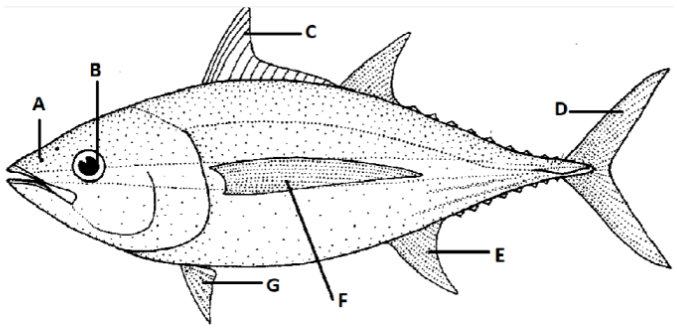 KCET 2010 Medium
 - \( \int_{0}^{\pi / 4} \log \left(\frac{\sin x+\cos x}{\cos x}\right) d x \)KCET 2015 Medium
- Which of the following statements is correct for an n-type semiconductor?KCET 2025 Easy
- If \(\sec ^{-1}\left(\frac{1+x}{1-y}\right)=a\), then \(\frac{d y}{d x}\) isKCET 2007 Medium
- \( 1 \) mole of \( \mathrm{NaCl} \) is doped with \( 10^{-5} \) mole of \( \mathrm{SrCl}_{2} . \) The number of cationic vacancies in the
crystal lattice will be:KCET 2019 Medium - Average natality rate in our village is 25, average mortality is 24, immigration 2 and emigration 3 and the net increase in population isKCET 2022 Easy