


KCET · Maths · Permutation Combination
If \( f(x)=x^{3} \) and \( g(x)=x^{3}-4 x \) in \( -2 \leq x \leq 2 \), then consider the statements:
(a) \( f(x) \) and \( g(x) \) satisfy mean value theorem.
(b) \( f(x) \) and \( g(x) \) both satisfy Rolle's theorem.
(c) Only \( g(x) \) satisfies Rolle's theorem.
Of these statements
- A (a) alone is cortect
- B (a) and (c) are correct.
- C (a) and (b) are correct.
- D None is correct.
Answer & Solution
Correct Answer
(B) (a) and (c) are correct.
Step-by-step Solution
Detailed explanation
Given that, \(f(x)=x^{3}\) and \(g(x)=x^{3}-4 x\)
Since, \(f(x)\) and \(g(x)\) are both continuous at \([-2,2]\) and differentiable at \([-2,2]\)
So, \(f(x)\) and \(g(x)\) satisfy mean value theorem.
Now, \(f(-2)=-8, f(2)=8\)
So, \(f(-2) \neq f(2)\)
\(g(2)=(2)^{3}-4(2)=0=g(-2)=(-2)^{3}-4(-2)=0\)
Therefore, \(f(x)\) does not satisfy Rolle's theorem but \(g(x)\) satisfy Rolle's theorem.
Since, \(f(x)\) and \(g(x)\) are both continuous at \([-2,2]\) and differentiable at \([-2,2]\)
So, \(f(x)\) and \(g(x)\) satisfy mean value theorem.
Now, \(f(-2)=-8, f(2)=8\)
So, \(f(-2) \neq f(2)\)
\(g(2)=(2)^{3}-4(2)=0=g(-2)=(-2)^{3}-4(-2)=0\)
Therefore, \(f(x)\) does not satisfy Rolle's theorem but \(g(x)\) satisfy Rolle's theorem.
See the Complete Solution
Get step-by-step explanations for this and 2.5 Lakh+ more JEE, NEET & CET questions.
- Unlock all solutions
- Practice the full chapter
- Track accuracy across PYQs
4.8 rated on Google Play · 14,000+ reviews
More questions from Maths
- A particle starts form rest and its angular displacement (in radians) is given by \(\theta=\frac{t^{2}}{20}+\frac{t}{5}\). If the angular velocity at the end of \(t=4\) is \(k\), then the value of \(5 k\) isKCET 2021 Easy
- \((\sin \theta+\cos \theta)(\tan \theta+\cot \theta)\) is equal toKCET 2010 Easy
- If \(\tan A+\cot A=2\), then the value of \(\tan ^{4} A+\cot ^{4} A=\)KCET 2020 Easy
- Two cards are drawn at random from a pack of \( 52 \) cards. The probability of these two being
'Aces" isKCET 2016 Easy - A line passes through \((2,2)\) and is perpendicular to the line \(3 x+y=3\). Its \(y\)-intercept isKCET 2023 Easy
- If the parabola \(x^{2}=4 a y\) passes through the point \((2,1)\), then the length of the latus rectum isKCET 2020 Easy
More PYQs from KCET
- \(\mathrm{p} \rightarrow \sim \mathrm{q}\) can also be written asKCET 2012 Easy
- The unit cell with crystallographic dimensions, \( a \neq b \neq c, \alpha=y=90^{\circ} \) and \( \beta \neq 90^{\circ} \) isKCET 2015 Easy
- If \(A\) and \(B\) are events, such that \(P(A)=\frac{1}{4}\) \(P(A / B)=\frac{1}{2}\) and \(P(B / A)=\frac{2}{3}\), then \(P(B)\) isKCET 2023 Easy
- The enzymes which are absolutely necessary for recombinant DNA technology areKCET 2012 Medium
- If \(\cos \alpha+2 \cos \beta+3 \cos \gamma=0\),
\(\sin \alpha+2 \sin \beta+3 \sin \gamma=0\) and \(\alpha+\beta+\gamma=\pi\), then \(\sin 3 \alpha+8 \sin 3 \beta+27 \sin 3 \gamma\) is equal toKCET 2012 Medium -
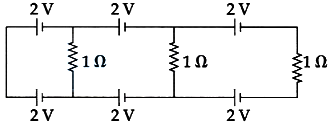
In the above circuit the current in each resistance is:KCET 2009 Hard