


KCET · Maths · Continuity and Differentiability
If
\(f(x)=\left\{\begin{array}{cl}\frac{\left.x^{2}-(a+2) x+a\right)}{x-2} & x \neq 2 \\ 2 & , x=2\end{array} \quad\right.\) is continuous at \(x=2\), then the value of \(a\) is
- A \(-6\)
- B 0
- C 1
- D \(-1\)
Answer & Solution
Correct Answer
(B) 0
Step-by-step Solution
Detailed explanation
Given, \(\mathrm{f}(\mathrm{x})=\left\{\begin{array}{cc}\frac{\mathrm{x}^{2}-(\mathrm{a}+2) \mathrm{x}+\mathrm{a}}{\mathrm{x}-2}, & \mathrm{x} \neq 2 \\ 2 & , x=2\end{array}\right.\)
\[
\begin{aligned}
&\lim _{x \rightarrow 2} \frac{x^{2}-(a+2) x+a}{x-2} \\
&=\lim _{x \rightarrow 2} \frac{2 x-(a+2)}{1} \text { (by L. Hospital's rule) } \\
&=2 \times 2-a-2 \\
&=2-a
\end{aligned}
\]
Since, \(f(x)\) is continuous at \(x=2\), therefore
\(\lim _{x \rightarrow 2} f(x)=f(2)\)
\(\begin{aligned} \therefore & 2-a &=2 \\ \Rightarrow & a &=0 . \end{aligned}\)
\[
\begin{aligned}
&\lim _{x \rightarrow 2} \frac{x^{2}-(a+2) x+a}{x-2} \\
&=\lim _{x \rightarrow 2} \frac{2 x-(a+2)}{1} \text { (by L. Hospital's rule) } \\
&=2 \times 2-a-2 \\
&=2-a
\end{aligned}
\]
Since, \(f(x)\) is continuous at \(x=2\), therefore
\(\lim _{x \rightarrow 2} f(x)=f(2)\)
\(\begin{aligned} \therefore & 2-a &=2 \\ \Rightarrow & a &=0 . \end{aligned}\)
See the Complete Solution
Get step-by-step explanations for this and 2.5 Lakh+ more JEE, NEET & CET questions.
- Unlock all solutions
- Practice the full chapter
- Track accuracy across PYQs
4.8 rated on Google Play · 14,000+ reviews
More questions from Maths
- If \(\lim _{x \rightarrow 0} \frac{\sin (2+x)-\sin (2-x)}{x}=A \cos B\), then the values of \(A\) and \(B\) respectively areKCET 2023 Easy
- A die has two face each with number ' 1 ', three faces each with number ' 2 ' and one face with number ' 3 '. If the die is rolled once, then \(\mathrm{P}(1\) or 3\()\) isKCET 2025 Easy
- If \( A \) and \( B \) are two events of a sample space \( S \) such that \( P(A)=0.2, P(B)=0.6 \) and \( P(A \mid B)= \)
\( 0.5 \) then \( P\left(A^{\prime} \mid B\right)= \)KCET 2019 Medium - \(\int xf(x)\,dx + \dfrac{f(x)}{2} = 0\), then \(f(x)\) is equal toKCET 2026 Medium
- \( \int_{0}^{1} \sqrt{\frac{1+x}{1-x}} d x= \)KCET 2019 Medium
- If \(\mathbf{a}=2 \hat{\mathbf{i}}+3 \hat{\mathbf{j}}-\hat{\mathbf{k}}, \mathbf{b}=\hat{\mathbf{i}}+2 \hat{\mathbf{j}}-5 \mathbf{k}\), \(\mathbf{c}=3 \hat{\mathbf{i}}+5 \hat{\mathbf{j}}-\hat{\mathbf{k}}\), then a vector perpendicular to \(\mathbf{a}\) and in the plane containing \(\mathbf{b}\) and \(\mathbf{c}\) isKCET 2007 Hard
More PYQs from KCET
- When red blood corpuscles containing both A and B antigens are mixed with your blood serum, they agglutinate. Hence your blood group is __________ type.KCET 2010 Hard
- Several mammary ducts join to form a wider structure called:KCET 2018 Hard
- A particle of mass \( 1 \mathrm{gm} \) and charge \( 1 \mu \mathrm{C} \) is held at rest on a frictionless horizontal surface at distance \( 1 \mathrm{~m} \) from the fixed charge \( 2 \mathrm{mC} \). If the particle is released, it will be repelled. The speed of the particle when it is at a distance of \( 10 \mathrm{~m} \) from the fixed chargeKCET 2016 Medium
- In Young's double slit experiment, two wavelengths \( \lambda_{1}=780 \mathrm{~nm} \) and \( \lambda_{2}=520 \mathrm{~nm} \) are used to
obtain interferance fringes. If the \( n^{\text {th }} \) bright band due to \( \lambda_{1} \) concides with \( (n+1)^{\text {th }} \) bright band
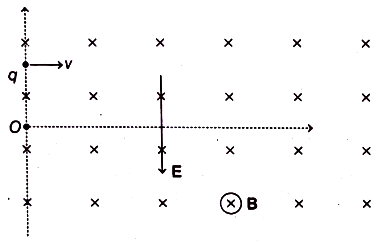
due to \( \lambda_{2} \) then the value of \( n \) isKCET 2018 Hard - A positively charged particle \(q\) of mass \(m\) is passed through a velocity selector. It moves horizontally righward without deviation along the line \(y=\frac{2 m v}{q B}\) with a speed \(v\). The electric field is vertically downwards and magnetic field is into the plane of paper. Now, the electric field is. switched off at \(t=0\). The angular momentum of the charged particle about origin \(O\) at \(t=\frac{\pi m}{q B}\) is
 KCET 2023 Hard
 - 2n16 in a primary spermatocyte which is in metaphase of first meiotic division. What shall be the total number of chromatids in each of the secondary spermatocyte?KCET 2009 Hard