


KCET · Physics · Wave Optics
In Young's double slit experiment, two wavelengths \( \lambda_{1}=780 \mathrm{~nm} \) and \( \lambda_{2}=520 \mathrm{~nm} \) are used to
obtain interferance fringes. If the \( n^{\text {th }} \) bright band due to \( \lambda_{1} \) concides with \( (n+1)^{\text {th }} \) bright band
due to \( \lambda_{2} \) then the value of \( n \) is
- A \( 04 \)
- B \( 03 \)
- C \( 12 \)
- D \( 06 \)
Answer & Solution
Correct Answer
(C) \( 12 \)
Step-by-step Solution
Detailed explanation
Given,
\( n^{\text {th }} \) bright band due to \( \lambda_{1}=(n+1)^{\text {th }} \) bright band due to \( \lambda_{2} \)
\[
\begin{array}{l}
\Rightarrow \frac{n \lambda_{1} D}{d}=\frac{(n+1) \lambda_{2} D}{d} \\
\Rightarrow n \lambda_{1}=(n+1) \lambda_{2} \\
\Rightarrow \frac{n+1}{n}=\frac{\lambda_{1}}{\lambda_{2}}
\end{array}
\]
Given, \( \lambda_{1}=780 \mathrm{~nm} \) and \( \lambda_{2}=520 \mathrm{~nm} \), therefore
\[
\frac{n+1}{n}=\frac{780}{520}
\]
On rearranging, we get
\[
\begin{array}{l}
52(n+1)=78 n \\
\Rightarrow 52 n+52=78 n \\
\Rightarrow 78 n-52 n=52 \\
\Rightarrow 26 n=52 \\
n=\frac{52}{26}=2
\end{array}
\]
Thus, value of \( n \) is \( 2 \).
\( n^{\text {th }} \) bright band due to \( \lambda_{1}=(n+1)^{\text {th }} \) bright band due to \( \lambda_{2} \)
\[
\begin{array}{l}
\Rightarrow \frac{n \lambda_{1} D}{d}=\frac{(n+1) \lambda_{2} D}{d} \\
\Rightarrow n \lambda_{1}=(n+1) \lambda_{2} \\
\Rightarrow \frac{n+1}{n}=\frac{\lambda_{1}}{\lambda_{2}}
\end{array}
\]
Given, \( \lambda_{1}=780 \mathrm{~nm} \) and \( \lambda_{2}=520 \mathrm{~nm} \), therefore
\[
\frac{n+1}{n}=\frac{780}{520}
\]
On rearranging, we get
\[
\begin{array}{l}
52(n+1)=78 n \\
\Rightarrow 52 n+52=78 n \\
\Rightarrow 78 n-52 n=52 \\
\Rightarrow 26 n=52 \\
n=\frac{52}{26}=2
\end{array}
\]
Thus, value of \( n \) is \( 2 \).
See the Complete Solution
Get step-by-step explanations for this and 2.5 Lakh+ more JEE, NEET & CET questions.
- Unlock all solutions
- Practice the full chapter
- Track accuracy across PYQs
4.8 rated on Google Play · 14,000+ reviews
More questions from Physics
- A carnot engine takes \( 300 \) calories of heat from a source at \( 500 \mathrm{~K} \) and rejects \( 150 \) calories of
heat to the sink. The temperature of the sink isKCET 2018 Easy - The dimensional formula for impulse isKCET 2007 Easy
- The spectral series of the hydrogen atom that lies in the visible region of the electromagnetic spectrumKCET 2009 Easy
- In the given circuit, the resonant frequency is
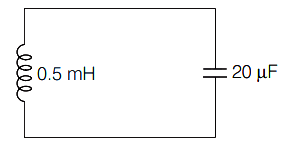 KCET 2020 Medium
 - A neutron, a proton, an electron and an \(\alpha\)-particle enter a region of uniform magnetic field with the same velocities. The magnetic field is perpendicular and directed into the plane of the paper. The tracks of the particles are labelled in the figure. The electron follows the track.
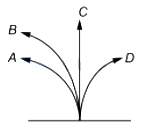 KCET 2011 Easy
 - A monochromatic beam of light is travelling from medium \(A\) of refractive index \(n_{1}\) to a medium \(\mathrm{B}\) of refractive index \(\mathrm{n}_{2}\). In the medium \(A\), there are \(x\) number of waves in certain distance. In the medium B, there are \(y\) number of waves in the same distance. Then, refractive index of medium \(A\) with respect to medium \(B\) isKCET 2012 Hard
More PYQs from KCET
- A particle executes SHM with amplitude \(0.2 \mathrm{~m}\) and time period \(24 \mathrm{~s}\). The time required it to move from the mean position to a point \(0.1 \mathrm{~m}\) from the mean position isKCET 2012 Hard
- Generally, the first ionisation energy increases along a period. But there are some exceptions. The one which is not an exception isKCET 2011 Easy
- Which one of the following noble gas has an unusual property of diffusing through the
materials such as rubber, glass or plastic ?KCET 2017 Easy - The volume of air inspired or expired by a healthy man per minute isKCET 2017 Easy
- Both male and female have normal vision though their fathers were colour blind, and mothers did not have any gene for colour blindness. The probability of their daughter becoming colour blind isKCET 2018 Hard
- Which one of the following groups of three animals each is correctly matched with their one characteristic morphological features?KCET 2013 Hard