


KCET · Maths · Vector Algebra
If \(\mathbf{a}=2 \hat{\mathbf{i}}+3 \hat{\mathbf{j}}-\hat{\mathbf{k}}, \mathbf{b}=\hat{\mathbf{i}}+2 \hat{\mathbf{j}}-5 \mathbf{k}\), \(\mathbf{c}=3 \hat{\mathbf{i}}+5 \hat{\mathbf{j}}-\hat{\mathbf{k}}\), then a vector perpendicular to \(\mathbf{a}\) and in the plane containing \(\mathbf{b}\) and \(\mathbf{c}\) is
- A \(-17 \hat{\mathbf{i}}+21 \hat{\mathbf{j}}-97 \hat{\mathbf{k}}\)
- B \(17 \hat{\mathbf{i}}+21 \hat{\mathbf{j}}-123 \hat{\mathbf{k}}\)
- C \(-17 \hat{\mathbf{i}}-21 \hat{\mathbf{j}}+97 \hat{\mathbf{k}}\)
- D \(-17 \hat{\mathbf{i}}-21 \hat{\mathbf{j}}-97 \hat{\mathbf{k}}\)
Answer & Solution
Correct Answer
(D) \(-17 \hat{\mathbf{i}}-21 \hat{\mathbf{j}}-97 \hat{\mathbf{k}}\)
Step-by-step Solution
Detailed explanation
We know that a vector perpendicular to \(\mathbf{a}\) and in the plane containing \(\mathbf{b}\) and \(\mathbf{c}\) is given by
\(\therefore \quad \mathbf{b} \times \mathbf{c}=\left|\begin{array}{ccc}\hat{\mathbf{i}} & \hat{\mathbf{j}} & \hat{\mathbf{k}} \\ 1 & 2 & -5 \\ 3 & 5 & -1\end{array}\right|\)
Now, \(\mathbf{a} \times(\mathbf{b} \times \mathbf{c})=\left|\begin{array}{ccc}\hat{\mathbf{i}} & \hat{\mathbf{j}} & \hat{\mathbf{k}} \\ 2 & 3 & -1 \\ 23 & -14 & -1\end{array}\right|\)
which is the required vector.
\(\therefore \quad \mathbf{b} \times \mathbf{c}=\left|\begin{array}{ccc}\hat{\mathbf{i}} & \hat{\mathbf{j}} & \hat{\mathbf{k}} \\ 1 & 2 & -5 \\ 3 & 5 & -1\end{array}\right|\)
Now, \(\mathbf{a} \times(\mathbf{b} \times \mathbf{c})=\left|\begin{array}{ccc}\hat{\mathbf{i}} & \hat{\mathbf{j}} & \hat{\mathbf{k}} \\ 2 & 3 & -1 \\ 23 & -14 & -1\end{array}\right|\)
which is the required vector.
See the Complete Solution
Get step-by-step explanations for this and 2.5 Lakh+ more JEE, NEET & CET questions.
- Unlock all solutions
- Practice the full chapter
- Track accuracy across PYQs
4.8 rated on Google Play · 14,000+ reviews
More questions from Maths
- \(\mathrm{R}\) is a relation on \(\mathrm{N}\) given by \(R=\{(x, y): 4 x+3 y=20\}\). Which of the following belongs to \(R\) ?KCET 2008 Easy
- \(3(\sin x-\cos x)^{4}+6(\sin x+\cos x)^{2}\)
\(+4\left(\sin ^{6} x+\cos ^{6} x\right)\)
is equal toKCET 2009 Medium - \(\int_0^\pi \frac{x \tan x}{\sec x \cdot \operatorname{cosec} x} d x\) is equals toKCET 2023 Medium
- If \(P=\left[\begin{array}{lll}1 & \alpha & 3 \\ 1 & 3 & 3 \\ 2 & 4 & 4\end{array}\right]\) is the adjoint of a \(3 \times 3\)
matrix \(A\) and \(|A|=4\), then \(\alpha\) is equal toKCET 2024 Easy - If \( \alpha \) and \( \beta \) are roots of the equation \( \chi^{2}+x+1=0 \) then \( \alpha^{2}+\beta^{2} \) isKCET 2019 Medium
- If \( \left|\begin{array}{ll}3 & x \\ x & 1\end{array}\right|=\left|\begin{array}{ll}3 & 2 \\ 4 & 1\end{array}\right| \) then \( x \) is equal toKCET 2017 Easy
More PYQs from KCET
- Cis-1, 4-polyisoprene is calledKCET 2019 Easy
- On the set of positive rationals, a binary operation * is defined by \( a^{*} b=\frac{2 a b}{5} \). If \( 2^{*} x=3^{-1} \)
then \( x= \)KCET 2019 Easy - For a chemical reaction \(\mathrm{A} \rightarrow \mathrm{B}\), the rate of the reaction is \(2 \times 10^{-3} \mathrm{~mol} \mathrm{} \mathrm{dm}^{-3} \mathrm{~s}^{-1}\), when the initial concentration is \(0.05 \mathrm{~mol} \mathrm{dm}^{-3}\). The rate of the same reaction is \(1.6 \times 10^{-2} \mathrm{~mol} \mathrm{dm}^{-3} \mathrm{~s}^{-1}\) when the initial concentration is \(0.1 \mathrm{~mol} \mathrm{} \mathrm{dm}^{-3}\). The order of the reaction isKCET 2009 Easy
- In the figure, a conducting ring of certain,resistance is falling towards a current carrying straight long conductor. The ring and conductor are in the same plane. Then, the
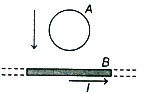 KCET 2024 Medium
 - An ideal resistance \(\mathrm{R}\), ideal inductance \(\mathrm{L}\), ideal capacitance \(\mathrm{C}\) and \(\mathrm{AC}\) voltmeters \(\mathrm{V}_{1}, \mathrm{~V}_{3}\) and \(\mathrm{V}_{4}\) are connected to an AC sources as shown in figure. At resonance,
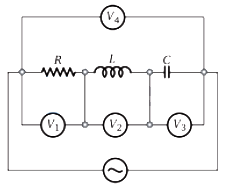 KCET 2012 Medium
 - The modulus of the complex number
\(\frac{(1+i)^2(1+3 i)}{(2-6 i)(2-2 i)}\) isKCET 2023 Easy