


KCET · Maths · Vector Algebra
If \( \vec{a}=\hat{i}+\lambda \hat{j}+2 \hat{k} ; \vec{b}=\mu \hat{i}+\hat{j}-\hat{k} \) are orthogonal and \( |\vec{a}|=|\vec{b}| \) then
\( (\lambda, \mu)= \)
- A \( \left(\frac{1}{4}, \frac{7}{4}\right) \)
- B \( \left(\frac{7}{4}, \frac{1}{4}\right) \)
- C \( \left(\frac{1}{4}, \frac{9}{4}\right) \)
- D \( \left(\frac{-1}{4}, \frac{9}{4}\right) \)
Answer & Solution
Correct Answer
(A) \( \left(\frac{1}{4}, \frac{7}{4}\right) \)
Step-by-step Solution
Detailed explanation
Given vectors,
\[
\begin{array}{l}
\vec{a}=\hat{i}+\lambda \hat{j}+2 \hat{k} \rightarrow(1) \\
\vec{b}=\mu \hat{i}+\hat{j}-\hat{k} \rightarrow(2)
\end{array}
\]
For vectors to be orthogonal, we have
\[
\begin{array}{l}
\vec{a} \cdot \vec{b}=0 \\
\Rightarrow(\hat{i}+\lambda \hat{j}+2 \hat{k}) \cdot(\mu \hat{i}+\hat{j}-\hat{k})=0 \\
\Rightarrow \mu+\lambda-2=0 \\
\Rightarrow \lambda+\mu=2 \rightarrow(3) \\
\text { and }|\vec{a}|=|\vec{b}| \\
\Rightarrow \sqrt{1+\lambda^{2}+4}=\sqrt{\mu^{2}+1+1} \\
\Rightarrow 1+\lambda^{2}+4=\mu^{2}+1+1 \rightarrow(4)
\end{array}
\]
From Eqs. (3) and (4), we get
\[
\begin{array}{l}
\lambda^{2}+3=\mu^{2}=(2 \lambda)^{2} \\
\Rightarrow \lambda^{2}+3=4+\lambda^{2}-4 \lambda \\
\text { So, } \lambda=\frac{1}{4} \Rightarrow \mu=2-\frac{1}{4}=\frac{7}{4}
\end{array}
\]
\[
\text { Hence }(\lambda, \mu)=\left(\frac{1}{4}, \frac{7}{4}\right)
\]
\[
\begin{array}{l}
\vec{a}=\hat{i}+\lambda \hat{j}+2 \hat{k} \rightarrow(1) \\
\vec{b}=\mu \hat{i}+\hat{j}-\hat{k} \rightarrow(2)
\end{array}
\]
For vectors to be orthogonal, we have
\[
\begin{array}{l}
\vec{a} \cdot \vec{b}=0 \\
\Rightarrow(\hat{i}+\lambda \hat{j}+2 \hat{k}) \cdot(\mu \hat{i}+\hat{j}-\hat{k})=0 \\
\Rightarrow \mu+\lambda-2=0 \\
\Rightarrow \lambda+\mu=2 \rightarrow(3) \\
\text { and }|\vec{a}|=|\vec{b}| \\
\Rightarrow \sqrt{1+\lambda^{2}+4}=\sqrt{\mu^{2}+1+1} \\
\Rightarrow 1+\lambda^{2}+4=\mu^{2}+1+1 \rightarrow(4)
\end{array}
\]
From Eqs. (3) and (4), we get
\[
\begin{array}{l}
\lambda^{2}+3=\mu^{2}=(2 \lambda)^{2} \\
\Rightarrow \lambda^{2}+3=4+\lambda^{2}-4 \lambda \\
\text { So, } \lambda=\frac{1}{4} \Rightarrow \mu=2-\frac{1}{4}=\frac{7}{4}
\end{array}
\]
\[
\text { Hence }(\lambda, \mu)=\left(\frac{1}{4}, \frac{7}{4}\right)
\]
See the Complete Solution
Get step-by-step explanations for this and 2.5 Lakh+ more JEE, NEET & CET questions.
- Unlock all solutions
- Practice the full chapter
- Track accuracy across PYQs
4.8 rated on Google Play · 14,000+ reviews
More questions from Maths
- A box contains \( 6 \) red marbles numbers from \( 1 \) through \( 6 \) and \( 4 \) white marbles \( 12 \) through \( 15 . \)
Find the probability that a marble drawn 'at random' is white and odd numbered.KCET 2015 Easy - If \(3 x+i(4 x-y)=6-i\) where \(x\) and \(y\) are real numbers, then the values of \(x\) and \(y\) are respectively,KCET 2022 Easy
- \(\sec ^2\left(\tan ^{-1} 2\right)+\operatorname{cosec}^2\left(\cot ^{-1} 3\right)=\)KCET 2025 Easy
- The domain of the function \(\sqrt{\dfrac{x-7}{9-x}}\) isKCET 2026 Easy
- If a plane meets the coordinate axes at \(A, B\) and \(C\) in such a way that the centroid of \(\triangle A B C\) is at the point \((1,2,3)\), then the equation of the plane isKCET 2021 Easy
- The equation of the line joining the points \((-3,4,11)\) and \((1,-2,7)\) isKCET 2021 Easy
More PYQs from KCET
- Out of the following options, identify which one is NOT a natural method of contraceptionKCET 2025 Medium
- In series \(L C R\) circuit at resonance, the phase difference between voltage and current isKCET 2023 Easy
- \( 25 \mathrm{~cm}^{3} \) of oxalic acid completely neutralized \( 0.064 \mathrm{~g} \) of sodium hydroxide. Molarity of the
oxalic acid solution isKCET 2014 Medium - On adding which of the following, the \(\mathrm{pH}\) of \(20 \mathrm{~mL}\) of \(0.1 \mathrm{~N} \mathrm{HCl}\) will not alter?KCET 2012 Medium
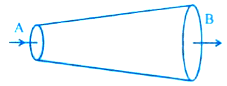
- An ideal fluid flows through a pipe of circular cross section with diameters \( 5 \mathrm{~cm} \) and \( 10 \mathrm{~cm} \) as shown. The ratio of velocities of fluid at \( A \) and \( B \) is
 KCET 2016 Easy
 - In which of the processes, does the internal energy of the system remain constant?KCET 2008 Easy