


KCET · Maths · Quadratic Equation
If \( \alpha \) and \( \beta \) are roots of the equation \( \chi^{2}+x+1=0 \) then \( \alpha^{2}+\beta^{2} \) is
- A \( \frac{-1+i \sqrt{3}}{2} \)
- B \( -1 \)
- C \( 11 \)
- D \( \frac{-1-i \sqrt{3}}{2} \)
Answer & Solution
Correct Answer
(B) \( -1 \)
Step-by-step Solution
Detailed explanation
(B)
\(x^{2}+x+1=0\)
\(\Rightarrow x=\omega, \beta=\omega^{2}\) where \(\omega\) is the cube root of unity
\(\alpha^{2}+\beta^{2}=\omega^{2}+\omega^{4}\)
\(=\omega^{2}+\omega\)
\(=-1\)
\(x^{2}+x+1=0\)
\(\Rightarrow x=\omega, \beta=\omega^{2}\) where \(\omega\) is the cube root of unity
\(\alpha^{2}+\beta^{2}=\omega^{2}+\omega^{4}\)
\(=\omega^{2}+\omega\)
\(=-1\)
See the Complete Solution
Get step-by-step explanations for this and 2.5 Lakh+ more JEE, NEET & CET questions.
- Unlock all solutions
- Practice the full chapter
- Track accuracy across PYQs
4.8 rated on Google Play · 14,000+ reviews
More questions from Maths
- If \( \alpha \) and \( \beta \) are the roots of \( x^{2}-a x+b^{2}=0 \), then \( \alpha^{2}+\beta^{2} \) is equal toKCET 2015 Medium
- \(\lim _{x \rightarrow 0} \frac{\log _{e}(1+x)}{3^{x}-1}\) is equal toKCET 2013 Easy
- The value of \( \int_{2}^{8} \frac{\sqrt{10-x}}{\sqrt{x}+\sqrt{10-x}} d x \) isKCET 2016 Medium
- The remainder when \(3^{100} \times 2^{50}\) is divided by 5 isKCET 2008 Hard
- If \(x \cos \alpha+y \sin \alpha=4\) is tangent to \(\frac{x^{2}}{25}+\frac{y^{2}}{9}=1\), then the value of \(\alpha\) isKCET 2011 Hard
- The inverse of 2010 in the group \(\mathrm{Q}^{+}\)of all positive rational under the binary operation * defined by \(\mathrm{a}\) * \(\mathrm{b}=\frac{\mathrm{ab}}{2010}, \forall \mathrm{a}, \mathrm{b} \in \mathrm{Q}^{+}\), isKCET 2010 Easy
More PYQs from KCET
- A uniform electric field vector \(\mathbf{E}\) exists along horizontal direction as shown. The electric potential at \(A\) is \(V_A\). A small point charge \(q\) is slowly taken from \(A\) to \(B\) along the curved path as shown. The potential energy of the charge when it is at point \(B\) is
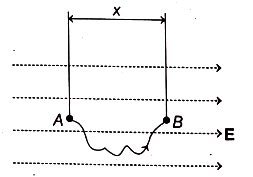 KCET 2023 Medium
 - The points \((1,0),(0,1),(0,0)\) and \((2 \mathrm{k}, 3 \mathrm{k}), \mathrm{k} \neq 0\) are concyclic, if \(\mathrm{k}\) isKCET 2010 Medium
- Blue colour of sea water is due toKCET 2008 Easy
- The range of the function \(f(x)=\sin [x],-\frac{\pi}{4} < x < \frac{\pi}{4}\), where \([x]\) denotes the greatest integer \(\leq x\), isKCET 2013 Easy
- If \( f(x)=\left\{\begin{aligned} K x^{3} ; & \text { if } x \leq 2 \\ 3 ; & \text { if } x>2 \end{aligned}\right. \) is continuous at \( x=2 \), then the value of \( K \) isKCET 2017 Easy
- The maximum area of a rectangle that can be inscribed in a circle of radius 2 units isKCET 2013 Hard