


KCET · Chemistry · Chemical Kinetics
For a chemical reaction \(\mathrm{A} \rightarrow \mathrm{B}\), the rate of the reaction is \(2 \times 10^{-3} \mathrm{~mol} \mathrm{} \mathrm{dm}^{-3} \mathrm{~s}^{-1}\), when the initial concentration is \(0.05 \mathrm{~mol} \mathrm{dm}^{-3}\). The rate of the same reaction is \(1.6 \times 10^{-2} \mathrm{~mol} \mathrm{dm}^{-3} \mathrm{~s}^{-1}\) when the initial concentration is \(0.1 \mathrm{~mol} \mathrm{} \mathrm{dm}^{-3}\). The order of the reaction is
- A 2
- B 0
- C 3
- D 1
Answer & Solution
Correct Answer
(C) 3
Step-by-step Solution
Detailed explanation
\(\mathrm{A} \longrightarrow \mathrm{B}\)
Rate \(=k[A]^{n}\)
\((\text { Rate })_{1}=\mathrm{k}(0.05)^{\mathrm{n}}=2 \times 10^{-3} \quad \text{...(i)}\)
\((\text { Rate })_{2}=\mathrm{k}(0.1)^{\mathrm{n}}=1.6 \times 10^{-2} \quad \text{...(ii)}\)
Dividing the Eq. (ii) by Eq. (i).
\[
\begin{gathered}
\frac{(\text { Rate })_{2}}{(\text { Rate })_{1}}=\frac{\mathrm{k}(0.1)^{\mathrm{n}}}{\mathrm{k}(0.05)^{\mathrm{n}}}=\frac{1.6 \times 10^{-2}}{2 \times 10^{-3}} \\
\quad(2)^{\mathrm{n}}=8 \quad \text { or } \quad(2)^{\mathrm{n}}=2^{3} \\
\therefore \quad \mathrm{n}=3
\end{gathered}
\]
Rate \(=k[A]^{n}\)
\((\text { Rate })_{1}=\mathrm{k}(0.05)^{\mathrm{n}}=2 \times 10^{-3} \quad \text{...(i)}\)
\((\text { Rate })_{2}=\mathrm{k}(0.1)^{\mathrm{n}}=1.6 \times 10^{-2} \quad \text{...(ii)}\)
Dividing the Eq. (ii) by Eq. (i).
\[
\begin{gathered}
\frac{(\text { Rate })_{2}}{(\text { Rate })_{1}}=\frac{\mathrm{k}(0.1)^{\mathrm{n}}}{\mathrm{k}(0.05)^{\mathrm{n}}}=\frac{1.6 \times 10^{-2}}{2 \times 10^{-3}} \\
\quad(2)^{\mathrm{n}}=8 \quad \text { or } \quad(2)^{\mathrm{n}}=2^{3} \\
\therefore \quad \mathrm{n}=3
\end{gathered}
\]
See the Complete Solution
Get step-by-step explanations for this and 2.5 Lakh+ more JEE, NEET & CET questions.
- Unlock all solutions
- Practice the full chapter
- Track accuracy across PYQs
4.8 rated on Google Play · 14,000+ reviews
More questions from Chemistry
- \(C_{1}-C_{4}\) glycosidic bond is not found inKCET 2020 Easy
- The correct statement regarding defects in solid isKCET 2021 Easy
- The correct sequence of reactions to convert p-nitrophenol into quinol involvesKCET 2010 Easy
- Match List-I (Laws) with the List-II (Mathematical expressions):
Codes:List-I List-II (a) Henry's law (i) \(p_1 = p_1^0 x_1\) (b) Raoult's law (ii) \(p = K_H \chi\) (c) First law of thermodynamics (iii) \(\Lambda_m = v_+ \lambda_+ + v_- \lambda_-\) (d) Kohlrausch's law (iv) \(\Delta U = q + w\) KCET 2026 Medium - 180 g of glucose, \(\mathrm{C}_6 \mathrm{H}_{12} \mathrm{O}_6\), is dissolved in 1 kg of water in a vessel. The temperature at which water boils at 1.013 bar is ______ (given, \(\mathrm{K}_{\mathrm{b}}\) for water is \(052 \mathrm{~K} \mathrm{~kg} \mathrm{~mol}^{-1}\). Boiling point for pure water is 373.15 K )KCET 2025 Medium
- A complex compound in which the oxidation number of a metal is zero isKCET 2008 Easy
More PYQs from KCET
- The number of turns in a coil of Galvanometer is tripled, thenKCET 2019 Medium
- If \(A=\left[\begin{array}{ll}0 & 1 \\ 0 & 0\end{array}\right]\), then \((a I+b A)^n\) is (where \(I\) is the identify matrix of order 2)KCET 2022 Hard
- The rate equation for a reaction \(\mathrm{A} \rightarrow \mathrm{B}\) is \(\mathrm{r}=\mathrm{k}[\mathrm{A}]^{0}\). If the initial concentration of the reactant is \(a \mathrm{~mol} \mathrm{dm}{ }^{-3}\), the half-life period of the reaction isKCET 2009 Easy
- Sulphide ore on roasting gives a gas \(X . X\) reacts with \(\mathrm{Cl}_{2}\) in the presence of activated charcoal to give \(Y\). \(Y\) isKCET 2020 Easy
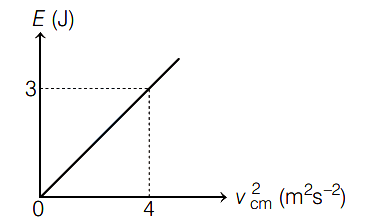
- In figure \(E\) and \(v_{\mathrm{cm}}\) represent the total energy and speed of centre of mass of an object of mass \(1 \mathrm{~kg}\) in pure rolling. The object is
 KCET 2021 Hard
 - During the extraction of gold the following reactions take place
\[
\begin{aligned}
\mathrm{Au}+\mathrm{CN}^{-}+\mathrm{H}_{2} \mathrm{O} \stackrel{\mathrm{O}_{2}}{\longrightarrow}[X] \\
{[X]+\mathrm{Zn} \longrightarrow[Y]+\mathrm{Au} }
\end{aligned}
\]
\(X\) and \(Y\) are respectivelyKCET 2007 Medium