


KCET · Chemistry · Structure of Atom
Which one of the following sets of ions represents the collection of isoelectronic species?
- A \(\mathrm{K}^{+}, \mathrm{Cl}^{-}, \mathrm{Mg}^{2+}, \mathrm{Sc}^{3+}\)
- B \(\mathrm{Na}^{+}, \mathrm{Ca}^{2+}, \mathrm{Sc}^{3+}, \mathrm{F}^{-}\)
- C \(\mathrm{K}^{+}, \mathrm{Ca}^{2+}, \mathrm{Sc}^{3+}, \mathrm{Cl}^{-}\)
- D \(\mathrm{Na}^{+}, \mathrm{Mg}^{2+}, \mathrm{Al}^{3+}, \mathrm{Cl}^{-}\)
Answer & Solution
Correct Answer
(C) \(\mathrm{K}^{+}, \mathrm{Ca}^{2+}, \mathrm{Sc}^{3+}, \mathrm{Cl}^{-}\)
Step-by-step Solution
Detailed explanation
The number of electrons in these species are
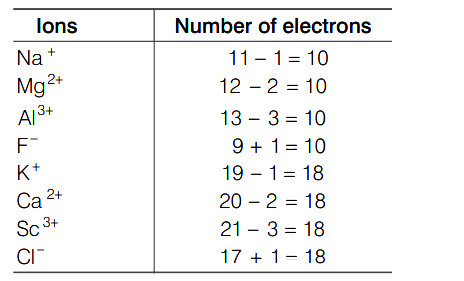
\(\therefore \mathrm{Na}^{+}, \mathrm{Mg}^{2+}, \mathrm{Al}^{3+}\) and \(\mathrm{F}^{-}\)are isoelectronic species and each one of which has 10. Also, \(\mathrm{K}^{+}, \mathrm{Ca}^{2+}, \mathrm{SC}^{3+}\) and \(\mathrm{Cl}^{-}\)are electronic species and each one of which has 18 electrons.
\(\therefore \mathrm{Na}^{+}, \mathrm{Mg}^{2+}, \mathrm{Al}^{3+}\) and \(\mathrm{F}^{-}\)are isoelectronic species and each one of which has 10. Also, \(\mathrm{K}^{+}, \mathrm{Ca}^{2+}, \mathrm{SC}^{3+}\) and \(\mathrm{Cl}^{-}\)are electronic species and each one of which has 18 electrons.
See the Complete Solution
Get step-by-step explanations for this and 2.5 Lakh+ more JEE, NEET & CET questions.
- Unlock all solutions
- Practice the full chapter
- Track accuracy across PYQs
4.8 rated on Google Play · 14,000+ reviews
More questions from Chemistry
- In Buna-S, the symbol Bu stands forKCET 2013 Easy
- The electronegativities of \( \mathrm{C}, \mathrm{N}, \mathrm{Si} \) and \( \mathrm{P} \) are in the order ofKCET 2017 Hard
- Lower members of aliphatic carboxylic acidare soluble in water. This is due toKCET 2017 Easy
- 1 mole of \(\mathrm{HI}\) is heated in a closed container of capacity of \(2 \mathrm{~L}\). At equilibrium half a mole of \(\mathrm{HI}\) is dissociated.
The equilibrium constant of the reaction isKCET 2022 Medium - The monomer used in Novolac, a polymer usedin paintsKCET 2017 Medium
- Gram molecular volume of oxygen at STP isKCET 2007 Medium
More PYQs from KCET
- Benzene carbaldehyde is reacted with concentrated \( \mathrm{NaOH} \) solution to give the products \( \mathrm{A} \) and
B. The product \( A \) can be used food preservative and the product \( B \) is an aromatic hydroxy
compound where \( \mathrm{OH} \) gorup is linked to \( s p^{3} \) hybridised carbon atom next to Benzene ring. The
products \( A \) and \( B \) are respectively,KCET 2016 Hard - Dry ice isKCET 2018 Easy
- The compound obtained when acetaldehyde reacts with dilute aqueous sodium hydroxide exhibitsKCET 2010 Medium
- Which of the following reagent cannot be usedto oxidize primary alcohols to aldehydes?KCET 2017 Medium
- The perimeter of a sector is a constant. If its area is to be maximum, then the sectorial angle isKCET 2012 Hard
- Which one of the following is a molecular crystal?KCET 2010 Easy