


KCET · Chemistry · Chemical Kinetics
For a reaction, \(\mathrm{A}+\mathrm{B} \rightarrow\) products, the rate of the reaction at various concentrations are given below
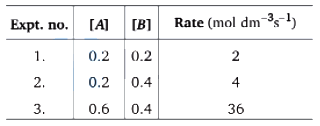
The rate law for the above reaction is
- A \(r=k[A][B]^{2}\)
- B \(r=k[A]^{3}[B]\)
- C \(\mathrm{r}=\mathrm{k}[\mathrm{A}]^{2}[\mathrm{~B}]^{2}\)
- D \(r=k[A]^{2}[B]\)
Answer & Solution
Correct Answer
(D) \(r=k[A]^{2}[B]\)
Step-by-step Solution
Detailed explanation
Let order of reaction wrt A and \(\mathrm{B}\) is \(\mathrm{m}\) and \(\mathrm{n}\) respectively. Then
\[
\begin{aligned}
\text { rate } &=\mathrm{k}[\mathrm{A}]^{\mathrm{m}}[\mathrm{B}]^{\mathrm{n}} \\
2 &=\mathrm{k}[0.2]^{\mathrm{m}}[0.2]^{\mathrm{n}}
\end{aligned}
\]
\[
4=k[0.2]^{m}[0.4]^{n}
\]
\[
36=\mathrm{k}[0.6]^{\mathrm{m}}[0.4]^{\mathrm{n}}
\]
On comparing Eqs. (i) and (ii), we get
\[
\begin{aligned}
& \frac{4}{2} &=\frac{[0.4]^{\mathrm{n}}}{[0.2]^{\mathrm{n}}} \\
\Rightarrow & 2 &=2^{\mathrm{n}} \\
\Rightarrow & \mathrm{n} &=1
\end{aligned}
\]
Again on comparing Eqs. (ii) and (iii), we get
\[
\begin{aligned}
& & \frac{36}{4} &=\frac{[0.6]^{\mathrm{m}}}{[0.2]^{\mathrm{m}}} \\
\Rightarrow & & 9=3^{2}=3^{\mathrm{m}} \\
\Rightarrow & & \mathrm{m}=2
\end{aligned}
\]
\(\therefore\) Rate law for the given reaction will be
\[
\mathrm{r}=\mathrm{k}[\mathrm{A}]^{2}[\mathrm{~B}]
\]
\[
\begin{aligned}
\text { rate } &=\mathrm{k}[\mathrm{A}]^{\mathrm{m}}[\mathrm{B}]^{\mathrm{n}} \\
2 &=\mathrm{k}[0.2]^{\mathrm{m}}[0.2]^{\mathrm{n}}
\end{aligned}
\]
\[
4=k[0.2]^{m}[0.4]^{n}
\]
\[
36=\mathrm{k}[0.6]^{\mathrm{m}}[0.4]^{\mathrm{n}}
\]
On comparing Eqs. (i) and (ii), we get
\[
\begin{aligned}
& \frac{4}{2} &=\frac{[0.4]^{\mathrm{n}}}{[0.2]^{\mathrm{n}}} \\
\Rightarrow & 2 &=2^{\mathrm{n}} \\
\Rightarrow & \mathrm{n} &=1
\end{aligned}
\]
Again on comparing Eqs. (ii) and (iii), we get
\[
\begin{aligned}
& & \frac{36}{4} &=\frac{[0.6]^{\mathrm{m}}}{[0.2]^{\mathrm{m}}} \\
\Rightarrow & & 9=3^{2}=3^{\mathrm{m}} \\
\Rightarrow & & \mathrm{m}=2
\end{aligned}
\]
\(\therefore\) Rate law for the given reaction will be
\[
\mathrm{r}=\mathrm{k}[\mathrm{A}]^{2}[\mathrm{~B}]
\]
See the Complete Solution
Get step-by-step explanations for this and 2.5 Lakh+ more JEE, NEET & CET questions.
- Unlock all solutions
- Practice the full chapter
- Track accuracy across PYQs
4.8 rated on Google Play · 14,000+ reviews
More questions from Chemistry
- Which of the following set of polymers are used as fibre?
(i) Teflon
(ii) Starch
(iii) Terylene
(iv) OrlonKCET 2024 Easy - Conductivity of a saturated solution of a sparingly soluble salt \( A B \) at \( 298 K \) is
\( 1.85 \times 10^{-5} \mathrm{Sm}^{-1} \). Solubility product of the salt AB at \( 298 \mathrm{~K} \) is
Given \( \Lambda{ }_{\mathrm{m}}^{\circ}(A B)=140 \times 10^{-4} \mathrm{~S} \mathrm{~m}^{2} \mathrm{~mol}^{-1} \)KCET 2014 Easy - Based on the first law of thermodynamics, which one of the following is correct?KCET 2011 Easy
- An oxygen containing organic compound was found to contain \(52 \%\) carbon and \(13 \%\) of hydrogen. Its vapour density is 23 . The compound reacts with sodium metal to liberate hydrogen. A functional isomer of this compound isKCET 2012 Hard
- Select wrong chemical reaction among thefollowing:KCET 2017 Easy
- The salt which responds to dilute and concentrated \( \mathrm{H}_{2} \mathrm{SO}_{4} \) isKCET 2015 Easy
More PYQs from KCET
- The rms velocity of molecules of a gas of density \(4 \mathrm{~kg} \mathrm{~m}^{-3}\) and pressure \(1.2 \times 10^{5} \mathrm{Nm}^{-2}\) isKCET 2009 Easy
- A small conducting sphere of radius is lying concentrically inside a bigger hollow conducting sphere of radius The bigger and smaller spheres are charged with and \((Q>q)\) and are insulated from each other. The potential difference between the spheres will beKCET 2008 Hard
- A parallel plate capacitor is charged and then isolated. The effect of increasing the plate separation on charge, potential and capacitance respectively areKCET 2015 Easy
- A non-volatile solute, 'A' tetramerises in water to the extent of 80\%. \( 2.5 \mathrm{~g} \) of 'A' in \( 100 \mathrm{~g} \) of
water, lowers the freezing point by \( 0.3^{\circ} \mathrm{C} \). the molar mass of \( \mathrm{A} \) in \( \mathrm{g} \mathrm{mol}^{-1} \) is (Kf for water \( = \)
\( 1.86 \mathrm{~K} \mathrm{~kg} \mathrm{~mol}^{-1} \) )KCET 2019 Medium - Match List-I with List-II
Choose the correct answer from the options given below.List-I (Complex) List-II (Geometry) (a) \([\text{Co(NH}_3\text{)}_6]^{3+}\) (i) Trigonal bipyramidal (b) \([\text{NiCl}_4]^{2-}\) (ii) Octahedral (c) \([\text{Ni(CN)}_4]^{2-}\) (iii) Tetrahedral (d) \([\text{Fe(CO)}_5]\) (iv) Square planar KCET 2026 Medium - Which of the following is incorrect?
If \(\mathrm{a} \equiv \mathrm{b}(\bmod \mathrm{m})\) and \(\mathrm{x}\) is an integer, thenKCET 2012 Easy