


KCET · Chemistry · Thermodynamics (C)
When the same quantity of heat is absorbed by a system at two different temperatures \(T_{1}\) and \(T_{2}\), such that \(T_{1}>T_{2}\), change in entropies are \(\Delta S_{1}\) and \(\Delta S_{2}\) respectively. Then
- A \(\Delta S_{1} < \Delta S_{2}\)
- B \(\Delta S_{1}=\Delta S_{2}\)
- C \(S_{1}>S_{2}\)
- D \(\Delta S_{2} < \Delta S_{1}\)
Answer & Solution
Correct Answer
(A) \(\Delta S_{1} < \Delta S_{2}\)
Step-by-step Solution
Detailed explanation
We know, \(\Delta S=\frac{q_{\mathrm{rev}}}{T}\)
Here, \(\Delta S_{1}=\frac{q_{\mathrm{rev}}}{T_{1}}\) and \(\Delta S_{2}=\frac{q_{\mathrm{rev}}}{T_{2}}\)
Here, \(q_{\text {rev }}\) is same in both the cases and \(T_{1}>T_{2}\) When denominator is larger, the value is lesses.
So, \(\Delta S_{1} < \Delta S_{2}\)
Here, \(\Delta S_{1}=\frac{q_{\mathrm{rev}}}{T_{1}}\) and \(\Delta S_{2}=\frac{q_{\mathrm{rev}}}{T_{2}}\)
Here, \(q_{\text {rev }}\) is same in both the cases and \(T_{1}>T_{2}\) When denominator is larger, the value is lesses.
So, \(\Delta S_{1} < \Delta S_{2}\)
See the Complete Solution
Get step-by-step explanations for this and 2.5 Lakh+ more JEE, NEET & CET questions.
- Unlock all solutions
- Practice the full chapter
- Track accuracy across PYQs
4.8 rated on Google Play · 14,000+ reviews
More questions from Chemistry
- Match List-I with List-II and select the correct options
Codes:List-I (Functional group) List-II (Functional group reagent) (a) 
(i) Neutral ferric chloride test (b) \(\text{C}_6\text{H}_5\text{NH}_2\) (ii) Azo dye test (c) \(\text{CH}_3\text{CH}_2\text{CHO}\) (iii) Ceric ammonium nitrate test (d) 
(iv) Tollen's reagent test KCET 2026 Medium - If Aniline is treated with \( 1: 1 \) mixture of conc. \( \mathrm{HNO}_{3} \) and con. \( \mathrm{H} 2 \mathrm{SO}_{4}, \mathrm{p} \)-nitroaniline and \( \mathrm{m} \) -
nitroaniline are formed nearly in equal amounts. This is due toKCET 2019 Medium - Consider the following gaseous equilibria with equilibrium constants \(\mathrm{K}_{1}\) and \(\mathrm{K}_{2}\) respectively.
\(\begin{aligned} \mathrm{SO}_{2}(\mathrm{~g})+& \frac{1}{2} \mathrm{O}_{2}(\mathrm{~g}) \rightleftharpoons \mathrm{SO}_{3}(\mathrm{~g}) \\ 2 \mathrm{SO}_{3}(g) & \rightleftharpoons 2 \mathrm{SO}_{2}(g)+\mathrm{O}_{2}(g) \end{aligned}\)
The equilibrium constants are related asKCET 2010 Medium - Which of the following has the maximum number of unpaired ' \(d\) ' electrons?KCET 2008 Easy
- The reagent used to convert an alkyne to alkene isKCET 2008 Easy
- In the reaction; \( \mathrm{F} e(\mathrm{OH})_{3}(\mathrm{~s}) \rightleftharpoons \mathrm{F} e^{3+}(a q)+3 \mathrm{OH}^{-}(a q) \), if the concentration of \( \mathrm{OH}^{-} \)ions is
decreased by \( \frac{1}{4} \) times, then the equilibrium concentration of \( F e^{3+} \) will increase by,KCET 2016 Medium
More PYQs from KCET
- Dalton's law of partial pressure is applicable to which one of the following systems?KCET 2007 Easy
- The interaction between "Cuckoo and Crow" is an example forKCET 2017 Hard
- Vitellogenesis occurs during the formation ofKCET 2009 Medium
- The codon on mRNA are CAU-CCU-AAA-CUG. Identify the correct sequence of amino acids.KCET 2018 Medium
- Match List-I with List-II and select the correct option:
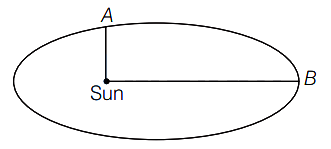
\begin{array}{|l|l|l|l|}\hline & \text{List-I (Molecule / ion} & & \text{List-II (Bond order)} \\\hline \text{1}. & \text{NO} & \text{(i)} & \text {15} \\\hline \text{2.} & \text{CO} & \text{(ii)} & \text{2.0} \\\hline \text{3.} & \mathrm{O}_2^{-} & \text{(iii)} & \text{2.5} \\\hline \text{4.} & \mathrm{O}_2 & \text{(iv)} & \text{3.0} \\\hline\end{array}KCET 2025 Medium - Earth is moving around the sun in elliptical orbit as shown. The ratio of \(O B\) and \(O A\) is \(R\). Then the ratio of Earth's velocities at \(A\) and \(B\) is
 KCET 2013 Easy