


KCET · Chemistry · Chemical Equilibrium
Consider the following gaseous equilibria with equilibrium constants \(\mathrm{K}_{1}\) and \(\mathrm{K}_{2}\) respectively.
\(\begin{aligned} \mathrm{SO}_{2}(\mathrm{~g})+& \frac{1}{2} \mathrm{O}_{2}(\mathrm{~g}) \rightleftharpoons \mathrm{SO}_{3}(\mathrm{~g}) \\ 2 \mathrm{SO}_{3}(g) & \rightleftharpoons 2 \mathrm{SO}_{2}(g)+\mathrm{O}_{2}(g) \end{aligned}\)
The equilibrium constants are related as
- A \(\mathrm{K}_{1}^{2}=\frac{1}{\mathrm{~K}_{2}}\)
- B \(2 \mathrm{~K}_{1}=\mathrm{K}_{2}^{2}\)
- C \(\mathrm{K}_{2}=\frac{2}{\mathrm{~K}_{1}^{2}}\)
- D \(\mathrm{K}_{2}^{2}=\frac{1}{\mathrm{~K}_{1}}\)
Answer & Solution
Correct Answer
(A) \(\mathrm{K}_{1}^{2}=\frac{1}{\mathrm{~K}_{2}}\)
Step-by-step Solution
Detailed explanation
For the reaction,
\[
\begin{aligned}
&\mathrm{SO}_{2}(\mathrm{~g})+\frac{1}{2} \mathrm{O}_{2}(\mathrm{~g}) \rightleftharpoons \mathrm{SO}_{3}(\mathrm{~g}) \\
&\text { Equilibrium constant, } \mathrm{K}_{1}=\frac{\left[\mathrm{SO}_{3}\right]}{\left[\mathrm{SO}_{2}\right]\left[\mathrm{O}_{2}\right]^{1 / 2}} \quad \ldots \text { (i) }
\end{aligned}
\]
For the reaction,
\[
\begin{aligned}
&2 \mathrm{SO}_{3}(\mathrm{~g}) \rightleftharpoons 2 \mathrm{SO}_{2}(\mathrm{~g})+\mathrm{O}_{2}(\mathrm{~g}) \\
&\text { equilibrium constant, } \mathrm{K}_{2}=\frac{\left[\mathrm{SO}_{2}\right]^{2}\left[\mathrm{O}_{2}\right]}{\left[\mathrm{SO}_{3}\right]^{2}} \quad \ldots \text { (ii) }
\end{aligned}
\]
On squaring both sides in Eq (i), we get
\[
\mathrm{K}_{1}^{2}=\frac{\left[\mathrm{SO}_{3}\right]^{2}}{\left[\mathrm{SO}_{2}\right]^{2}\left[\mathrm{O}_{2}\right]} \quad \ldots \text { (iii) }
\]
Eqs. (ii) \(\times\) Eq (iii), we get
\[
\mathrm{K}_{1}^{2} \times \mathrm{K}_{2}=1
\]
or
\[
\begin{aligned}
\mathrm{K}_{2} &=\frac{1}{\mathrm{~K}_{1}^{2}} \\
\mathrm{~K}_{1}^{2} &=\frac{1}{\mathrm{~K}_{2}}
\end{aligned}
\]
\[
\begin{aligned}
&\mathrm{SO}_{2}(\mathrm{~g})+\frac{1}{2} \mathrm{O}_{2}(\mathrm{~g}) \rightleftharpoons \mathrm{SO}_{3}(\mathrm{~g}) \\
&\text { Equilibrium constant, } \mathrm{K}_{1}=\frac{\left[\mathrm{SO}_{3}\right]}{\left[\mathrm{SO}_{2}\right]\left[\mathrm{O}_{2}\right]^{1 / 2}} \quad \ldots \text { (i) }
\end{aligned}
\]
For the reaction,
\[
\begin{aligned}
&2 \mathrm{SO}_{3}(\mathrm{~g}) \rightleftharpoons 2 \mathrm{SO}_{2}(\mathrm{~g})+\mathrm{O}_{2}(\mathrm{~g}) \\
&\text { equilibrium constant, } \mathrm{K}_{2}=\frac{\left[\mathrm{SO}_{2}\right]^{2}\left[\mathrm{O}_{2}\right]}{\left[\mathrm{SO}_{3}\right]^{2}} \quad \ldots \text { (ii) }
\end{aligned}
\]
On squaring both sides in Eq (i), we get
\[
\mathrm{K}_{1}^{2}=\frac{\left[\mathrm{SO}_{3}\right]^{2}}{\left[\mathrm{SO}_{2}\right]^{2}\left[\mathrm{O}_{2}\right]} \quad \ldots \text { (iii) }
\]
Eqs. (ii) \(\times\) Eq (iii), we get
\[
\mathrm{K}_{1}^{2} \times \mathrm{K}_{2}=1
\]
or
\[
\begin{aligned}
\mathrm{K}_{2} &=\frac{1}{\mathrm{~K}_{1}^{2}} \\
\mathrm{~K}_{1}^{2} &=\frac{1}{\mathrm{~K}_{2}}
\end{aligned}
\]
See the Complete Solution
Get step-by-step explanations for this and 2.5 Lakh+ more JEE, NEET & CET questions.
- Unlock all solutions
- Practice the full chapter
- Track accuracy across PYQs
4.8 rated on Google Play · 14,000+ reviews
More questions from Chemistry
- lodoform reaction is answered by all, exceptKCET 2014 Easy
- On adding which of the following, the \(\mathrm{pH}\) of \(20 \mathrm{~mL}\) of \(0.1 \mathrm{~N} \mathrm{HCl}\) will not alter?KCET 2012 Medium
- The value of entropy of solar system isKCET 2013 Easy
- During the adsorption of krypton on activated charcoal at low temperatureKCET 2011 Medium
- \(\mathrm{CH}_{3} \mathrm{COOH} \stackrel{\mathrm{LiAlH}_{4}}{\longrightarrow} \mathrm{X} \underset{300^{\circ} \mathrm{C}}{\stackrel{\mathrm{Cu}}{\longrightarrow}} \mathrm{Y} \underset{\mathrm{NaOH}}{\stackrel{\text { Dilute }}{\longrightarrow}} \mathrm{Z}\)
In the above reaction \(Z\) isKCET 2009 Easy - In equilibrium state the value of \(\Delta G\) isKCET 2007 Easy
More PYQs from KCET
- The process in which a small part of the vas deferens is removed or tied up through a small incision, is calledKCET 2024 Hard
- The following data is obtained during the first order thermal decomposition of
\(2 \mathrm{~A}(g) \longrightarrow \mathrm{B}(g)+\mathrm{C}(\mathrm{s})\)
at constant volume and temperature.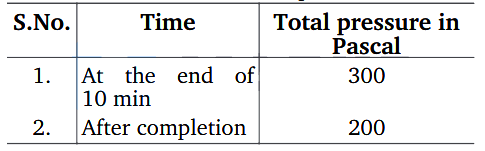
The rate constant in \(\min ^{-1}\) isKCET 2010 Easy - The equation of the line parallel to the line \( 3 x-4 y+2=0 \) and passing through
\( (-2,3) \) isKCET 2018 Easy - RNA interference which is employed in making tobacco plant resistant to Meloidgyne incognita is essentially involved inKCET 2014 Hard
- If \(\vec{a}=\hat{i}+2 \hat{j}+\hat{k}, \vec{b}=\hat{i}-\hat{j}+4 \hat{k}\) and \(\vec{c}=\hat{i}+\hat{j}+\hat{k}\) are such that \(\vec{a}+\lambda \vec{b}\) is perpendicular to \(\vec{c}\), then the value of \(\lambda\) isKCET 2025 Easy
- For one mole of an ideal gas, increasing the temperature from \(10^{\circ} \mathrm{C}\) to \(20^{\circ} \mathrm{C}\)KCET 2010 Medium