


KCET · Chemistry · Practical Chemistry
When salt BA is treated with Conc. \(\text{H}_2\text{SO}_4\) reddish brown gas is liberated. The aqueous solution of BA gives pale yellow precipitate with \(\text{AgNO}_3\) solution. Which of the following anion (\(\text{A}^-\)) is present in the salt BA?
- A \(\text{Cl}^-\)
- B \(\text{CO}_3^{2-}\)
- C \(\text{SO}_4^{2-}\)
- D \(\text{Br}^-\)
Answer & Solution
Correct Answer
(D) \(\text{Br}^-\)
Step-by-step Solution
Detailed explanation
When a salt containing bromide ion (\(\text{Br}^-\)) is treated with concentrated \(\text{H}_2\text{SO}_4\), reddish-brown bromine gas (\(\text{Br}_2\)) is evolved due to the oxidation of bromide ions by sulphuric acid.
The reaction is: \(2\text{Br}^- + 2\text{H}_2\text{SO}_4 \rightarrow \text{Br}_2 \uparrow + \text{SO}_2 + \text{SO}_4^{2-} + 2\text{H}_2\text{O}\).
When an aqueous solution of a bromide salt is treated with \(\text{AgNO}_3\) solution, a pale yellow precipitate of silver bromide (\(\text{AgBr}\)) is formed.
The reaction is: \(\text{Br}^- + \text{Ag}^+ \rightarrow \text{AgBr} \downarrow\).
Therefore, the anion \(\text{A}^-\) present in the salt BA is \(\text{Br}^-\).
Answer: \(\text{Br}^-\)
The reaction is: \(2\text{Br}^- + 2\text{H}_2\text{SO}_4 \rightarrow \text{Br}_2 \uparrow + \text{SO}_2 + \text{SO}_4^{2-} + 2\text{H}_2\text{O}\).
When an aqueous solution of a bromide salt is treated with \(\text{AgNO}_3\) solution, a pale yellow precipitate of silver bromide (\(\text{AgBr}\)) is formed.
The reaction is: \(\text{Br}^- + \text{Ag}^+ \rightarrow \text{AgBr} \downarrow\).
Therefore, the anion \(\text{A}^-\) present in the salt BA is \(\text{Br}^-\).
Answer: \(\text{Br}^-\)
See the Complete Solution
Get step-by-step explanations for this and 2.5 Lakh+ more JEE, NEET & CET questions.
- Unlock all solutions
- Practice the full chapter
- Track accuracy across PYQs
4.8 rated on Google Play · 14,000+ reviews
More questions from Chemistry
- Which of the following is not true for \(\mathrm{S}_{\mathrm{N}}\) l reaction?KCET 2012 Medium
- The composition of 'copper matte' is,KCET 2016 Easy
- In chrysoberyl, a compound containing beryllium, aluminium and oxygen, oxide ions form cubic close packed structure. Aluminium ions occupy \(\frac{1}{4}\) th of octahedral voids. The formula of the compound isKCET 2021 Medium
- Which one of these is not known ?KCET 2014 Hard
- Carbocation as an intermediate is likely to be formed in the reaction :KCET 2014 Medium
- Which of the following statements related to lanthanoids is incorrect?KCET 2024 Medium
More PYQs from KCET
- In the following equation representing \(\beta^{-}\) decay, the number of neutrons in the nucleus \(X\) is
\({ }_{83}^{210} \mathrm{Bi} \longrightarrow X+e^{-1}+\bar{v}\)KCET 2023 Easy - \(\int \frac{1}{1+3 \sin ^2 x+8 \cos ^2 x} d x\) is equals toKCET 2023 Hard
- Which of the following hormones is not secreted by human placenta?KCET 2022 Hard
- An ideal gas is taken path as shown in figure. The net work done in the whole cycle is
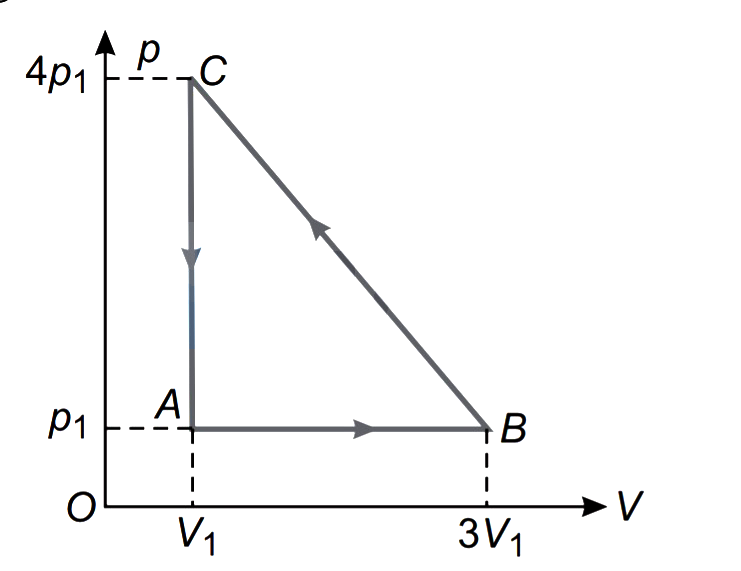 KCET 2008 Medium
 - If \(I_{n}=\int_{0}^{\frac{\pi}{4}} \tan ^{n} x d x\), where \(n\) is positive integer, then \(I_{10}+I_{8}\) is equal toKCET 2021 Hard
- The correct order for wavelengths of light absorbed in the complex ions \(\left[\operatorname{CoCl}\left(\mathrm{NH}_{3}\right)_{5}\right]^{2+},\left[\mathrm{Co}\left(\mathrm{NH}_{3}\right)_{6}\right]^{3+}\) and \(\left[\mathrm{Co}(\mathrm{CN})_{6}\right]^{3-}\) isKCET 2021 Medium