


KCET · Chemistry · Haloalkanes and Haloarenes
Which of the following is not true for \(\mathrm{S}_{\mathrm{N}}\) l reaction?
- A \(3^{\circ}\)-alkyl halides generally react through \(\mathrm{S}_{\mathrm{N}} 1\) reaction
- B The rate of the reaction does not depend upon the molar concentration of the nucleophile
- C \(1^{\circ}\)-alkyl halides generally react through \(\mathrm{S}_{\mathrm{N}} 1\) reaction
- D It is favoured by polar solvents
Answer & Solution
Correct Answer
(C) \(1^{\circ}\)-alkyl halides generally react through \(\mathrm{S}_{\mathrm{N}} 1\) reaction
Step-by-step Solution
Detailed explanation
In \(S_{N} 1\) reactions, rate of the reaction depends upon the concentration of the substrate only. It does not depend upon the concentration of the nucleophile.
In this type of reaction, covalent nucleophile reacts/attacks on substrate. \(3^{\circ}\) alkyl halide generally react by this mechanism, whereas \(1^{\circ}\) alkyl halide generally follow \(\mathrm{S}_{\mathrm{N}} 2\) reactions. \(\mathrm{S}_{\mathrm{N}} 1\) reactions are favoured by polar solvents.
In this type of reaction, covalent nucleophile reacts/attacks on substrate. \(3^{\circ}\) alkyl halide generally react by this mechanism, whereas \(1^{\circ}\) alkyl halide generally follow \(\mathrm{S}_{\mathrm{N}} 2\) reactions. \(\mathrm{S}_{\mathrm{N}} 1\) reactions are favoured by polar solvents.
See the Complete Solution
Get step-by-step explanations for this and 2.5 Lakh+ more JEE, NEET & CET questions.
- Unlock all solutions
- Practice the full chapter
- Track accuracy across PYQs
4.8 rated on Google Play · 14,000+ reviews
More questions from Chemistry
- Pick the correct statement among the following :KCET 2017 Easy
- Which one of the following has no unpaired electrons?KCET 2012 Easy
- Select wrong chemical reaction among thefollowing:KCET 2017 Easy
- An oxide of the element contains \(20 \% \mathrm{O}_{2}\) by weight. Calculate the equivalent weight of the element.KCET 2007 Easy
- \(\mathrm{CH}_{3} \mathrm{CH}_{2} \mathrm{Br} \underset{\Delta}{\stackrel{\mathrm{aq} \cdot \mathrm{KOH}}{\longrightarrow}} \mathrm{A} \underset{\Delta}{\stackrel{\mathrm{KMnO}_{4} / \mathrm{H}^{+}}{\longrightarrow}}\)
\(\mathrm{B} \underset{\Delta}{\stackrel{\mathrm{NH}_{3}}{\longrightarrow}} \mathrm{C} \underset{\text { alkali }}{\stackrel{\mathrm{Br}_{2}}{\longrightarrow}} \mathrm{D,}\) 'D' isKCET 2010 Easy - In the following reaction

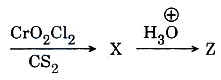
the compound \( Z \) isKCET 2018 Hard
More PYQs from KCET
- What will be the total electric flux through the faces of the cube as given in the figure with side of length '\(a\)' if a charge Q is placed at B midpoint of an edge of the cube (see figure)?
 KCET 2026 Medium
 - The codons UUU and UUC codes for phenylalanine only. This features of genetic code is calledKCET 2016 Medium
- A plane electromagnetic wave of frequency \( 20 \mathrm{MHz} \) travels through a space along \( x \) direction. If the electric field vector at a certain point in space is \( 6 \mathrm{~V} \mathrm{~m}^{-1} \), what is the magnetic field vector at that point?KCET 2014 Medium
- 'Hydraulic lift' works on the basis ofKCET 2017 Easy
- Which of the following is more basic than aniline?KCET 2018 Easy
- If \(\alpha, \beta\) and \(\gamma\) are the roots of the equation \(x^{3}+4 x+2=0\), then \(\alpha^{3}+\beta^{3}+\gamma^{3}\) is equal toKCET 2012 Easy