


KCET · Chemistry · Aldehydes and Ketones
The formation of cyanohydrin from a ketone is an example of
- A Nucleophilic substitution
- B Nucleophilic addition
- C Electrophilic addition
- D Electrophilic substitution
Answer & Solution
Correct Answer
(B) Nucleophilic addition
Step-by-step Solution
Detailed explanation
Formation of cyanohydrin from a ketone reaction with HCN is an example of nucleophilic addition reaction.
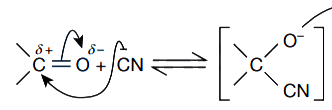
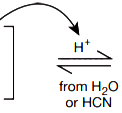
Cyanohydrin
Cyanohydrin
See the Complete Solution
Get step-by-step explanations for this and 2.5 Lakh+ more JEE, NEET & CET questions.
- Unlock all solutions
- Practice the full chapter
- Track accuracy across PYQs
4.8 rated on Google Play · 14,000+ reviews
More questions from Chemistry
- An oxide of the element contains \(20 \% \mathrm{O}_{2}\) by weight. Calculate the equivalent weight of the element.KCET 2007 Easy
- Which one of the following is the most energetic conformation of cyclohexane?KCET 2011 Medium
- Which of the following compound possesses the " \( \mathrm{C}-\mathrm{H} \) " bond with the lowest bond dissociation
energy?KCET 2015 Easy - The rms velocity of molecules of a gas of density \(4 \mathrm{~kg} \mathrm{~m}^{-3}\) and pressure \(1.2 \times 10^{5} \mathrm{Nm}^{-2}\) isKCET 2009 Easy
- In the detection of II group acid radical, the salt containing chloride is treated with concentrated sulphuric acid, the colourless gas is liberated. The name of the gas isKCET 2021 Medium
- Lucas test is associated withKCET 2009 Medium
More PYQs from KCET
- A fruit that develops from a single flower with a syncarpous pistil isKCET 2012 Hard
- If \( [x] \) represents the greatest integer function and \( f(x)=x-[x]-\cos x \) then \( f^{\prime}\left(\frac{I}{2}\right)= \)KCET 2019 Medium
- Match List-I with List-II
\begin{array}{|l|l|l|l|}\hline & \text{List-I (Types of redox reactions)} & & \text{List-II (Examples)} \\\hline \text{a}. & \text{Combination reaction} & \text{(i)} & \mathrm{Cl}_{2(\mathrm{~g})}+2 \mathrm{Br}_{(\mathrm{aq})}^{-} \rightarrow 2 \mathrm{Cl}_{(\mathrm{aq})}^{-}+\mathrm{Br}_{2(\mathrm{l})} \\\hline \text{b.} & \text{Decomposition reaction} & \text{(ii)} & 2 \mathrm{H}_2 \mathrm{O}_{2(\mathrm{aq})} \rightarrow 2 \mathrm{H}_2 \mathrm{O}_{(1)}+\mathrm{O}_{2(\mathrm{~g})} \\\hline \text{c.} & \text{Displacement reaction} & \text{(iii)} & \mathrm{CH}_{4(\mathrm{~g})}+2 \mathrm{O}_{2(\mathrm{~g})} \xrightarrow{\Delta} \mathrm{CO}_{2(\mathrm{~g})}+2 \mathrm{H}_2 \mathrm{O}_{(1)} \\\hline \text{d.} & \text{Disproportionation reaction} & \text{(iv)} & \mathrm{H}_2 \mathrm{O}_{(1)} \xrightarrow{\Delta} 2 \mathrm{H}_{2(\mathrm{~g})}+\mathrm{O}_{2(\mathrm{~g})} \\\hline\end{array}
Choose the correct answer from the options given below.KCET 2025 Medium - Consider an electrical conductor connected across a potential difference \(V\). Let \(\Delta q\) be a small charge moving through it in time \(\Delta t\). If \(I\) is the electric current through it,
I. the kinetic energy of the charge increases by \(I V \Delta t\).
II. the electric potential energy of the charge decreases by \(I V \Delta t\).
III. the thermal energy of the conductor increases by IV \(\Delta t\).
Choose the correct option.KCET 2021 Easy - Let \(f(x)=\left|\begin{array}{ccc}\cos x & x & 1 \\ 2 \sin x & x & 2 x \\ \sin x & x & x\end{array}\right|\). Then, \(\lim _{x \rightarrow 0} \frac{f(x)}{x^2}\) isKCET 2024 Medium
- If \( \tan x=\frac{3}{4}, \Pi < x < \frac{3 \Pi}{2} \), then the value of \( \cos \frac{x}{2} \) isKCET 2014 Medium