


KCET · Maths · Three Dimensional Geometry
If \( \tan x=\frac{3}{4}, \Pi < x < \frac{3 \Pi}{2} \), then the value of \( \cos \frac{x}{2} \) is
- A \( \frac{3}{\sqrt{10}} \)
- B \( -\frac{3}{\sqrt{10}} \)
- C \( -\frac{1}{\sqrt{10}} \)
- D \( \frac{1}{\sqrt{10}} \)
Answer & Solution
Correct Answer
(C) \( -\frac{1}{\sqrt{10}} \)
Step-by-step Solution
Detailed explanation
Given,
\( \tan x=\frac{3}{4}, \Pi < x < 3 \frac{\Pi}{2} \) \( \Rightarrow \frac{\Pi}{2} < \frac{x}{2} < 3 \frac{\Pi}{4} \) (belongs to quadrant II)
In the second quadrant, \( \cos \left(\frac{x}{2}\right) \) is negative.
\[
\begin{array}{l}
\sec 2 x=1+\tan 2 x=1+\left(\frac{3}{4}\right) 2=\frac{(16+9)}{16}=\frac{25}{16} \\
\sec x=\pm \frac{5}{4}
\end{array}
\]
Thus, \( \cos x=-\frac{4}{5}\left\{\right. \) since \( \left.\Pi < x < 3 \frac{\Pi}{2}\right\} \)
Using the formula, \( \cos 2 A=2 \cos 2 A-1 \),
\( 2 \cos 2\left(\frac{x}{2}\right)=1+\cos x=1+\left(-\frac{4}{5}\right) \)
\( 2 \cos 2\left(\frac{x}{2}\right)=\frac{1}{5} \)
\( \cos 2\left(\frac{x}{2}\right)=\frac{1}{10} \)
\( \cos \left(\frac{x}{2}\right)=\pm \frac{\sqrt{1}}{10}=-\frac{1}{\sqrt{10}}\left\{\right. \) since \( \frac{x}{2} \) lies in the quadrant II\}
\( \tan x=\frac{3}{4}, \Pi < x < 3 \frac{\Pi}{2} \) \( \Rightarrow \frac{\Pi}{2} < \frac{x}{2} < 3 \frac{\Pi}{4} \) (belongs to quadrant II)
In the second quadrant, \( \cos \left(\frac{x}{2}\right) \) is negative.
\[
\begin{array}{l}
\sec 2 x=1+\tan 2 x=1+\left(\frac{3}{4}\right) 2=\frac{(16+9)}{16}=\frac{25}{16} \\
\sec x=\pm \frac{5}{4}
\end{array}
\]
Thus, \( \cos x=-\frac{4}{5}\left\{\right. \) since \( \left.\Pi < x < 3 \frac{\Pi}{2}\right\} \)
Using the formula, \( \cos 2 A=2 \cos 2 A-1 \),
\( 2 \cos 2\left(\frac{x}{2}\right)=1+\cos x=1+\left(-\frac{4}{5}\right) \)
\( 2 \cos 2\left(\frac{x}{2}\right)=\frac{1}{5} \)
\( \cos 2\left(\frac{x}{2}\right)=\frac{1}{10} \)
\( \cos \left(\frac{x}{2}\right)=\pm \frac{\sqrt{1}}{10}=-\frac{1}{\sqrt{10}}\left\{\right. \) since \( \frac{x}{2} \) lies in the quadrant II\}
See the Complete Solution
Get step-by-step explanations for this and 2.5 Lakh+ more JEE, NEET & CET questions.
- Unlock all solutions
- Practice the full chapter
- Track accuracy across PYQs
4.8 rated on Google Play · 14,000+ reviews
More questions from Maths
- The angle between two diagonals of a cube is \( 30^{\circ} \)KCET 2014 Medium
- The value of \(\int_{-1 / 2}^{1 / 2} \cos ^{-1} x d x\) isKCET 2020 Easy
- The shaded region is the solution set of the inequalities
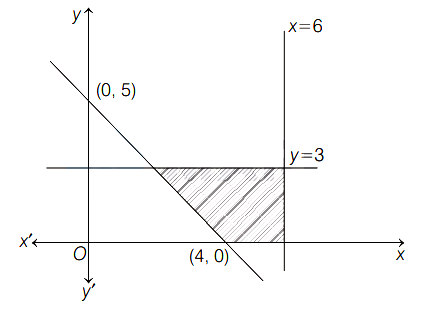 KCET 2021 Easy
 - If \(\sqrt{r}=a e^{\theta \cot \alpha}\) where \(a\) and \(\alpha\) are real numbers, then \(\frac{d^{2} r}{d \theta^{2}}-4 r \cot ^{2} \alpha\) isKCET 2011 Hard
- The corner points of the feasible region of an LPP are \((0,2),(3,0),(6,0),(6,8)\) and \((0,5)\), then the minimum value of \(z=4 x+6 y\) occurs atKCET 2022 Medium
- \(\int \mathrm{e}^{\tan ^{-1} \mathrm{x}}\left(1+\frac{\mathrm{x}}{1+\mathrm{x}^{2}}\right) \mathrm{dx}\) is equal toKCET 2009 Easy
More PYQs from KCET
- The reducing agent in the given equations
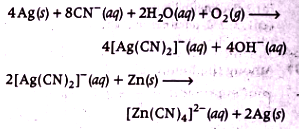 KCET 2023 Easy
 - Which one of the following properties is generally not applicable to ionic hydrides?KCET 2024 Easy
- The area of the region bounded by the curve \( y=x^{2} \) and the line \( y=16 \) isKCET 2017 Medium
- The nitrogen base found only in DNA is also calledKCET 2015 Easy
- Identify \({ }^{\prime} C^{\circ}\) in the following
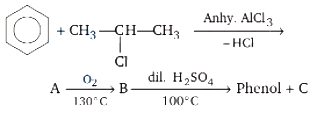 KCET 2012 Medium
 - In the given sequence of reactions, identify \({ }^{\prime} P^{\prime}, ' Q{ }^{\prime}, R^{\prime}\) and ' \(S\) respectively.
\(\mathrm{CH}_2= \underset{\underset{}{\Large | ~~~~} \atop \huge \mathrm{Br}}{\mathrm{CH}_2}-\underset{\underset{}{\Large | ~~~~} \atop \huge \mathrm{Br}}{\mathrm{CH}_2} \xrightarrow{Q}\)
\(\mathrm{CH}_2=\mathrm{CH}-\mathrm{Br} \xrightarrow{R} \mathrm{CH} \equiv \mathrm{CH} \xrightarrow{s} \mathrm{C}_6 \mathrm{H}_6\)KCET 2024 Easy