


KCET · Chemistry · Practical Chemistry
In the detection of II group acid radical, the salt containing chloride is treated with concentrated sulphuric acid, the colourless gas is liberated. The name of the gas is
- A hydrogen chloride gas
- B chlorine gas
- C sulphur dioxide gas
- D hydrogen gas
Answer & Solution
Correct Answer
(A) hydrogen chloride gas
Step-by-step Solution
Detailed explanation
In the detecting of II group acid radical, when salt containing chloride is treated with concentrated sulphuric acid, the colourless gas is liberated. The name of the gas is hydrogen chloride gas.
See the Complete Solution
Get step-by-step explanations for this and 2.5 Lakh+ more JEE, NEET & CET questions.
- Unlock all solutions
- Practice the full chapter
- Track accuracy across PYQs
4.8 rated on Google Play · 14,000+ reviews
More questions from Chemistry
- The mass of \(112 \mathrm{~cm}^{3}\) of \(\mathrm{NH}_{3}\) gas at \(\mathrm{STP}\) isKCET 2013 Medium
- Density of carbon monoxide is maximum atKCET 2014 Hard
- \(25 \mathrm{~g}\) of each of the following gasses are taken at \(27^{\circ} \mathrm{C}\) and \(600 \mathrm{~mm}\) pressure. Which of these will have the least volume?KCET 2011 Easy
- In the following reaction

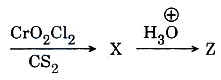
the compound \( Z \) isKCET 2018 Hard - When formic acid is heated with conc. \(\mathrm{H}_{2} \mathrm{SO}_{4}\), the gas evolved isKCET 2013 Medium
- Which of the following on heating gives an ether as major products?
(P) \(\mathrm{C}_6 \mathrm{H}_5 \mathrm{CH}_2 \mathrm{Br}+\mathrm{CH}_3 \mathrm{ONa}\)
(Q) \(\mathrm{C}_6 \mathrm{H}_5 \mathrm{ONa}+\mathrm{CH}_3 \mathrm{Br}\)
(R) \(\left(\mathrm{CH}_3\right)_3 \mathrm{C}-\mathrm{Cl}+\mathrm{CH}_3 \mathrm{ONa}\)
(S) \(\mathrm{C}_6 \mathrm{H}_5 \mathrm{CH}=\mathrm{CHCl}+\mathrm{CH}_3 \mathrm{ONa}\)KCET 2020 Medium
More PYQs from KCET
- If \(f(x)=\sin \left[\pi^2\right] x-\sin \left[-\pi^2\right] x\), where \([x]=\) greatest integer \(\leq x\), then which of the following is not true?KCET 2025 Medium
- Match the following types of waves with their wavelength ranges
\(\begin{array}{|l|l|l|l|}\hline & \text{Waves} & & \text{Wavelength ranges} \\\hline \text{i}. & \text{Microwave} & \text{(a.)} & \text { } 700 \mathrm{~nm} \text { to } 400 \mathrm{~nm} \\\hline \text{ii.} & \text{Visible light} & \text{(b.)} & 1 \mathrm{~nm} \text { to } 10^{-3} \mathrm{~nm} \\\hline \text{iii.} & \text{Ultraviolet} & \text{(c.)} & 0.1 \mathrm{~m} \text { to } 1 \mathrm{~mm} \\\hline \text{iv.} & \text{X-rays} & \text{(d.)} & 400 \mathrm{~nm} \text { to } 1 \mathrm{~nm} \\\hline\end{array}\)KCET 2025 Easy - \( \int_{-5}^{5}|x+2| d x \) is equal toKCET 2017 Easy
- When a brown compound of \( M n(A) \) is treated with \( H C l \), it gives a gas (B). The gas (B) taken in
excess reacts with \( \mathrm{NH}_{3} \) to give an explosive compound (C).
The compounds A, B and C are;KCET 2016 Hard - The spectral series of the hydrogen atom that lies in the visible region of the electromagnetic spectrumKCET 2009 Easy
- Catalysts are used to increase the rate of a chemical reaction. Because itKCET 2025 Easy