


KCET · Chemistry · Aldehydes and Ketones
The correct arrangement for the ions in the increasing order of their radii is
- A \( \mathrm{Ca}^{2+}, \mathrm{K}^{+}, \mathrm{S}^{2-} \)
- B \( \mathrm{Ol}^{-}, \mathrm{F}^{-}, \mathrm{S}^{2-} \)
- C \( \mathrm{Na}^{+}, \mathrm{Cl}^{-}, \mathrm{Ca}^{2+} \)
- D \( N a^{+}, A l^{3+}, B e^{2+} \)
Answer & Solution
Correct Answer
(A) \( \mathrm{Ca}^{2+}, \mathrm{K}^{+}, \mathrm{S}^{2-} \)
Step-by-step Solution
Detailed explanation
The number of electrons and the group number of the given species are given below:
\(\begin{array}{|l|l|l|l|l|}
\hline Ions & At. No & Group & Period & No. of e^{-} s \\
\hline S^{2-} & 16 & 16 & 3 & 18 \\
\hline K^{+} & 13 & 1 & 4 & 18 \\
\hline C a^{2+} & 20 & 2 & 4 & 18 \\
\hline
\end{array}\)
There ions are isoelectronic, therefore \( S^{2-} \) have greater size due to higher effective nuclear charge \( \left(Z_{\text {eff }}\right) \) followed by
\( \mathrm{K}^{+} \)then \( \mathrm{Ca}^{2+} \) Hence, the correct order of decreasing ionic radii is \( \mathrm{Ca}^{2+} < \mathrm{K}^{+} < \mathrm{S}^{2-} \)
\(\begin{array}{|l|l|l|l|l|}
\hline Ions & At. No & Group & Period & No. of e^{-} s \\
\hline S^{2-} & 16 & 16 & 3 & 18 \\
\hline K^{+} & 13 & 1 & 4 & 18 \\
\hline C a^{2+} & 20 & 2 & 4 & 18 \\
\hline
\end{array}\)
There ions are isoelectronic, therefore \( S^{2-} \) have greater size due to higher effective nuclear charge \( \left(Z_{\text {eff }}\right) \) followed by
\( \mathrm{K}^{+} \)then \( \mathrm{Ca}^{2+} \) Hence, the correct order of decreasing ionic radii is \( \mathrm{Ca}^{2+} < \mathrm{K}^{+} < \mathrm{S}^{2-} \)
See the Complete Solution
Get step-by-step explanations for this and 2.5 Lakh+ more JEE, NEET & CET questions.
- Unlock all solutions
- Practice the full chapter
- Track accuracy across PYQs
4.8 rated on Google Play · 14,000+ reviews
More questions from Chemistry
- Excess of \(\mathrm{PCl}_{5}\) reacts with concentrated \(\mathrm{H}_{2} \mathrm{SO}_{4}\) givingKCET 2013 Easy
- \(\text{C}-\text{Cl}\) bond in methyl chloride compared to \(\text{C}-\text{Cl}\) bond in chlorobenzene isKCET 2026 Medium
- A secondary amine isKCET 2022 Medium
- Which of the following has the lowest boiling point?KCET 2020 Medium
- For a reaction having three steps, the overall rate constant is \(k = \dfrac{k_1 k_2}{k_3}\). The values of \(E_{a_1}, E_{a_2}\) and \(E_{a_3}\) (activation energies stepwise) are \(40\), \(50\) and \(60\) kJ mol\(^{-1}\) respectively. Then the overall \(E_a\) (activation energy) of the reaction is ____KCET 2026 Medium
- Conjugate base of \(\mathrm{H}_{2} \mathrm{PO}_{4}^{-}\)isKCET 2013 Easy
More PYQs from KCET
- Three moles of \(\mathrm{PCl}_{5}\), three moles of \(\mathrm{PCl}_{3}\) and two moles of \(\mathrm{Cl}_{2}\) are taken in a closed vessel. If at equilibrium the vessel has \(1.5\) moles of \(\mathrm{PCl}_{5}\), the number of moles of \(\mathrm{PCl}_{3}\) present in it isKCET 2008 Medium
- \(\int \frac{\sec x}{\sec x+\tan x} d x\) is equal toKCET 2008 Easy
- A complex compound in which the oxidation number of a metal is zero isKCET 2008 Easy
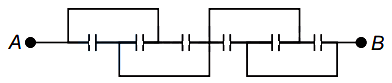
- All capacitors used in the diagram are identical and each is of capacitance C. Then the effective capacitance between the point \(A\) and \(B\) is
 KCET 2010 Medium
 - Two resistors of resistances \( 2 \Omega \) and \( 6 \Omega \) are connected in parallel. This combination is then connected to a battery of emf \( 2 \mathrm{~V} \) and internal resistance \( 0.5 \Omega \). What is the current flowing through the battery?KCET 2014 Easy
- In which one of the following reactions, rate constant has the unit \(\mathrm{mol} \mathrm{L}^{-1} \mathrm{~s}^{-1}\) ?KCET 2023 Hard