


KCET · Chemistry · Chemical Kinetics
The activation energy of a chemical reaction can be determined by,
- A evaluating rate constants at two different temperatures.
- B O changing the concentration of reactants.
- C evaluating the concentration of reactants at two different temperatures.
- D evaluating rate constant at standard temperature,
Answer & Solution
Correct Answer
(A) evaluating rate constants at two different temperatures.
Step-by-step Solution
Detailed explanation
Activation energy of a chemical reaction can be determined by measuring the values of rate constant at two
differenttemperatures
Let \( k_{1} \) and \( k_{2} \) are the rate constant for the reaction at two different temperature, that is, \( T_{1} \) and \( T_{2} \) respectively.
\( \log k_{1}=\log A-\frac{E_{a}}{2.303 R T_{1}} \rightarrow(1) \) \( \log k_{2}=\log A-\frac{E_{a}}{2.303 R T_{2}} \rightarrow(2) \)
Subtract Eq. (1) from Eq. (2), we get
\[
\begin{array}{l}
\log k_{2}-\log k_{1}=\frac{E_{a}}{2.303 R}\left[\frac{1}{T_{1}}-\frac{1}{T_{2}}\right] \\
\log \frac{k_{2}}{k_{1}}=\frac{E_{a}}{2.303 R}\left[\frac{1}{T_{1}}-\frac{1}{T_{2}}\right] \\
\log \frac{k_{2}}{k_{1}}=\frac{E_{a}}{2.303 R}\left[\frac{T_{2}-T_{1}}{T_{1} T_{2}}\right] \\
E_{a}=2.303 R \log \frac{k_{2}}{k_{1}} \times\left[\frac{T_{1} T_{2}}{T_{2}-T_{1}}\right]
\end{array}
\]
differenttemperatures
Let \( k_{1} \) and \( k_{2} \) are the rate constant for the reaction at two different temperature, that is, \( T_{1} \) and \( T_{2} \) respectively.
\( \log k_{1}=\log A-\frac{E_{a}}{2.303 R T_{1}} \rightarrow(1) \) \( \log k_{2}=\log A-\frac{E_{a}}{2.303 R T_{2}} \rightarrow(2) \)
Subtract Eq. (1) from Eq. (2), we get
\[
\begin{array}{l}
\log k_{2}-\log k_{1}=\frac{E_{a}}{2.303 R}\left[\frac{1}{T_{1}}-\frac{1}{T_{2}}\right] \\
\log \frac{k_{2}}{k_{1}}=\frac{E_{a}}{2.303 R}\left[\frac{1}{T_{1}}-\frac{1}{T_{2}}\right] \\
\log \frac{k_{2}}{k_{1}}=\frac{E_{a}}{2.303 R}\left[\frac{T_{2}-T_{1}}{T_{1} T_{2}}\right] \\
E_{a}=2.303 R \log \frac{k_{2}}{k_{1}} \times\left[\frac{T_{1} T_{2}}{T_{2}-T_{1}}\right]
\end{array}
\]
See the Complete Solution
Get step-by-step explanations for this and 2.5 Lakh+ more JEE, NEET & CET questions.
- Unlock all solutions
- Practice the full chapter
- Track accuracy across PYQs
4.8 rated on Google Play · 14,000+ reviews
More questions from Chemistry
- A gas mixture contains \(25 \%\) He and \(75 \% \mathrm{CH}_{4}\) by volume at a given temperature and pressure. The percentage by mass of methane in the mixture is approximately____KCET 2020 Medium
- The products \( X \) and \( Z \) in the following reaction sequence are
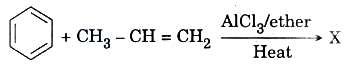
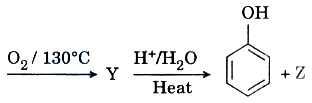 KCET 2018 Medium
 - In chromite ore, the oxidation number of iron, and chromium are respectivelyKCET 2010 Easy
- HCHO was treated with a reagent X. The product formed upon hydrolysis in the presence of an acid gave \(\mathrm{C}_{2} \mathrm{H}_{5} \mathrm{OH}\). The reagent \(\mathrm{X}\) isKCET 2012 Medium
- \(E_{1}, E_{2}\) and \(E_{3}\) are the emfs of the following three galvanic cells respectively.KCET 2011 Easy
- Which of the following colligative properties can provide molar mass of proteins, polymers and colloids with greater precision?KCET 2022 Easy
More PYQs from KCET
- Conductivity of a saturated solution of a sparingly soluble salt \( A B \) at \( 298 K \) is
\( 1.85 \times 10^{-5} \mathrm{Sm}^{-1} \). Solubility product of the salt AB at \( 298 \mathrm{~K} \) is
Given \( \Lambda{ }_{\mathrm{m}}^{\circ}(A B)=140 \times 10^{-4} \mathrm{~S} \mathrm{~m}^{2} \mathrm{~mol}^{-1} \)KCET 2014 Easy - If \(f(x)=b e^{a x}+a e^{b x}\), then \(f^{\prime \prime}(0)\) is equal toKCET 2008 Medium
- The true length of a wire is \(3.678 \mathrm{~cm}\). When the length of this wire is measured using instrument \(A\), the length of the wire is \(3.5 \mathrm{~cm}\). When the length of the wire is measured using instrument \(B\), it is found to have length \(3.38 \mathrm{~cm}\). Then, theKCET 2023 Easy
- The negation of the proposition "If 2 is prime, then 3 is odd'" isKCET 2007 Easy
- \( 3 \mathrm{~A} \rightarrow 2 \mathrm{~B} \), rate of reaction \( +\frac{d[B]}{d t} \) is equal toKCET 2016 Easy
- Which one of the following statements is wrong with respect to separation of DNA fragments on gel electrophoresis?KCET 2016 Medium