


KCET · Chemistry · Hydrocarbons
The products \( X \) and \( Z \) in the following reaction sequence are
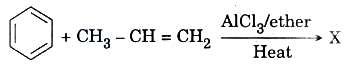
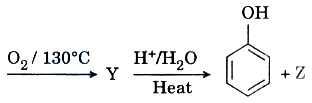
- A Isopropylbenzene and acetone
- B Cumene peroxide and acetone
- C Isopropylbenzene and isopropyl alcohol
- D Phenol and acetone
Answer & Solution
Correct Answer
(A) Isopropylbenzene and acetone
Step-by-step Solution
Detailed explanation
The reaction involved is
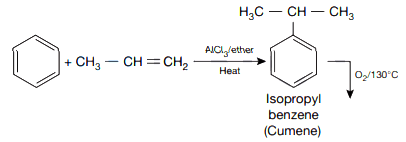
(Cumene)
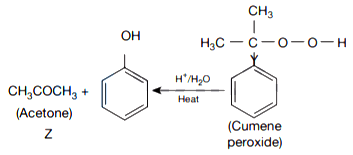
(Cumene)
See the Complete Solution
Get step-by-step explanations for this and 2.5 Lakh+ more JEE, NEET & CET questions.
- Unlock all solutions
- Practice the full chapter
- Track accuracy across PYQs
4.8 rated on Google Play · 14,000+ reviews
More questions from Chemistry
- Peroxide effect is observed with the addition of HBr but not with the addition of HI to unsymmetrical alkene becauseKCET 2021 Hard
- The spin only magnetic moment of \(\mathrm{Mn}^{4+}\) ion is nearlyKCET 2010 Easy
- A compound of 'A' and 'B' crystallises in a cubic lattice in which 'A' atoms occupy the lattice points at the corners of the cube. The ' \(B\) ' atoms occupy the centre of each face of the cube. The probable empirical formula of the compound isKCET 2009 Medium
- \[
\mathrm{P} \stackrel{\mathrm{H}_{2} / \mathrm{Pd}-\mathrm{BaSO}_{4}}{\rightarrow} \mathrm{Q} \stackrel{\text { (i) conc. } \mathrm{NaOH}}{\rightarrow} \mathrm{R}+\mathrm{S}
\]
\( R \) and \( S \) form benzyl benzoate when treated with each other. Hence, \( P \) isKCET 2019 Hard - Match List-I with List-II
\begin{array}{|l|l|l|l|}\hline & \text{List-I (Types of redox reactions)} & & \text{List-II (Examples)} \\\hline \text{a}. & \text{Combination reaction} & \text{(i)} & \mathrm{Cl}_{2(\mathrm{~g})}+2 \mathrm{Br}_{(\mathrm{aq})}^{-} \rightarrow 2 \mathrm{Cl}_{(\mathrm{aq})}^{-}+\mathrm{Br}_{2(\mathrm{l})} \\\hline \text{b.} & \text{Decomposition reaction} & \text{(ii)} & 2 \mathrm{H}_2 \mathrm{O}_{2(\mathrm{aq})} \rightarrow 2 \mathrm{H}_2 \mathrm{O}_{(1)}+\mathrm{O}_{2(\mathrm{~g})} \\\hline \text{c.} & \text{Displacement reaction} & \text{(iii)} & \mathrm{CH}_{4(\mathrm{~g})}+2 \mathrm{O}_{2(\mathrm{~g})} \xrightarrow{\Delta} \mathrm{CO}_{2(\mathrm{~g})}+2 \mathrm{H}_2 \mathrm{O}_{(1)} \\\hline \text{d.} & \text{Disproportionation reaction} & \text{(iv)} & \mathrm{H}_2 \mathrm{O}_{(1)} \xrightarrow{\Delta} 2 \mathrm{H}_{2(\mathrm{~g})}+\mathrm{O}_{2(\mathrm{~g})} \\\hline\end{array}
Choose the correct answer from the options given below.KCET 2025 Medium - Zeta potential isKCET 2021 Medium
More PYQs from KCET
- \( \int \frac{1}{x^{2}\left(x^{4}+1\right)^{3 / 4}} \mathrm{dx} \) is equal toKCET 2015 Medium
- Which one of the following noble gas has an unusual property of diffusing through the
materials such as rubber, glass or plastic ?KCET 2017 Easy - If a cell has twice as much DNA as in a normal functional cell, it means that the cell __________KCET 2005 Hard
- A car covers the first half of the distance between two places at \(40\) km/h and another half at \(50\) km/h. The average speed of the car isKCET 2026 Easy
- Spectrum of sunlight is an example forKCET 2012 Easy
- If an LPP admits optimal solution at two consecutive vertices of a feasible region, thenKCET 2017 Medium